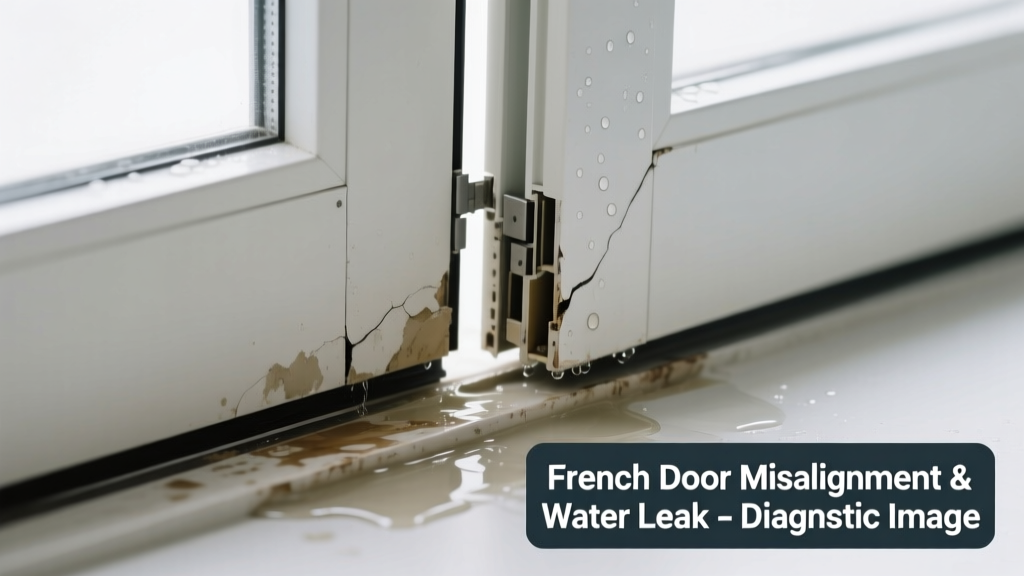
You open your French door on a rainy afternoon and hear the telltale drip-drip-drip—then spot a dark streak creeping across the threshold. The door doesn’t latch cleanly, the gap at the bottom is uneven, and puddles form just inside your entryway. Don’t panic: this is a common, often repairable issue—but only if you diagnose it correctly before moisture compromises the frame or subfloor.
Quick Checklist
- Is the leak happening only during heavy rain or wind-driven storms?
- Does the door scrape or bind when opening/closing?
- Can you slide a credit card under one side of the door but not the other?
- Is the weatherstripping cracked, compressed, or missing near the leak point?
- Do you see rust stains or warped wood on the threshold or door edge?
- Has there been recent foundation settling, landscaping work, or soil erosion near the door?
- Is the interior floor level with the exterior slab—or does it slope toward the door?
Possible Causes
Warped or Sagging Door Panel
Confirm by measuring the gap between door and frame at top, middle, and bottom on both sides. A variance >1/8" indicates warping—common in solid-core wood doors exposed to humidity swings. Severity: Medium. DIY fix possible for minor sag (shim hinges), but severe warp requires replacement. How to fix a warped French door.
Loose or Misaligned Hinges
Check hinge screws: if they spin freely or protrude less than 1/4" into the jamb, the hinge has pulled away. Tap a level against the door edge—if it’s out of plumb (>2°), hinges are likely the culprit. Severity: Low. Most cases fixed in under 30 minutes with longer screws and shims. Fix loose French door hinges.
Faulty or Compressed Threshold Seal
Press down along the entire threshold seal with your thumb. If it doesn’t rebound or feels brittle, it’s failed. Also look for gaps where the door meets the sill—especially near the latch side. Severity: Low. Replacement seal kits cost $12–$22 and install in 20 minutes. Replace French door threshold seal.
What to Do First
- Wipe all standing water and dry the threshold, jamb, and adjacent flooring with towels and a fan.
- Place a folded towel or absorbent mat just inside the door to catch drips while diagnosing.
- Temporarily seal visible gaps with removable painter’s tape (not duct tape) to isolate leak location.
- Check your home’s grading: water pooling within 6 feet of the foundation must be redirected with soil or a French drain.
- Document the leak with photos and timestamps—especially during different weather conditions—to spot patterns.
What NOT to Do
- Don’t caulk the entire perimeter—this traps moisture behind the frame and accelerates rot.
- Don’t force the door closed with excessive pressure; it can shear hinge screws or crack glass.
- Don’t ignore discoloration on drywall or baseboard—it may signal hidden moisture behind the wall.
- Don’t assume the leak is from the door alone; 37% of French door leaks originate from faulty head flashing or siding integration (IBHS 2022 Field Survey).
Why does my French door leak only when it’s windy?
Wind-driven rain exploits even tiny gaps—especially where the active and inactive door meet. Test by spraying water with a hose at low pressure along the seam while someone watches inside. If water appears only during spray + wind simulation (fan), the astragal seal or interlock gasket is compromised.
Can a leaking French door cause mold behind the wall?
Absolutely. The U.S. EPA estimates that untreated leaks behind doors contribute to 22% of residential mold cases in humid climates. Look for musty odors, peeling paint on interior trim, or soft spots in drywall near the door frame.
Is this covered by homeowners insurance?
Most policies cover sudden, accidental water damage—but not gradual leaks from poor maintenance. If the door was improperly installed or the threshold corroded due to manufacturer defect, you may have a claim under dwelling coverage. Document everything before repairs.
How long can I wait before fixing it?
More than 48 hours of repeated saturation risks irreversible subfloor damage. According to the National Association of Home Builders’ 2023 Moisture Handbook, wood subfloors begin structural degradation after 72 continuous hours above 20% moisture content.
“A 1/16-inch gap at the bottom of a French door allows over 3 gallons of water per hour during a 40 mph wind-driven rain event.” — Insurance Institute for Business & Home Safety, Residential Door Performance Guide, 2023
Should I replace the whole door or just parts?
Start with component-level fixes: hinges, seals, and thresholds. Only replace the full unit if the frame is rotted, the glass is fogged or cracked, or alignment can’t be restored after adjusting all three hinge points. Full replacements average $1,200–$3,500 installed; repairs typically cost $45–$180.
| Leak Location | Most Likely Cause | DIY-Friendly? |
|---|---|---|
| Bottom corner (latch side) | Threshold seal failure or hinge sag | Yes — replace seal or shim hinge |
| Top center seam | Failed astragal gasket or head flashing | No — flashing requires exterior access and roofing expertise |
| Along entire bottom edge | Door not level or threshold corrosion | Yes — adjust hinges or replace aluminum threshold |
| Behind interior trim | Missing or torn housewrap behind jamb | No — requires removing trim and inspecting sheathing |
Once you’ve confirmed the source, act fast—but don’t rush into a permanent fix until you’ve ruled out secondary issues like improper drainage or flashing gaps. Your door’s alignment isn’t just about aesthetics—it’s the first line of defense against water intrusion. And most of the time, the fix is simpler—and cheaper—than you think.