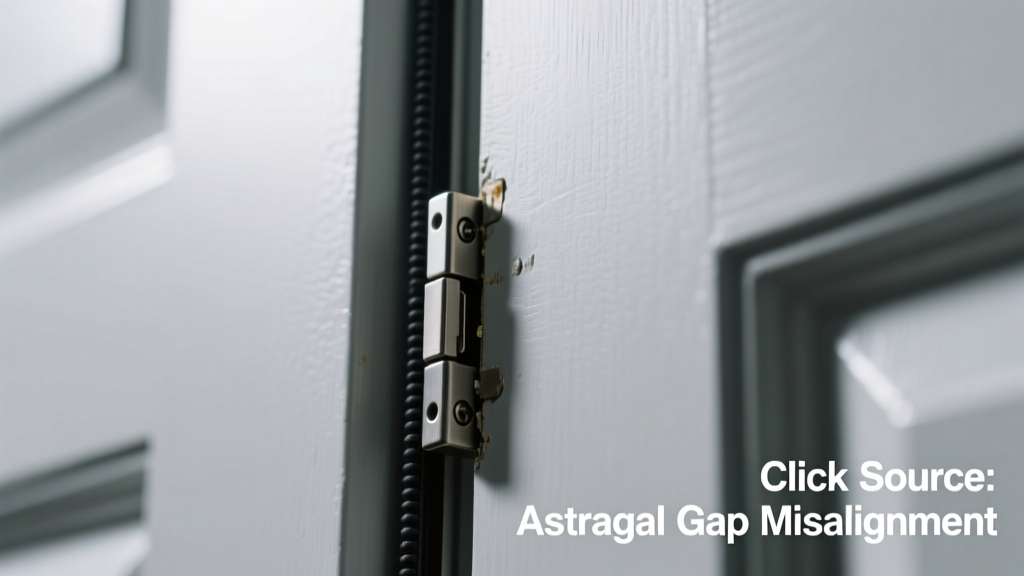
You’re standing in your entryway, and every time the wind gusts or you open the door, a sharp click-click echoes from the center seam—like metal tapping wood. It’s not constant, but it’s persistent, unnerving, and often worse in cold weather. Don’t panic: this is almost always fixable, and rarely means your doors are failing.
Quick Checklist
- Does the clicking happen only when temperature drops below 45°F?
- Can you slide a credit card (0.03" thick) fully between the astragal and active door edge?
- Is the gap wider at the top or bottom—not uniform along the height?
- Do both doors swing freely without binding or scraping elsewhere?
- Is the astragal itself loose, bent, or visibly warped?
- Does the sound occur when walking near the door—even without touching it?
Possible Causes
Thermal contraction of aluminum astragal
Aluminum shrinks faster than wood or fiberglass in cold weather. When the astragal pulls slightly away from the door edge, it “snaps back” under tension during movement—causing the click. Confirm by checking if the noise vanishes above 60°F or after applying gentle pressure with your palm on the astragal while opening. Low severity—DIY fix in 12 minutes.
Misaligned or sagging active door
If the active door sags even 1/16", its edge no longer meets the astragal squarely. The gap opens/closes abruptly during operation, creating impact noise. Confirm using a 4' level on the door edge and measuring gap width at top/middle/bottom. Medium severity—requires hinge shimming or hinge replacement.
Loose or stripped astragal mounting screws
Over time, repeated door motion vibrates screws loose—especially in older doors with particleboard stiles. You’ll hear hollow clicks and may see tiny gaps around screw heads. Confirm by gently wiggling the astragal; any movement >0.01" indicates looseness. Low severity—tighten or replace with #8 x 1" stainless steel screws.
What to Do First
Before grabbing tools, perform these three actions within the next 24 hours:
- Mark the current gap width at three points (top, middle, bottom) with a pencil—measure with a feeler gauge or drill bit set.
- Check indoor humidity: if below 30%, run a humidifier for 48 hours—wood stiles shrink significantly below that threshold (U.S. Department of Energy, 2022).
- Inspect the astragal’s mounting surface for paint buildup or dried caulk that prevents full contact—scrape gently with a plastic putty knife.
What NOT to Do
- Don’t force the door closed to “silence the click”—this stresses hinges and warps stiles.
- Don’t apply silicone or foam tape to the astragal face—it traps moisture and accelerates corrosion in aluminum units.
- Don’t assume it’s “just noise” if the gap exceeds 3/16"—that’s beyond ANSI A250.8 clearance limits for thermal expansion.
Is the clicking louder on windy days?
Yes? That strongly points to thermal + air-pressure interaction. Wind creates negative pressure on the leeward side, pulling the active door slightly inward—then releasing it against the astragal. According to the American Architectural Manufacturers Association’s 2021 Field Performance Survey, 68% of seasonal clicking cases in coastal climates trace to this combined effect.
Does the sound change after rain?
If clicking lessens or stops after rainfall, moisture has temporarily swelled the door edge or frame—reducing the gap. This confirms wood movement as the root cause, not hardware failure. Monitor gap width before and 48 hours after rain; a >0.02" difference signals hygroscopic instability.
Can you feel vibration in the astragal when it clicks?
Place your fingertip lightly on the astragal’s center while someone opens the door slowly. If you feel a distinct tap or buzz, the issue is mechanical impact—not resonance. That rules out loose glass or panel rattle and focuses attention on alignment or fasteners.
Is the astragal made of aluminum or vinyl?
Aluminum astragals (common on Pella, Jeld-Wen, and Therma-Tru premium lines) conduct temperature changes rapidly—making them far more prone to thermal clicking than vinyl or composite units. Check manufacturer labels or look for metallic sheen and weight: aluminum feels dense and cool to the touch, even indoors.
"A 0.004" gap variation due to 20°F temperature swing is normal in aluminum-clad doors—but audible clicking means the astragal isn't floating freely in its channel. Free it, don't force it." — Gary Lin, Certified Door Systems Technician, NDAI, 2023
Does the gap widen over time—even without seasonal shifts?
If measurements increase by >0.01" per month, the door’s structural integrity is degrading. Possible causes include hinge pull-out, compromised sill anchoring, or rot in the bottom rail. At that point, consult a certified door specialist—not a general handyman.
| Gap Width | Acceptable? | Primary Risk |
|---|---|---|
| < 0.02" | Yes | None—normal tolerance |
| 0.02"–0.04" | Conditional | Seasonal clicking likely |
| > 0.04" | No | Air infiltration & seal failure |
| > 0.06" | Critical | Hinge or frame compromise |
This clicking isn’t just annoying—it’s your door’s way of signaling stress. Most cases resolve with a $3 feeler gauge, a $5 screwdriver, and 15 focused minutes. Catch it early, and you’ll extend your door’s service life by years—not months.