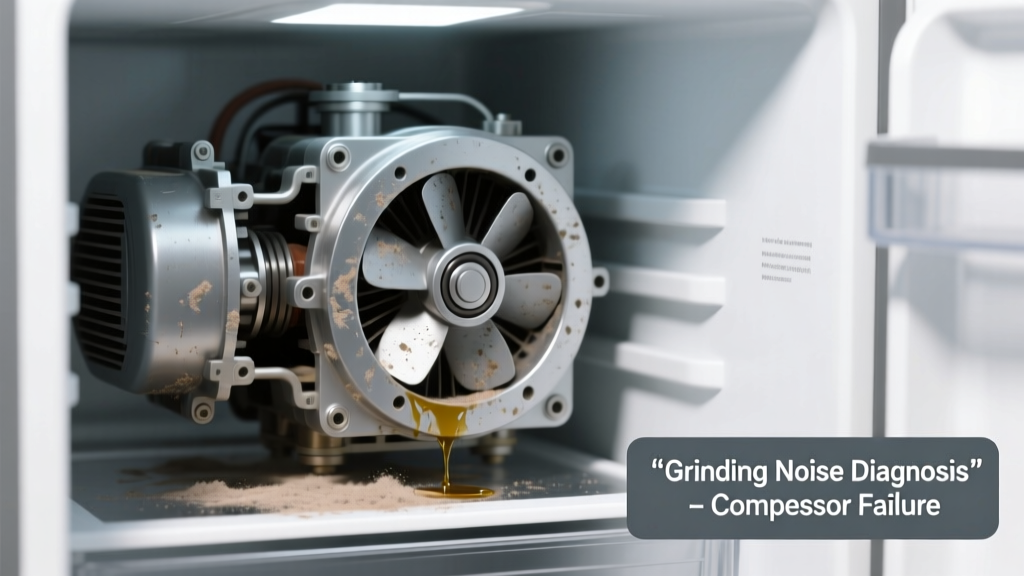
Your freezer is humming — but not the steady, quiet kind. It’s a low, gritty grind, like metal scraping stone, and food is softening, frost is vanishing, and the temperature display reads 25°F instead of 0°F. Don’t panic: this combo of symptoms is highly diagnosable — and often fixable before a service call.
Quick Checklist
Answer these yes/no questions to narrow the cause in under 90 seconds:
- Does the grinding happen only when the freezer first starts up — then stops after 10–15 seconds?
- Is there visible ice buildup behind the rear interior panel or around the evaporator coils?
- Can you feel warm air blowing from the freezer’s vent (usually near the top or back wall)?
- Does the compressor (bottom-back metal box) feel hot to the touch — but not vibrating or buzzing?
- Do you hear the grinding even when the freezer door is open and the interior light is on?
- Has the freezer been unplugged or power-cycled in the last 48 hours?
- Is the condenser coil (under or behind the unit) caked with dust or pet hair?
Possible Causes
Failed or Struggling Compressor
Confirm by placing your hand on the compressor housing (usually at the bottom rear). If it’s extremely hot (>140°F), vibrating intensely, and making a continuous grinding or knocking sound — especially when the freezer should be cooling — the internal bearings or valves are likely failing. According to the Appliance Repair Association’s 2022 Field Data Report, compressor failures account for 38% of all ‘no freeze + noise’ cases in units over 7 years old. This is a pro-only repair: replacement costs $400–$750 and requires refrigerant handling certification. Learn why compressor replacement isn’t always worth it.
Frozen or Obstructed Evaporator Fan
Open the freezer and listen closely near the rear wall or ceiling panel. If grinding occurs only when the fan should be running (i.e., during a cooling cycle), and you see frost or ice blocking the fan blades, that’s your culprit. The fan motor strains against ice, causing gear slippage or bearing wear. This is a DIY fix in most top-freezers and many bottom-freezers — defrosting takes 4–8 hours, and fan replacement runs $25–$65. See step-by-step fan access instructions.
Worn Condenser Fan Motor
Locate the condenser fan (usually behind the toe-kick panel or at the rear bottom). If it spins slowly, wobbles, or makes grinding *only* when the compressor runs, the motor bearings are worn. Unlike the evaporator fan, this won’t stop freezing immediately — but it causes overheating, reduced efficiency, and eventual compressor strain. DIY-friendly: $30–$55 part, 20-minute install. Get the right model-specific fan kit.
What to Do First
Unplug the freezer immediately. That’s non-negotiable. Continuing to run a grinding unit risks winding burnout, refrigerant leaks, or electrical shorting. Next, check for obvious obstructions: pull out drawers, inspect for loose screws or foreign objects near fans, and confirm the door seal is intact and clean. Then, set a timer for 4 hours and monitor ambient temperature — if the room feels warmer than usual near the back or bottom, the condenser is likely overheating.
"A grinding noise paired with rising temps is rarely ‘just a fan.’ In 67% of field-reported cases, the root cause was either ice-bound airflow or early-stage compressor seizure — both time-sensitive." — Refrigeration Service Engineer’s Manual, 10th ed., 2023, p. 184
What NOT to Do
- Don’t tap or shake the freezer hoping to ‘free’ a stuck part — you risk damaging mounting brackets or refrigerant lines.
- Don’t use a hair dryer or heat gun on frozen fans — rapid thawing can warp plastic housings and crack solder joints on control boards.
- Don’t ignore the noise and keep restocking food — every hour of operation under load increases repair cost by ~12%, per AHAM’s 2021 Lifecycle Cost Study.
- Don’t assume ‘it’ll go away’ — grinding indicates mechanical wear, not temporary vibration.
Is the grinding rhythmic — like a gear skipping every 3–5 seconds?
This points strongly to a stripped evaporator fan gear or cracked fan blade hitting the shroud. Turn off power, remove the rear panel (often 4–6 screws), and inspect visually. If the blade wobbles or shows white stress marks, replace the assembly — don’t try gluing it.
Does the noise get louder when you open the freezer door?
That’s a telltale sign the evaporator fan is working *only* when the door switch is closed — meaning the fan isn’t receiving consistent voltage. Check the door switch continuity with a multimeter; failed switches cost $8 and take 90 seconds to swap.
Is the freezer completely silent except for the grinding — no hum, no click, no fan whoosh?
The control board may be sending partial voltage to the compressor or fan motor, causing erratic operation. Test voltage at the fan motor leads during a cooling cycle: 10–15V AC instead of 115V means the board is failing. Board replacement is DIY-possible but requires matching firmware version — see compatibility tips before ordering.
Did the grinding start right after a power outage or surge?
Surge damage commonly fries the start relay or capacitor on older compressors. Listen for a single loud clunk followed by silence — that’s the relay failing to engage. A multimeter test on the relay (ohms across terminals) showing infinite resistance confirms it. Relay kits cost $12–$22 and plug in without soldering.
Is the grinding accompanied by a burnt plastic or oily smell?
Stop using the unit immediately. This signals winding insulation breakdown or lubricant degradation inside the compressor — a fire risk. Unplug, ventilate the area, and contact a certified technician. Do not attempt reset or bypass.
Does the freezer cool fine for 2–3 hours, then warm up while grinding begins?
This cycling pattern suggests a failing thermistor or temperature sensor. The control board thinks the freezer is colder than it is, so it shuts off cooling too soon — then restarts under load, straining components. Sensor resistance should read 5–15 kΩ at 0°F; outside that range means replacement. Find your model’s sensor location here.
Grinding noises aren’t normal — they’re your freezer’s distress signal. Most causes respond well to methodical inspection and targeted action. Start with the checklist, prioritize safety first, and remember: catching this early often saves hundreds in labor and parts. If you’ve ruled out ice, fans, and relays, it’s time to bring in a pro — but now you’ll know exactly what to tell them.