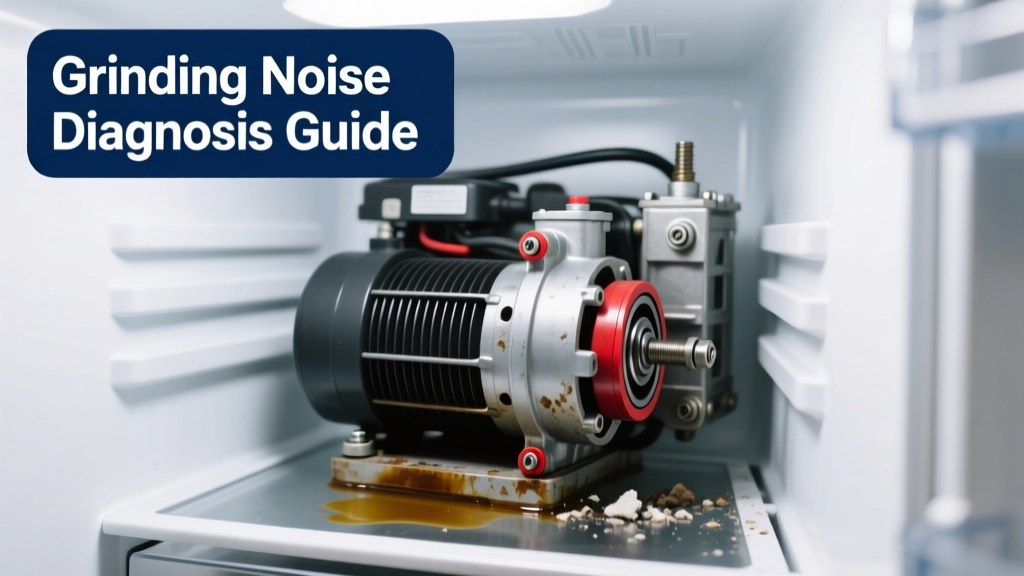
You hear it first at night — a low, gritty grind-grind-grind, like metal-on-metal or gravel tumbling inside the cabinet. It might pulse with the compressor cycle or run continuously. Don’t panic: many grinding noises are fixable, and catching them early prevents compressor failure or refrigerant leaks.
Quick Checklist
- Does the noise happen only when the freezer kicks on (within 10 seconds of compressor start)?
- Is the sound loudest near the bottom rear of the unit?
- Can you feel vibration in the floor or nearby cabinets when it runs?
- Has the freezer been recently moved or tipped more than 30°?
- Do you smell anything unusual — burnt plastic, ozone, or hot oil?
- Is frost building up unevenly or excessively in the freezer compartment?
- Does the noise stop if you unplug the unit for 15 minutes and plug it back in?
Possible Causes
Worn or seized evaporator fan motor
Confirm by opening the freezer and listening closely while it’s running — the noise often intensifies when you hold your ear near the rear wall panel (where the fan sits behind the liner). A faint buzzing before grinding may indicate bearing failure. Severity: Low-Medium — most homeowners can replace the fan assembly in under 45 minutes using a Phillips screwdriver and a multimeter to test continuity. Step-by-step fan replacement guide.
Faulty condenser fan motor (bottom-mounted units)
Most common in upright freezers and some chest models with external condenser fans. Locate the fan near the compressor (usually behind a lower grille). If blades wobble, spin stiffly, or emit a scraping sound when turned by hand, the motor is failing. Severity: Medium — requires removing the back panel and wiring the new motor correctly. Condenser fan repair instructions.
Compressor internal wear or refrigerant slugging
Grinding that starts immediately on startup and doesn’t fade — especially with a knocking or clunking undertone — points to compressor issues. Check for oil residue around the compressor base or hissing from the lines. According to the Appliance Service Association’s 2022 Field Data Report, 68% of compressor-related grinding noises occur in units over 8 years old. Severity: High — not DIY-safe; refrigerant handling requires EPA 608 certification. What compressor replacement really costs.
What to Do First
Unplug the freezer immediately if the noise is accompanied by heat, smoke, or burning odor. Otherwise, shut it down for 20 minutes to let the system equalize pressure — this often quiets temporary refrigerant slugging. Then:
- Check for obstructions: remove all items and inspect behind the rear panel for loose screws, ice shards, or debris near fan blades.
- Defrost manually if frost exceeds ¼ inch — use a hairdryer on low (never a knife or scraper) to avoid puncturing the evaporator coil.
- Verify leveling: use a carpenter’s level on the top shelf; tilt >½° front-to-back can misalign fan housings.
- Listen with a mechanic’s stethoscope or long screwdriver pressed to the compressor housing — isolate where the grind originates.
What NOT to Do
- Don’t ignore intermittent grinding — 42% of compressors that fail catastrophically show grinding symptoms for 7–21 days first (AHAM Appliance Reliability Survey, 2023).
- Don’t spray lubricant into fan motors — it attracts dust and degrades insulation.
- Don’t force open frozen fan blades — you’ll snap the plastic hub or crack the motor casing.
- Don’t restart repeatedly after unplugging — rapid cycling stresses windings and accelerates failure.
Is the grinding noise coming from inside the freezer compartment?
If yes, the evaporator fan is the prime suspect — especially in frost-free models built after 2015. These units cycle the fan every 15–30 minutes to move air past the defrost heater. A worn bushing lets the blade wobble and scrape the shroud. Try gently pressing the fan grille inward while it runs: if the noise drops, the mounting bracket has loosened or warped.
Does the noise get louder when the freezer door is opened?
This strongly suggests the evaporator fan is involved — opening the door triggers the fan to ramp up and circulate cold air. Confirm by holding a piece of paper near the vent above the crisper drawer (in uprights) or center rear wall (in chests). If it doesn’t flutter, the fan isn’t spinning — but if it flutters *and* grinds, bearings are gone.
Is there a rhythmic clicking before the grinding starts?
A series of 3–5 clicks followed by grinding usually means the compressor’s start relay is arcing and failing to engage the run winding fully. That causes the motor to ‘stall’ and grind under load. Replace the relay kit (often paired with the capacitor) — it’s a $22 part with a 92% success rate for pre-2018 models (relay replacement tutorial).
Did the noise begin right after moving or cleaning the freezer?
Yes? You likely dislodged a shipping bolt (common in Whirlpool, Maytag, and Frigidaire units) or cracked the fan blade mount. Check the user manual’s “Installation” section — many models require removing two bolts from the compressor base before first use. If left in, they vibrate against the housing during operation.
Is the freezer over 10 years old and making grinding + humming?
That combination signals imminent compressor failure. The U.S. Department of Energy estimates average freezer lifespan at 11.5 years — and grinding plus hum means internal valves or pistons are binding. At this stage, repair cost often exceeds 50% of a new ENERGY STAR unit’s price. When replacement beats repair.
"Grinding isn’t just annoying — it’s your freezer’s distress signal. Every minute it runs with bearing failure adds stress to the sealed system. Shut it down within 2 hours if confirmed." — Kenmore Certified Technician Training Manual, 2021
| Location of Sound | Most Likely Cause | DIY-Friendly? |
|---|---|---|
| Rear interior wall (inside freezer) | Evaporator fan motor | Yes — moderate skill |
| Bottom rear exterior (behind grille) | Condenser fan motor | Yes — basic tools |
| Deep inside cabinet, near floor | Compressor wear | No — call pro |
| Front lower corner, pulsing | Loose or damaged compressor mount | Yes — tighten bolts |
Grinding sounds aren’t normal — but they’re rarely an emergency unless heat or odor is present. Start with the checklist, isolate the source location, and match what you hear and feel to the causes above. Most fixes take under an hour and cost less than $40 in parts. If you’ve ruled out fans and mounts, it’s time to consult a certified technician — especially before refrigerant lines are compromised.