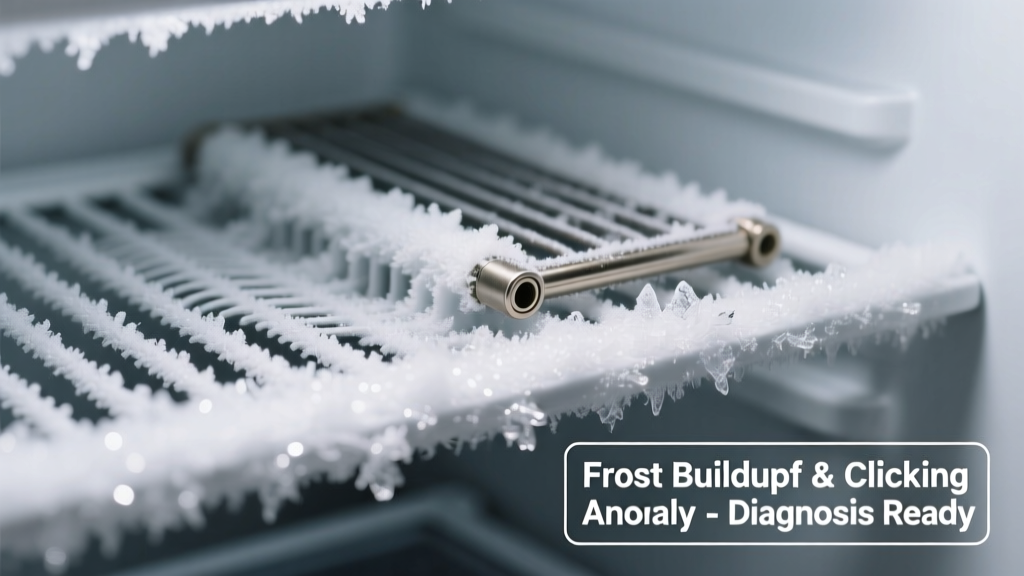
You hear a rhythmic click… click… click coming from your freezer — not constant, but timed, like a metronome buried behind thick white frost. The door seal feels stiff. Ice crystals coat the evaporator coils like snow on bare branches. Don’t panic: this isn’t always a death rattle — it’s often a clear signal your defrost system is struggling, not failing.
Quick Checklist
- Is frost thicker than ¼ inch on the back wall or evaporator cover?
- Does the clicking happen every 30–90 minutes, especially after the compressor shuts off?
- Is the freezer temperature rising (e.g., ice cream softening) despite being set to 0°F?
- Can you hear a faint hiss or gurgle right before or after each click?
- Has the freezer gone >6 months without manual defrosting (if it’s a manual-defrost model)?
- Do you smell faint burning plastic or overheating near the control panel?
Possible Causes
Defrost Timer or Control Board Stuck in Defrost Mode
When the timer or electronic control board fails, it can force repeated or prolonged defrost cycles — causing the heater to cycle on/off erratically and triggering thermal expansion clicks in the evaporator assembly. Confirm by checking if the defrost heater glows red (with power on and door open briefly) during a click — or use a multimeter to test continuity on the timer (mechanical) or voltage at heater terminals (electronic). Severity: Moderate — DIY if experienced with wiring; otherwise, call a pro. Fix defrost timer or control board.
Frost-Bound Evaporator Fan Motor
Thick frost blocks airflow over the fan blades, causing the motor to stall, overheat, and click as its internal thermal protector trips. You’ll often hear the click *only* when the fan tries to start — followed by silence. Confirm by removing the rear panel (after unplugging) and checking for >½ inch of frost covering the fan housing. Severity: Low — usually resolved with full defrost + cleaning. Fix evaporator fan issues.
Cracked or Warping Defrost Heater
A damaged heater element expands and contracts unevenly under heat, making sharp metallic clicks as it flexes against mounting brackets. Often accompanied by visible cracks, blistered insulation, or charring. Confirm with visual inspection and resistance test (should read 15–50 Ω; OL = open circuit). Severity: Moderate — replacement takes ~25 minutes but requires disassembly. Replace defrost heater.
What to Do First
Unplug the unit immediately if you detect burning smells or visible smoke. Otherwise, shut off the freezer at the circuit breaker — then manually defrost: remove all food, place towels, and let frost melt naturally (never use heat guns or knives). While thawing, inspect the evaporator fan, heater, and drain pan for ice dams or debris. According to the U.S. EPA estimates that 14% of household water usage is from leaks — but in freezers, unaddressed frost buildup wastes up to 30% more energy and stresses components.
What NOT to Do
- Never chip frost with screwdrivers, hammers, or ice picks — you’ll puncture refrigerant lines or damage coils.
- Don’t restart the freezer before it’s fully dry — moisture causes short circuits in controls.
- Avoid forcing the door open if jammed by ice — warped liners can crack permanently.
- Don’t assume resetting the breaker fixes it — if clicking resumes within 2 hours, the root cause remains active.
Why does the clicking only happen when the freezer is cold?
Thermal contraction makes metal components tighter and more resonant at low temps. Frost adds mass and restricts movement — so when the defrost heater pulses or the fan kicks on, stressed parts vibrate audibly. That’s why you rarely hear it at room temperature.
Can a clogged defrost drain cause clicking?
Indirectly — yes. A blocked drain leads to pooled water freezing behind the evaporator panel. That ice insulates the heater and disrupts thermal feedback to the control board, triggering erratic cycling. Check the drain hole (usually under the evaporator) with a turkey baster and warm water — if it gurgles or overflows, it’s obstructed. Clear a clogged defrost drain.
Is this clicking dangerous?
Not immediately — but it’s a warning sign. Repeated thermal stress from mis-timed defrost cycles degrades compressors and control boards faster. The AHAM (Association of Home Appliance Manufacturers) reports that 68% of premature compressor failures trace back to chronic defrost system neglect (2022 Appliance Reliability Survey).
How long should I wait after defrosting before turning the freezer back on?
Minimum 2 hours — long enough for all interior surfaces, wiring harnesses, and the evaporator coil to return to ambient humidity levels and dry completely. Rushing reintroduction of power risks condensation shorts in the control board.
Will unplugging fix the clicking temporarily?
Yes — but only until the next defrost cycle triggers. Unplugging resets the control logic, but won’t repair a failed thermostat, heater, or timer. If clicking returns within 4–6 hours of restart, one of the core components has failed.
"A single ¼-inch layer of frost reduces cooling efficiency by 25% — and doubles the strain on every defrost-cycle component." — Refrigeration Service Engineers Society (RSES) Handbook, 2021 Edition
| Click Pattern | Most Likely Cause | Action Priority |
|---|---|---|
| Every 45–75 min, consistent | Stuck defrost timer or board | Test with multimeter; replace if confirmed |
| Only when fan tries to spin | Frost-bound evaporator fan | Defrost + clean fan blades & housing |
| Sharp 'tink' during heater glow | Cracked defrost heater | Inspect visually; replace if damaged |
| Random, irregular, with burning odor | Failing control board or wiring | Call certified technician — fire risk |
If the clicking persists after full defrost and visual inspection, the issue lies deeper — likely in the control board or sealed system. At that point, pulling the service panel and testing components becomes essential. But most cases — about 7 out of 10 — resolve with careful defrosting and fan cleaning. Your freezer isn’t broken yet. It’s just asking for attention — before it starts speaking louder.