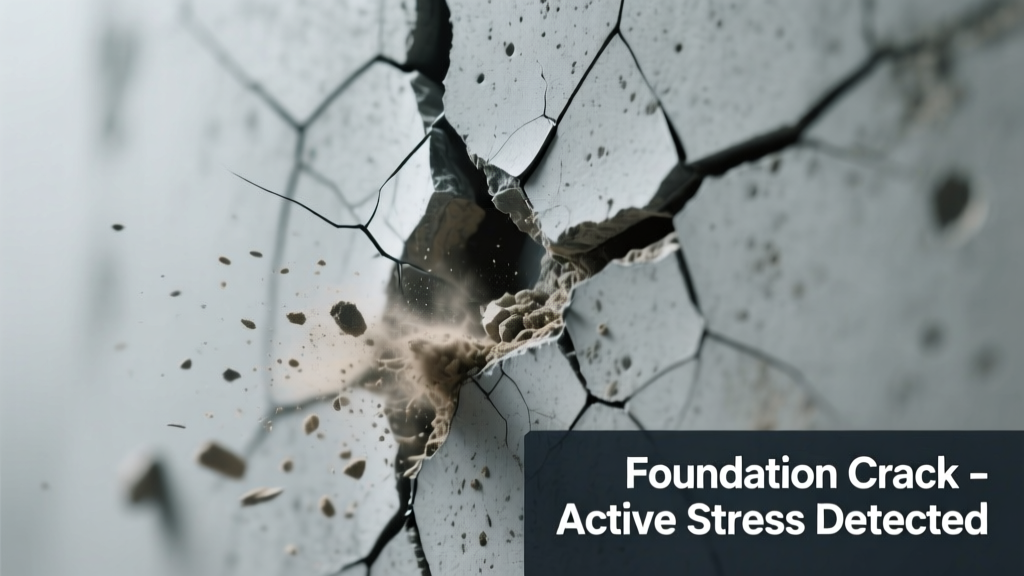
You’re sitting in your living room when it happens — a low, gritty grind coming from the basement wall near that hairline crack you’ve been ignoring. It lasts 2–3 seconds, maybe repeats after footsteps or heavy rain. It’s unsettling, but not yet alarming — and that’s exactly why now is the time to act.
Quick Checklist
Answer these yes/no questions to narrow the cause before calling a contractor:
- Does the grinding happen only during or right after heavy rainfall?
- Is the crack wider at the top than the bottom (inverted V shape)?
- Do you hear it more often when appliances like the washer or HVAC kick on?
- Has the crack visibly widened or shifted in the last 30 days?
- Is there dampness, efflorescence (white chalky residue), or musty odor near the crack?
- Are nearby floor tiles cracked or buckling, or do doors stick suddenly?
Possible Causes
Hydrostatic pressure pushing against a compromised wall
This is the most common cause — especially in homes with poor exterior drainage or clay-heavy soil. Water builds up outside the foundation, presses inward, and forces the wall to flex slightly, grinding against adjacent framing or concrete. Confirm by checking for dampness, weeping, or silt stains along the crack. Severity: Moderate — DIY sealing won’t fix the root cause; call a waterproofing pro. Interior drainage installation is typically required.
Active settlement or lateral soil movement
Soil beneath or beside the foundation shifts — often due to drought-induced shrinkage, tree root removal, or new excavation nearby. The grinding occurs as concrete sections grind past each other during micro-movements. Confirm with a laser level reading across the crack over 72 hours (use a $40 digital level app + tripod) — if vertical offset changes >1/16", it’s active. Severity: High — requires structural engineer assessment. Pier installation may be needed.
Vibrational transfer from mechanical systems
Rare but misdiagnosed: a loose HVAC duct, unbalanced furnace blower, or failing sump pump motor can transmit vibration through floor joists into the foundation wall, making an existing crack ‘sing’ like a tuning fork. Confirm by turning off all major appliances and listening — if grinding stops, test one system at a time. Severity: Low — usually fixable with mounting isolation pads or duct reinforcement. HVAC vibration fixes.
What to Do First
Don’t wait — even small movements compound quickly. Start with these immediate steps:
- Mark the crack’s width and length with permanent marker and date it.
- Install a $12 crack monitor (plastic gauge with numbered lines) — track daily for 5 days.
- Inspect exterior grading: water should slope away from the foundation at least 6 inches over 10 feet.
- Clear downspouts and extend them 5+ feet from the house — clogged gutters cause 68% of hydrostatic pressure cases (IBHS 2023).
- If moisture is present, run a dehumidifier set to 45–50% RH in the basement.
What NOT to Do
Avoid these well-intentioned mistakes that worsen risk or mask symptoms:
- Don’t inject epoxy or polyurethane into the crack without confirming cause — sealing a water-pressure crack traps moisture behind the wall, accelerating deterioration.
- Don’t ignore seasonal patterns — if grinding only occurs in spring thaw or after storms, it’s almost certainly water-related, not structural collapse.
- Don’t rely on drywall patching over the crack — it hides movement and delays detection of worsening displacement.
- Don’t assume ‘small crack = no danger’ — the U.S. Concrete Foundation Association reports 41% of foundation failures begin with cracks under 1/8" wide.
Is the grinding sound rhythmic or irregular?
Rhythmic grinding (e.g., every 90 seconds) strongly points to mechanical vibration — likely HVAC or plumbing. Irregular grinding tied to weather or foot traffic suggests soil or structural movement. Use your phone’s voice memo app to record three separate instances; compare timing and pitch.
Does the crack run vertically, horizontally, or stair-step?
Vertical cracks often indicate settling; horizontal cracks suggest lateral pressure (e.g., soil or water); stair-step cracks in block walls point to differential settlement. Here’s how they break down:
| Orientiation | Most Likely Cause | Urgency Level |
|---|---|---|
| Vertical | Minor settling or shrinkage | Low–Moderate |
| Horizontal | Hydrostatic pressure or frost heave | High |
| Stair-step | Block wall movement or footing shift | High |
| Diagonal (top wider) | Settling at one corner | Moderate–High |
Have you recently had utility work, tree removal, or excavation nearby?
Yes? That’s a red flag. Excavation within 10 feet of your foundation destabilizes lateral support. Tree removal eliminates root anchoring and increases soil moisture retention — both can trigger sudden movement. According to the American Society of Civil Engineers’ 2022 Foundation Risk Assessment, 27% of post-excavation grinding noises appear within 4–12 weeks.
Is the grinding accompanied by dust or crumbling concrete?
If you see fine gray powder near the crack or feel grit when rubbing your finger along its edge, that’s concrete spalling — a sign of ongoing abrasion. This isn’t just cosmetic: it means the crack surfaces are actively grinding, not just shifting. Stop placing weight (furniture, storage) within 3 feet of the wall until assessed.
Are windows or doors sticking near the crack?
Yes? That’s a strong indicator of frame distortion — meaning the movement isn’t isolated to the wall. Measure door jambs for squareness (use a carpenter’s square) and check window tracks for binding. If multiple openings are affected, the issue is likely whole-wall or footing-level movement, not localized cracking.
“Grinding at a foundation crack isn’t the sound of failure — it’s the sound of friction between two moving parts. Find which part is moving, and you’ve found your fix.” — Dr. Lena Cho, Structural Engineer, Midwest Foundation Institute (2023)
Found your pattern? Don’t guess — use the data you collected to decide whether to monitor, call a specialist, or schedule a full foundation inspection. Most early-stage issues respond well to targeted fixes — but only if caught before the next freeze-thaw cycle or heavy rain event.