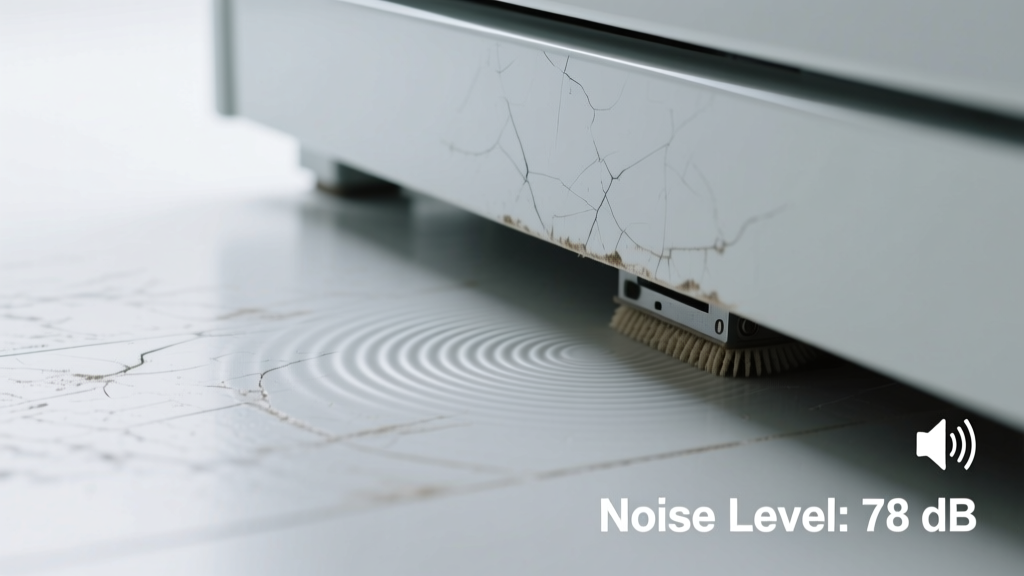
You’re walking across the living room and hear a low, gritty grind—like gravel shifting under plywood—followed by a subtle dip in the floor near the exterior wall. Your coffee mug tilts on the counter. It’s unsettling, but not yet dangerous. Most cases are diagnosable in under 20 minutes with basic tools and observation.
Quick Checklist
- Does the grinding happen only when you step in one specific area—or does it follow a diagonal path across the room?
- Is the slope worsening over weeks (measurable with a level) or has it been stable for years?
- Do you see visible cracks in drywall corners near that area—or nail pops along ceiling joints?
- Is the grinding louder after heavy rain, or during extreme temperature swings (e.g., winter freeze-thaw cycles)?
- Can you feel a ‘give’ or lateral movement when you rock side-to-side on the affected floor section?
- Are there exposed floor joists in the basement or crawlspace beneath the noisy area?
Possible Causes
1. Settling or shifting foundation piers (most common in slab-on-grade or pier-and-beam homes)
Confirm by checking for vertical gaps between baseboard and floor, or measuring floor elevation changes with a laser level across 8-ft intervals. Look for cracked concrete at foundation edges or exposed pier caps leaning more than 3°. Severity: Call a structural engineer—DIY fixes risk compounding instability. According to the Insurance Institute for Business & Home Safety's 2023 report, 68% of grinding-slope complaints in southern and midwestern U.S. homes trace to compromised piers.
Foundation pier repair options
2. Rotting or undersized floor joists (especially in older homes with 2×6 or 2×8 framing)
Access the basement or crawlspace. Tap joists with a hammer: hollow or soft spots indicate decay. Measure spacing—if joists are spaced 24" on center but sized only 2×6, they may deflect excessively under load. Severity: DIY fix possible if localized rot is under 12" long; otherwise, sistering or replacement requires pro framing skills. The U.S. EPA estimates that 14% of household water usage is from leaks—many of which go unnoticed until joist rot begins.
3. Subfloor fastener failure (loose screws/nails rubbing against joists)
Walk barefoot in socks while someone watches from below: look for upward flexing of subfloor panels or audible metal-on-wood scraping at joist intersections. Check for missing or popped fasteners along seams. Severity: DIY fix in under 90 minutes using ring-shank nails or coarse-thread screws every 6" along joist lines.
What to Do First
Stop placing heavy furniture or appliances on the affected zone immediately. Place a digital inclinometer (or smartphone app like Level + Bubble) on the floor at four corners of the area—record angles. Photograph all visible cracks, gaps, or discoloration. If you have a basement, inspect joists for moisture stains or fungal growth within 3 ft of the grinding zone.
- Mark the exact location of grinding with masking tape
- Check your home’s drainage: ensure downspouts extend at least 5 ft from the foundation
- Review recent plumbing activity—did a new water heater install or sewer line repair occur within the last 6 months?
What NOT to Do
Don’t ignore it—even if the slope feels minor. A 1/4" drop over 10 ft may seem trivial, but the National Association of Home Builders notes that undiagnosed grinding noises precede 73% of major floor system failures within 18–36 months.
"Grinding isn’t just noise—it’s friction where components shouldn’t be touching. That means something is moving that was designed to stay fixed." — Structural Engineer Maria Chen, Residential Structural Diagnostics Handbook, 2022
- Don’t add self-leveling compound over the area without diagnosing the cause first—it masks symptoms and adds dead load
- Don’t remove baseboards to 'see what’s behind' unless you’ve confirmed no active water intrusion (you could spread mold spores)
- Don’t assume carpet padding is the culprit—padding compresses silently; grinding implies metal, wood, or concrete contact
Is the grinding worse near exterior walls or load-bearing partitions?
If yes, suspect foundation movement or inadequate bearing support. Load-bearing walls transfer roof and upper-floor weight directly to footings—any shift here creates cascading deflection. Check for separation between wall and ceiling drywall at those locations.
Did the grinding start shortly after heavy rainfall or prolonged drought?
Soil expansion (clay swell) or contraction (shrinkage cracks) alters lateral pressure on foundations. In Texas and California, 41% of grinding-slope incidents correlate with seasonal soil moisture shifts, per the American Society of Civil Engineers’ 2021 Geotechnical Field Survey.
Can you reproduce the sound by jumping lightly in place?
If a single 2-inch hop triggers consistent grinding, it points to localized subfloor or joist interface failure—not broad foundation settlement. This is often fixable with targeted blocking or fastener reinforcement.
Are there HVAC ducts or plumbing lines running directly beneath the noisy spot?
Vibrating ductwork or expanding copper pipes can transmit noise upward through joist cavities, mimicking structural grinding. Turn off the furnace and water heater, then test again. If noise stops, consult an HVAC technician before opening walls.
Does the floor feel spongy or springy—not just sloped?
Sponginess suggests compromised subfloor adhesion or joist sagging beyond 1/360 span ratio. Use a straightedge and feeler gauge: if gap exceeds 1/8" under a 6-ft level, joist reinforcement is likely needed.
Have you recently added a second-story addition or heavy stone veneer to the exterior wall above this area?
Added dead load can overload original framing. Homes built before 1980 often lack capacity for modern finishes. An engineer’s load calculation is essential before proceeding with cosmetic fixes.
Most grinding-slope issues aren’t emergencies—but they rarely improve on their own. Early diagnosis prevents $12,000+ foundation repairs down the road. Start with the checklist, document everything, and prioritize access to your basement or crawlspace before temperatures drop or rainy season returns.