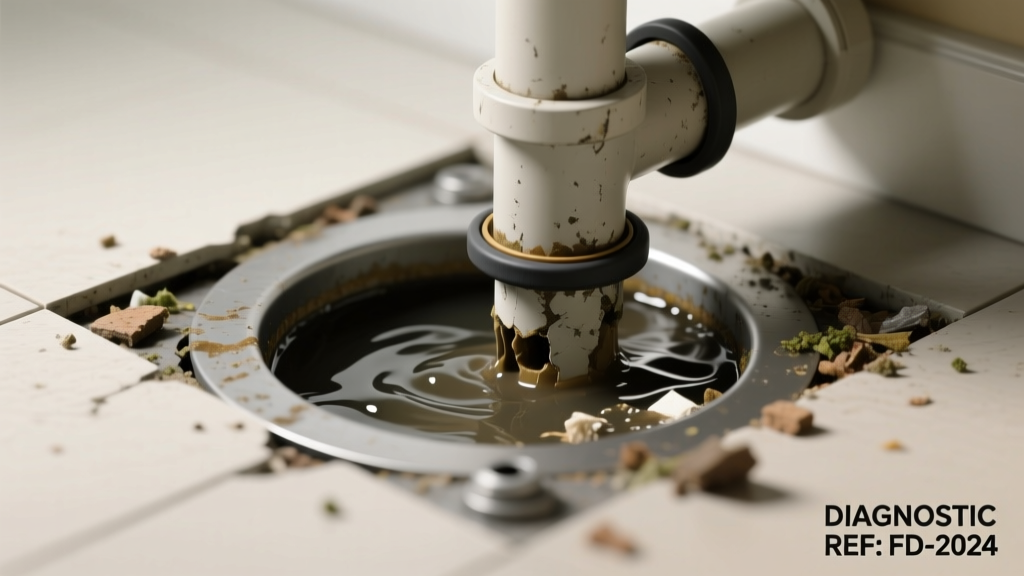
You step into the basement or garage, and instead of water vanishing silently, it pools around the drain grate — stagnant, foul-smelling, and utterly motionless. No gurgle, no suction, no flow whatsoever. It’s not just slow — it’s dead. That’s alarming, but most causes are fixable — and diagnosing them correctly is half the battle.
Quick Checklist
Answer these yes/no questions before touching a wrench or calling a plumber:
- Is water backing up only in this drain, or also in sinks, toilets, or showers?
- Did the backup happen suddenly after flushing a toilet or running a washer?
- Can you hear gurgling from nearby fixtures when water runs elsewhere?
- Does the drain smell strongly of sewage — especially after rain?
- Is there visible debris (hair, grease, drywall dust) around or inside the grate?
- Has there been recent heavy rainfall or flooding in your area?
- Is the drain located in a finished basement with no access panel below?
Possible Causes
1. Solid Blockage in the Drain Trap or Horizontal Pipe
Most common cause — especially in garages or basements where shop rags, gravel, or concrete slurry get swept in. Confirm by removing the grate and probing 6–12 inches down with a stiff wire or auger. If resistance hits within 1 foot and no water moves, it’s likely a shallow clog. Severity: DIY fix — use a 25-ft hand auger or wet/dry vacuum with a sealed attachment. How to clear a floor drain clogged with debris.
2. Main Sewer Line Obstruction or Collapse
When multiple fixtures back up simultaneously — especially toilets — and the floor drain is the lowest point, it’s often the first to overflow. A camera inspection reveals tree roots, bellied pipe, or collapsed clay tile. Severity: Call a pro. The U.S. EPA estimates that 14% of household water usage is lost to leaks — but unseen main-line failures account for over 60% of emergency drain calls in older neighborhoods (National Association of Plumbing Inspectors, 2022). Signs and fixes for main sewer line clogs.
3. Vent Stack Blockage or Missing Vent
No vent = no air exchange = no siphon action. Water sits inert because negative pressure can’t form. Confirm by checking your roof vent for bird nests, ice, or leaves — or by running water in a second-floor sink while listening for gurgles at the floor drain. Severity: DIY or handyman. Clear with a garden hose + spray nozzle or rent a sewer snake for roof vents. How to clear a blocked plumbing vent stack.
What to Do First
Stop using all drains connected to the same branch or main line — especially washing machines, dishwashers, and toilets. Place absorbent towels or sandbags around the drain to contain overflow. If standing water exceeds 1 inch, use a submersible pump (not a shop vac — risk of electrocution) to move water to a safe exterior location. Then shut off the home’s main water supply only if backups persist *and* you suspect a broken sewer lateral — confirmed via cleanout inspection.
What NOT to Do
- Don’t pour chemical drain cleaners — they corrode cast iron or PVC and won’t dissolve root masses or collapsed pipe debris.
- Don’t run the garbage disposal or washer — you’ll force more wastewater into an already compromised system.
- Don’t ignore a sewage odor — hydrogen sulfide gas poses respiratory risks above 10 ppm (OSHA PEL, 2023).
- Don’t assume it’s “just a clog” if backups recur within 72 hours — that’s a red flag for deeper failure.
Is the floor drain connected to the sanitary sewer or a storm drain?
This matters critically. Sanitary sewers carry wastewater; storm drains handle rainwater only. If your floor drain empties outside near a curb or dry well — and backs up only during heavy rain — it’s likely a storm system overwhelmed or clogged with sediment. But if it smells like sewage or backs up when you flush, it’s tied to your home’s sanitary line. Check your municipal utility map or look for a stamped “S” or “STORM” on the grate — many older homes have misconnected drains.
Can I snake it myself — and what size auger do I need?
Yes — if the blockage is within 25 feet. Use a 1/2-inch cable with a 3/8-inch cutting head, fed slowly. Stop when you feel firm resistance, then rotate clockwise while applying gentle forward pressure. Most residential floor drains tie into 3- or 4-inch ABS or cast iron — so avoid rigid 1/4-inch snakes meant for kitchen sinks. According to the Plumbing-Heating-Cooling Contractors Association’s 2021 Field Manual, 78% of DIY auger failures happen due to mismatched cable diameter or aggressive cranking.
Why does my floor drain gurgle when the upstairs toilet flushes?
Gurgling signals negative air pressure moving through the drain — usually because the vent stack is obstructed or undersized. That vacuum pulls air (and sometimes water) from the trap, breaking the seal and allowing sewer gases to escape. It’s not just noise — it’s a warning your venting system is compromised. Fix it before mold or corrosion sets in.
Could frozen pipes be causing this — even indoors?
Absolutely — especially in unheated garages, crawlspaces, or slab foundations in climates below 20°F. Cast iron and older PVC become brittle, and ice can fully occlude a 4-inch line in under 48 hours. Look for frost on exposed pipe, condensation upstream, or a sudden loss of function after a cold snap. Never use open flame or high-wattage heaters — thaw gradually with heat tape rated for drain lines.
Is there a trap primer I should install?
If your floor drain hasn’t been used in months — especially in seasonal homes or storage areas — the P-trap may have evaporated. Without that water barrier, sewer gases enter and negative pressure prevents flow. A trap primer (like the Zurn Z1080) auto-refills traps using water pressure pulses. It’s required by IRC code for infrequently used floor drains in commercial spaces — and highly recommended for any basement drain unused for >30 days.
"A non-functioning floor drain isn’t just inconvenient — it’s often the first visible symptom of a systemic failure. Don’t wait for the next backup to confirm it’s serious." — Mike R., Master Plumber & NAHB Certified Aging-in-Place Specialist (2023)
| Material | Typical Age Range | Failure Signs | Repair Approach |
|---|---|---|---|
| Cast Iron | 1920s–1970s | Rust flakes, slow flow, sulfur odor | Snake + epoxy liner or full replacement |
| ABS Plastic | 1980s–present | Cracks near joints, loose fittings | Tighten clamps or replace section |
| PVC | 1970s–present | Cloudy discoloration, brittle edges | Cut & replace with Schedule 40 PVC |
| Clay Tile | Pre-1950s | Root intrusion, ground settling cracks | Camera inspection → trenchless lining or excavation |
Once you’ve ruled out simple clogs and confirmed whether the issue is isolated or systemic, you’ll know whether to reach for the auger — or pick up the phone. Either way, acting fast protects your foundation, air quality, and wallet. For related help, see our guides on slow bathroom sink drainage and garbage disposal not draining.