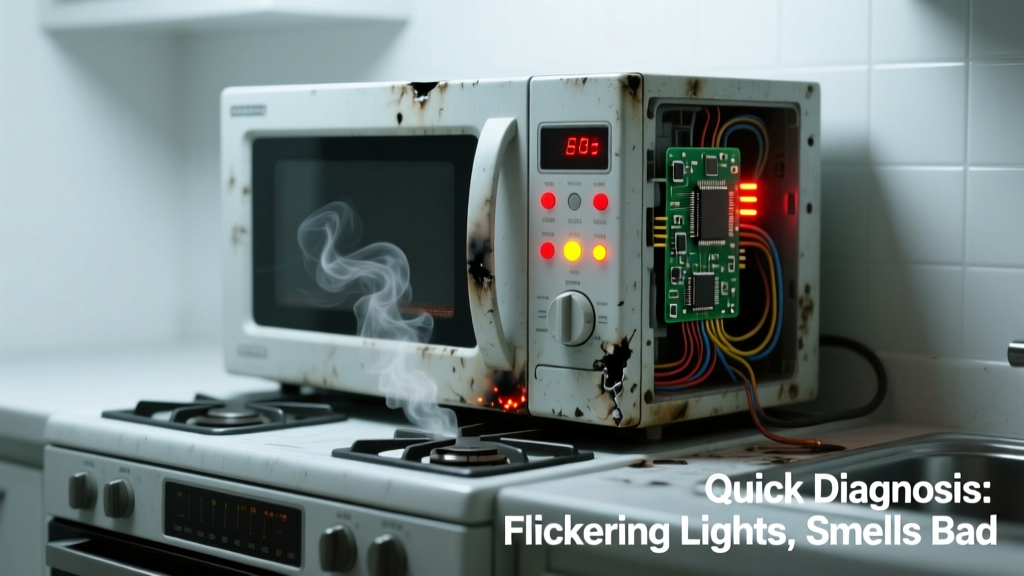
You flip a switch and the light stutters—then a sharp, acrid, or fishy smell hits your nose. Your skin prickles. This isn’t just annoying—it’s your home’s electrical system shouting for help. Don’t panic, but do pause. Most causes are fixable—but some demand immediate professional attention.
Quick Checklist
Answer these yes/no questions to narrow the root cause in under 90 seconds:
- Does the flickering happen only when you turn on a specific switch or appliance?
- Is the smell strongest near one outlet, switch, or ceiling fixture?
- Do you hear buzzing, sizzling, or popping sounds along with the flicker and odor?
- Has the circuit breaker tripped recently—or does it feel warm to the touch?
- Are the affected lights LED, incandescent, or older fluorescent?
- Did the issue start after installing a new dimmer, smart switch, or fixture?
- Have you noticed discoloration (brown/black scorch marks) on outlets, faceplates, or bulbs?
Possible Causes
Loose or corroded wiring connection
How to confirm: Use a non-contact voltage tester near suspect outlets/switches while the circuit is live (with caution). Look for warm faceplates or visible corrosion inside junction boxes. A multimeter reading showing fluctuating voltage across terminals also points here.
Severity: High risk—call an electrician immediately. Loose connections cause arcing, which generates heat up to 10,000°F—enough to ignite nearby insulation or framing. According to the U.S. Fire Administration’s 2022 report, faulty wiring accounts for 47% of residential electrical fires.
Failing light fixture or ballast (especially in older fluorescents)
How to confirm: Turn off power, remove the fixture cover, and inspect the ballast (a metal box wired to the tubes). If it’s swollen, leaking tar-like substance, or smells strongly of fish or ammonia, it’s failed. For LEDs, check for bulging capacitors or charring on the driver board.
Severity: Moderate—DIY replacement possible if comfortable with basic wiring. Ballasts contain PCBs in pre-1980 units; dispose per local hazardous waste rules. Modern LED drivers rarely fail catastrophically but can overheat if enclosed in tight spaces.
Overloaded circuit or undersized dimmer switch
How to confirm: Count all devices on the same circuit (use your panel map). If total wattage exceeds 80% of the circuit’s rating (e.g., >1,440W on a 15A/120V circuit), overload is likely. Also check dimmer compatibility—many LED bulbs require ELV or MLV dimmers, not standard TRIAC.
Severity: Low-to-moderate—DIY fixable with load audit and correct hardware. But sustained overheating degrades wire insulation. The National Electrical Code (NEC 2023) requires derating circuits above 80% continuous load.
Fix dimmer-related flicker and heat
What to Do First
Stop using the affected circuit. Flip the corresponding breaker to OFF—not just the wall switch. Unplug nearby electronics. If the smell persists after power-off, ventilate the area and evacuate if smoke appears.
- Use a flashlight—not a phone flashlight—to inspect (no spark risk).
- Check your main panel for breakers that feel unusually warm.
- Take photos before touching anything—they’ll help your electrician later.
- Call a licensed electrician if you detect warmth at outlets, scorch marks, or persistent odor after power-down.
What NOT to Do
Never ignore this symptom—even if it “goes away.” Arcing damage is cumulative and invisible until failure.
- Don’t reset a tripped breaker repeatedly without investigating why it tripped.
- Don’t spray air freshener or cleaners near outlets or fixtures—the chemicals can interact with hot components or mask critical warning signs.
- Don’t replace a bulb or fixture without verifying the underlying wiring is sound.
- Don’t use extension cords or power strips as permanent fixes for overloaded circuits.
Why does my light flicker and smell like fish?
This classic sign points to overheating electronic components—especially in magnetic ballasts or failing LED drivers. The “fishy” odor comes from thermal breakdown of phosphor coatings or organic circuit board laminates. As the U.S. EPA notes, many synthetic materials emit distinct odors when thermally degraded—often before visible smoke appears.
Can a bad light switch cause flickering and burning smell?
Yes—especially if it’s a worn-out toggle or incompatible dimmer. Internal arcing creates carbon tracking on contacts, reducing resistance and increasing heat. Over time, plastic switch bodies warp or discolor. If your switch feels stiff, clicks abnormally, or is warm to the touch, replace it—follow our safe switch replacement guide.
Is flickering + burning smell always dangerous?
Not always—but treat it as if it is. A 2023 study by the Electrical Safety Foundation International found that 68% of homeowners who ignored early arcing symptoms experienced full circuit failure within 3 weeks. Even brief arcing erodes conductor surfaces, increasing resistance and future fire risk.
"Smell is often the first and most reliable indicator of electrical fault—before smoke, sparks, or breaker trips. If you smell burning plastic or fish near wiring, assume there’s active arcing." — NFPA 70E Handbook, 2024 Edition
Why does the smell only happen at night or when AC runs?
Higher ambient temperatures reduce heat dissipation. When your HVAC cycles on, it may stress already marginal connections or overload shared circuits (e.g., lighting + AC on same leg). Voltage drop worsens under load—exposing weak joints. Check your panel’s leg balance using a clamp meter; imbalance over 5% stresses neutrals and increases heating.
Could this be related to my home’s age or wiring type?
Absolutely. Homes with knob-and-tube or aluminum wiring (common in 1960s–70s builds) are especially vulnerable. Aluminum oxidizes faster, increasing resistance at connections. The Consumer Product Safety Commission estimates homes with aluminum branch-circuit wiring have a 55x higher risk of fire than copper-wired homes.
| Odor Description | Most Likely Cause | Urgency Level |
|---|---|---|
| Burning plastic/rubber | Melting wire insulation or outlet housing | Critical—power off & call pro |
| Fishy or urine-like | Failing ballast, LED driver, or PCB breakdown | High—inspect fixture within 24h |
| Ozone (sharp, metallic, like after lightning) | Sustained arcing in switches or breakers | Critical—do not reset breaker |
| Musty or damp | Moisture intrusion into junction box or fixture | Moderate—check for leaks & seal |
Electrical faults don’t wait for convenience. That flicker and smell? It’s not background noise—it’s your home’s distress signal. Identify the source now, act decisively, and protect what matters most. If in doubt, reach out to a licensed electrician before flipping that switch again.