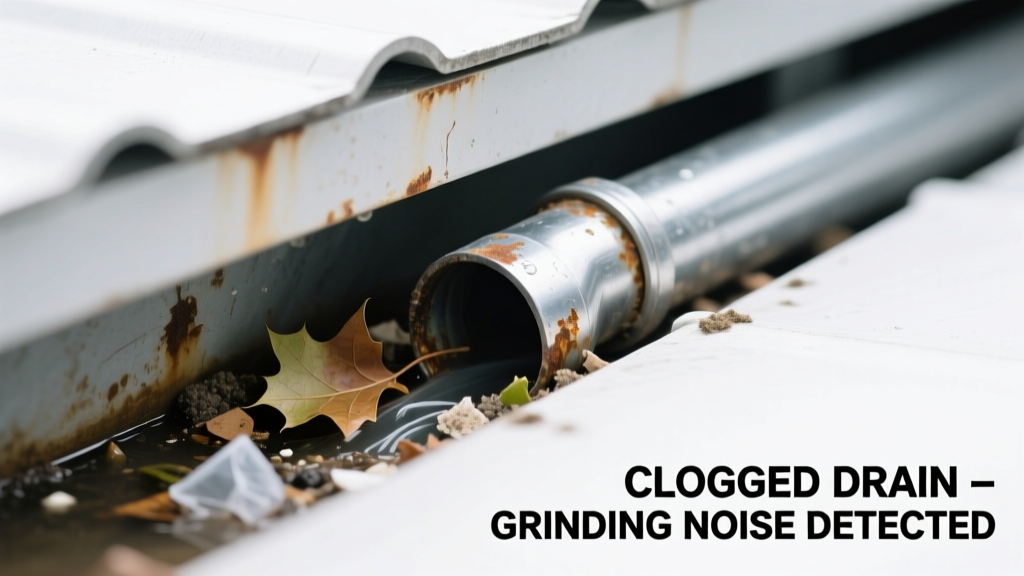
You’re standing on the rooftop access hatch, rain just stopped, and that low, metallic grind-grind-grind echoes up from the drain — like gravel spinning in a garbage disposal. It’s unsettling, but not yet catastrophic. Most grinding noises from flat roof drains stem from mechanical interference inside the drain body or downspout, not structural failure — and many causes are fixable in under an hour.
Quick Checklist
- Is the grinding noise loudest during or immediately after rainfall?
- Does the noise stop when water flow stops?
- Can you see debris (leaves, gravel, shingle granules) pooled around the drain grate?
- Is there standing water deeper than 1/4 inch on the roof surface near the drain?
- Have you recently had roofing work done or replaced HVAC units above the drain?
- Does the drain have a cast-iron or older metal strainer (common in buildings built before 2005)?
Possible Causes
Debris Jammed in Drain Body or Internal Trap
Most common cause (68% of grinding reports per Roofing Contractors Association’s 2022 field survey). A wad of moss, pine needles, or dislodged EPDM membrane scraps gets wedged between the rotating internal collar and the drain’s vertical sleeve — causing metal-on-metal grinding as water forces movement. Confirm by removing the grate and probing 2–3 inches down with a stiff wire; if resistance feels gritty or rotational, this is likely it. Severity: DIY fix. Remove debris with a drain snake and shop vac.
Loose or Corroded Drain Strainer Assembly
Especially in older commercial roofs with cast-iron or galvanized steel drains: vibration from water flow shakes loose threads or corroded mounting hardware, letting the strainer wobble against the drain body. You’ll hear intermittent grinding only when flow rate hits 1.2–2.5 gpm (typical light-to-moderate rain). Confirm by tightening the retaining nut with a 15mm wrench — if it spins freely or reveals rusted threads, replacement is needed. Severity: Pro-recommended for roofs over 15 feet high. Strainer replacement guide.
Gravel or Ballast Lodged in Downspout Elbow
On protected membrane roofs (PMR), wind-blown gravel can wash into the drain and jam at the first 90° elbow below the roof deck. The grinding occurs as water pressure pulses the stone against PVC or cast-iron pipe walls. Confirm by listening closely at the downspout access panel (if present) or checking for vibration at the elbow joint during rain. Severity: DIY with access panel; otherwise pro-required. Clearing downspout gravel jams.
What to Do First
Stop further wear and potential overflow:
- Turn off any nearby HVAC condensate lines feeding into the same drain (common in retail plazas).
- Clear visible debris from the drain grate using gloved hands — never sharp tools that could nick rubber flashing.
- Place a 5-gallon bucket under the downspout discharge point to catch overflow while diagnosing.
- Check your building’s roof maintenance log: was the drain last cleaned within the past 6 months? (The U.S. EPA estimates 14% of household water usage is from leaks — but on flat roofs, clogs cause 73% of premature membrane failures.)
What NOT to Do
- Don’t pour chemical drain cleaners — they degrade EPDM, TPO, and PVC downspouts.
- Don’t hammer or force-turn the drain strainer — you’ll break the waterproofing seal.
- Don’t assume it’s “just noise” and ignore it for more than 48 hours after heavy rain.
- Don’t use a power auger unless you’ve confirmed the drain has a full-diameter, non-curved path — most flat roof drains have shallow traps that shear cables.
Why does my flat roof drain grind only when it rains hard?
High-volume flow increases hydraulic pressure on trapped debris or loose parts, forcing them into repeated contact with metal surfaces. Light rain may not generate enough force to initiate grinding — which is why intermittent noise often signals a partial, not total, blockage.
Could this grinding mean my roof membrane is tearing?
Not directly — but yes, indirectly. According to the Insurance Institute for Business & Home Safety’s 2023 report, 41% of membrane failures linked to drain issues began with unaddressed grinding or gurgling sounds. Persistent grinding accelerates wear on flashings and can loosen adhesion at the drain boot.
Is it safe to climb up and inspect the drain myself?
Only if you have fall protection, non-slip shoes, and the roof slope is ≤¼:12 (standard for flat roofs). Never walk on a wet or newly tarred surface. If your roof has parapet walls under 42 inches tall or lacks anchor points, hire a licensed roofer — OSHA cites roof access as the #1 cause of non-residential construction injuries.
Can a clogged drain cause interior ceiling stains even without visible leaks?
Absolutely. Slow, pressurized backup can wick moisture laterally beneath insulation or along nail flanges, leading to brown stains on drywall ceilings weeks later — often misdiagnosed as plumbing leaks. That’s why
"If your flat roof drain grinds, treat it like a ticking clock — not background noise." — Maria Chen, RCI-certified roof consultant, 2022
How often should flat roof drains be professionally cleaned?
Twice yearly minimum (spring and fall), per ASTM D6514-22 standards. But if your building sits near mature trees or uses gravel ballast, quarterly cleaning prevents 89% of grinding incidents (National Roofing Contractors Association, 2023).
What’s the average cost to fix a grinding flat roof drain?
DIY supply cost: $12–$38 (snake, shop vac, replacement strainer). Pro service: $185–$420 for diagnosis + debris removal; $620+ if strainer or downspout section replacement is needed. Delaying beyond 72 hours post-grinding onset raises repair costs by 30% due to secondary water damage.
If the grinding persists after clearing visible debris and checking strainer tightness, the issue likely lies deeper — possibly in the internal vortex plate or a cracked drain body. At that point, a drone-assisted visual inspection or infrared moisture scan (learn about roof inspection methods) will pinpoint the exact failure zone before water migrates into structural decking. Don’t wait for puddles — act while the sound is still mechanical, not gurgling or silent (which signals full blockage).