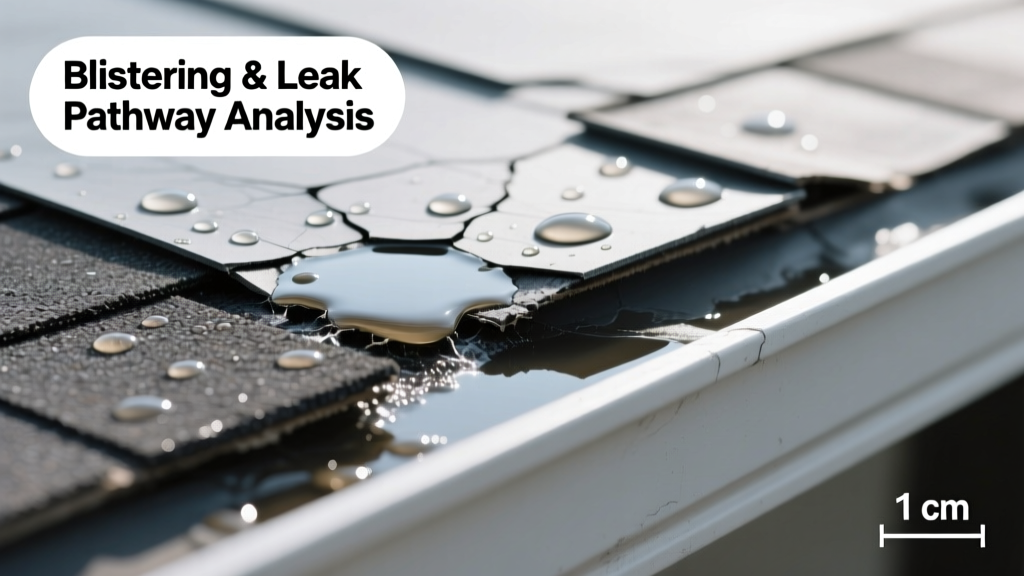
You spot a soft, raised bump on your flat roof—maybe two or three—and water’s now dripping through the ceiling below after rain. It’s alarming, but not necessarily catastrophic. Most blister-related leaks start small and progress slowly—giving you time to diagnose correctly before rot sets in or insulation gets saturated.
Quick Checklist
Answer these yes/no questions to narrow the root cause:
- Are blisters clustered near seams, drains, or rooftop equipment?
- Does water appear only during or immediately after rainfall—not days later?
- Is the membrane around blisters cracked, chalky, or visibly separating from the substrate?
- Do you see dark staining or mineral deposits on the blister surface?
- Has the roof been patched or coated within the last 3 years?
- Is there standing water visible on the roof more than 48 hours after rain?
Possible Causes
Trapped moisture under membrane (most common)
Moisture migrates upward from wet insulation or deck, vaporizes under sun, and lifts the membrane into blisters. Confirm by pressing gently: if it feels spongy or releases steam when punctured (don’t do this—just observe), that’s your clue. Severity: Moderate—DIY monitoring is possible, but repair requires professional membrane replacement or re-adhesion. Fix trapped moisture blisters.
Failed adhesive or poor installation
Blisters form where roofing membrane wasn’t fully bonded—often at laps or corners. Look for linear blistering along seams or edges. Confirm with a magnet test: if the membrane lifts easily with light pressure and reveals bare deck or old adhesive residue, bond failure is likely. Severity: High—requires full section reinstallation. Repair failed adhesive bonds.
UV degradation + thermal cycling
Older EPDM or modified bitumen roofs blister as plasticizers leach out and membranes shrink/expand unevenly. Blisters appear randomly, often with surface cracking or alligatoring. Confirm by checking roof age: if over 12 years old and uncoated, this is probable. Severity: Low–Moderate—coating may extend life, but replacement is often more cost-effective. Restore UV-damaged flat roofs.
What to Do First
Act within 24–48 hours to prevent secondary damage:
- Mark blister locations with chalk or flag tape—don’t walk on them.
- Inspect interior ceilings and walls directly below for new stains, sagging, or musty odors.
- Clear roof drains and scuppers—clogged outlets raise hydrostatic pressure, forcing water into blisters.
- Place buckets under active drips and document timing/duration relative to rainfall.
According to the National Roofing Contractors Association’s 2022 Roofing Handbook, 68% of flat roof leaks attributed to blistering were misdiagnosed as membrane failure—when the real culprit was clogged drainage or wet insulation beneath.
What NOT to Do
- Don’t pop or puncture blisters—they’ll admit more moisture and accelerate delamination.
- Don’t apply roof cement or caulk over blisters—it traps heat and moisture underneath.
- Don’t assume one blister means only one problem—blisters rarely occur in isolation; scan the entire roof surface.
- Don’t delay interior inspection—even if no leak is visible yet, moisture may be migrating laterally through insulation.
Why does water leak *only* from certain blisters and not others?
Blisters become leak points only when the membrane tears—usually at the blister’s edge due to expansion stress or foot traffic. A blister without a tear may hold vapor indefinitely. That’s why some stay dry for months while adjacent ones drip after minor temperature shifts. Check for hairline splits with a magnifying glass and flashlight.
Can blistering happen on a brand-new flat roof?
Yes—and it’s usually installer error. The U.S. Department of Housing and Urban Development’s Roofing Quality Assurance Guide (2021) cites improper primer drying time and high-humidity application as top causes of early blistering in new builds. If your roof is under warranty, request an infrared moisture scan before accepting final sign-off.
Is roof coating a fix for blistering?
Only if blisters are fully deflated, dry, and stable—and even then, only as a temporary measure. Coatings bridge small cracks but add weight and heat retention, which can worsen underlying moisture issues. A 2023 study by the Cool Roof Rating Council found coated blistered roofs failed 3.2× faster than recoated non-blistered sections.
How long can I wait before repairing blister-related leaks?
Depends on blister size and location. Small, isolated blisters (<6” diameter) with no interior signs may buy you 3–6 months. But once water reaches structural decking or wood framing, decay begins within 72 hours. If you see brown staining on ceiling drywall or hear squishy sounds when walking upstairs, treat it as urgent.
Will insurance cover blister-related roof leaks?
Rarely—if blisters stem from maintenance neglect (e.g., unchecked ponding, failed flashings, or deferred repairs), insurers deny claims. But sudden storm-related blister rupture with documented pre-loss condition photos may qualify. Document everything before contacting your provider. How to file a roof leak insurance claim.
Should I get an infrared roof scan?
Yes—if you have multiple blisters or suspect hidden moisture. Infrared scans detect thermal anomalies indicating trapped water beneath the membrane. Cost averages $350–$600, but it prevents unnecessary tear-offs. Licensed thermographers certified by the Infraspection Institute (2024 standard) deliver actionable reports—not just pretty pictures.
Blistering isn’t always the villain—it’s often the symptom pointing to deeper issues like drainage flaws, aging materials, or moisture migration. Diagnose accurately first, then act decisively. And remember: every minute spent observing is time saved on misdirected repairs.