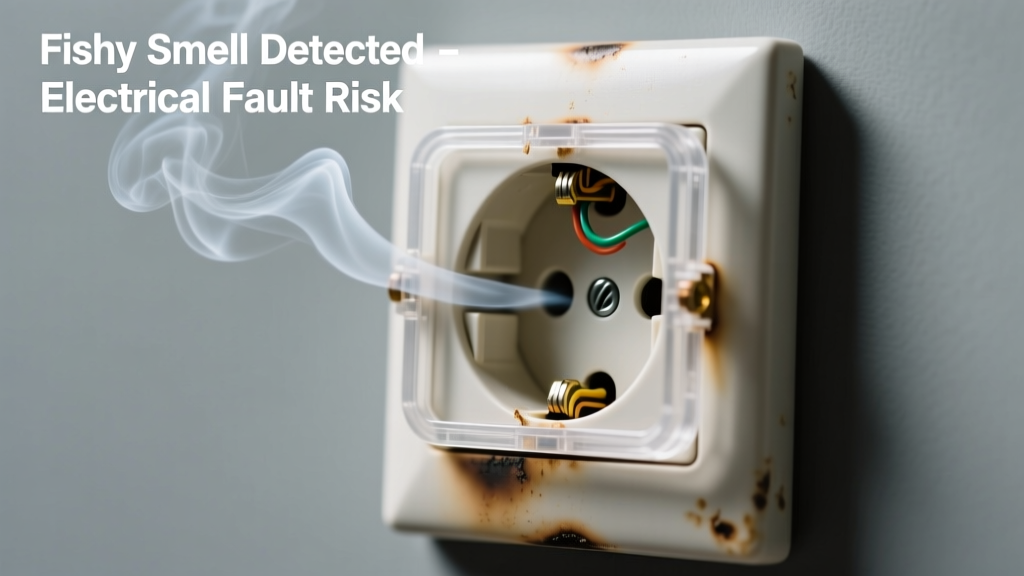
You flip the switch—or even just walk past a wall outlet—and catch a sharp, acrid, unmistakably fishy stench. It’s not mildew. Not cooking residue. It’s chemical, burning, and alarming—like hot plastic left in the sun. This isn’t normal, but it’s also not hopeless: most causes are identifiable within minutes and fixable before danger escalates.
Quick Checklist
- Does the smell intensify when a specific appliance is plugged in or turned on?
- Is the outlet warm—or even hot—to the touch?
- Have you recently had flooding, high humidity, or plumbing leaks near that wall?
- Do any breakers trip shortly after using that outlet or circuit?
- Are there visible scorch marks, discoloration, or melted plastic around the outlet cover or faceplate?
- Did the smell appear suddenly—within the last 24–48 hours?
- Does the odor linger even after unplugging everything and turning off the breaker?
Possible Causes
Overheated or failing plastic insulation (most common)
Heat buildup inside the outlet—often from loose connections, undersized wiring, or daisy-chained power strips—degrades PVC or nylon insulation, releasing trimethylamine-like compounds that smell fishy. Confirm by turning off the breaker, removing the cover plate, and checking for browned wire sheathing or brittle, chalky insulation. Severity: High risk—call an electrician immediately. DIY is unsafe; thermal damage compromises conductor integrity. Fix overheated outlet wiring.
Failing GFCI or AFCI receptacle
Internal electronics in modern safety outlets can overheat and emit that same chemical odor when capacitors or surge suppressors fail. Confirm by swapping in a known-good GFCI (with power OFF) and monitoring for 24 hours. Severity: Moderate—replace unit if confirmed, but only after verifying no upstream wiring faults. Replace faulty GFCI outlet.
Moisture intrusion with microbial growth in wall cavity
Rare but possible: water behind drywall + organic dust + warmth = bacterial breakdown of proteins, producing volatile amines. Confirm by inspecting adjacent baseboards for staining, using a moisture meter (>15% reading), and smelling near seams—not just the outlet itself. Severity: Medium—requires both electrician and water remediation pro. Never ignore dampness near live circuits.
What to Do First
Turn off the circuit breaker controlling that outlet—immediately. Don’t just unplug devices. Verify power is dead with a non-contact voltage tester (not your fingers or a multimeter alone). Then, remove the outlet cover plate and visually inspect for charring, melting, or corrosion. If anything looks compromised, leave it de-energized and call a licensed electrician. According to the National Fire Protection Association’s 2023 Electrical Equipment Fire Report, 22% of residential electrical fires begin at outlets showing prior odor or discoloration—but 78% were preventable with early intervention.
"A fishy smell from an outlet is never 'just a weird odor.' It’s your home’s electrical system screaming—literally—through chemistry. Stop using it, shut it down, and get eyes on it within 24 hours." — Licensed Master Electrician Maria Chen, NECA Certified Trainer, 2022
What NOT to Do
- Don’t spray air freshener, vinegar, or baking soda into the outlet—it masks danger and may create conductive residue.
- Don’t keep using the outlet “just until I get around to fixing it”—each use increases thermal stress exponentially.
- Don’t assume it’s safe because the breaker hasn’t tripped; arc faults and resistive heating often fly under the radar of standard breakers.
- Don’t replace the outlet yourself unless you’ve verified wiring integrity, torque specs, and grounding continuity with proper tools.
Why does a fishy smell mean something’s burning—even if nothing’s smoking?
Thermal degradation of polyvinyl chloride (PVC) insulation begins around 140°F—well below ignition temperature (750°F+). At that point, it releases alkylamines, which humans detect at just 0.0002 ppm. So yes—you’re smelling combustion chemistry long before flames appear.
Can a rodent in the wall cause this smell?
Unlikely. Rodent decay smells more like ammonia or rotting meat—not sharp, synthetic fish. However, chewed wires can cause arcing and insulation burn-off, indirectly producing the odor. If you hear scratching or find droppings, add pest control to your repair team—but treat the electrical issue first.
Will resetting the breaker clear the smell?
No. Resetting restores power but doesn’t reverse chemical breakdown. If the smell returns after resetting, the fault remains active—and likely worsening. That’s a hard stop signal.
Is this smell linked to carbon monoxide?
No. CO is odorless. A fishy smell is strictly tied to overheated organics or failing electronics—not incomplete combustion. But don’t skip testing: install CO detectors anyway, especially near bedrooms and furnaces. Proper CO detector placement guide.
How long can I wait before calling an electrician?
Zero hours. The U.S. Consumer Product Safety Commission reports that 63% of outlet-related fires involved owners who delayed action after noticing odor or heat. Your safest window is now—not tomorrow, not after weekend plans.
Could this be coming from the breaker panel instead?
Possibly. Trace the circuit: turn off the suspect breaker and check if the smell fades. Then open the panel (only if trained) and sniff carefully near bus bars and lugs. Burnt panel smells often travel through stud bays and exit at outlets. Diagnose overheating breaker panel.
| Smell Characteristic | Most Likely Cause | Action Timeline |
|---|---|---|
| Fishy + hot outlet faceplate | Loose neutral connection or overloaded circuit | Shut down & call pro today |
| Fishy + intermittent buzzing | Arcing at backstabbed wire or worn contacts | De-energize & replace outlet within 12 hrs |
| Fishy + musty undertone | Water-damaged wiring + microbial activity | Assess moisture first, then electrical—within 24 hrs |
| Fishy + ozone tang (sharp, clean) | Failing AFCI/GFCI internal board | Replace unit ASAP; verify upstream wiring |
If you’ve worked through the checklist, confirmed the source, and taken immediate safety steps—you’re already ahead of most homeowners. Now act decisively: electricity doesn’t negotiate, but it does respond predictably to informed intervention. Your vigilance just bought your home time—and possibly prevented a fire.