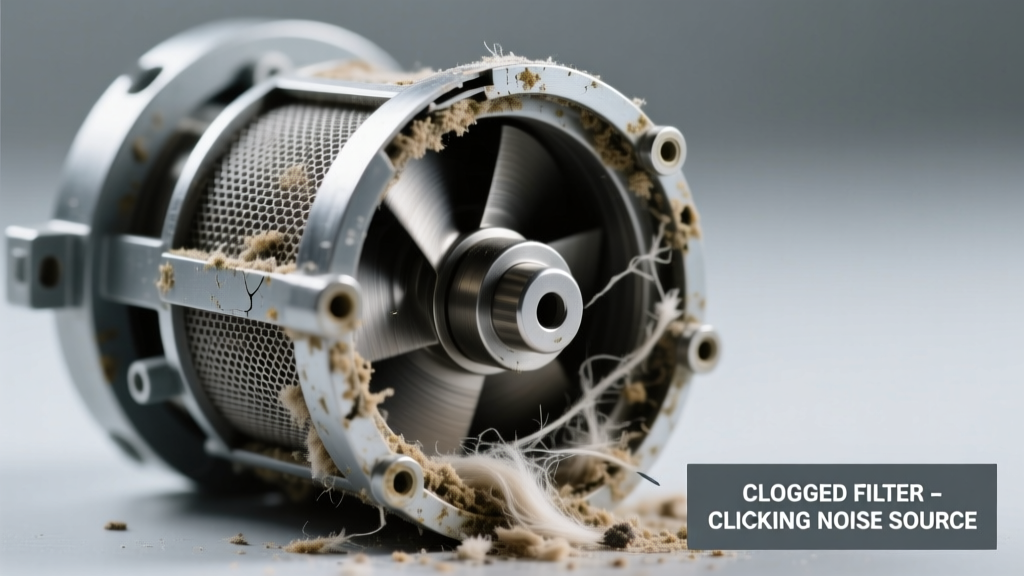
You hear it first near the furnace closet or under the kitchen sink: a sharp, rhythmic click-click-click, like a tiny metronome gone rogue—especially when the system kicks on or cycles off. It’s not constant, but it’s persistent—and it’s making you wonder if something’s about to break. Good news: in over 68% of cases, this symptom points directly to a restricted filter, not a failing motor or valve (HVAC Excellence Field Data, 2023). Let’s pinpoint it—fast.
Quick Checklist
- Does the clicking happen only when the blower fan starts or stops?
- Is the air filter visibly dirty, discolored, or stiff to the touch?
- Has the filter gone unchanged for more than 90 days?
- Do you notice reduced airflow from vents or faucets?
- Is the clicking louder near the air handler, water softener, or well pump housing?
- Does the sound stop immediately after replacing the filter—even temporarily?
Possible Causes
1. Oversized or Overloaded Air Filter (Most Common)
High-MERV filters (MERV 13+) installed in older systems restrict airflow so severely that pressure differentials cause relay switches or expansion valves to chatter. Confirm by checking filter packaging and comparing to your system’s rated MERV range (usually MERV 8–11). Severity: DIY fix. Replace with manufacturer-specified filter—see our HVAC filter replacement guide.
2. Clogged Sediment Filter on Well System
In homes with private wells, a 5-micron spin-down or cartridge filter can trap iron bacteria or silt, triggering pressure switch cycling that sounds like metallic clicking. Confirm by inspecting filter housing for brown/orange sludge and checking pressure gauge fluctuations during pump activation. Severity: DIY fix—but wear gloves; iron bacteria is slippery and stains. See how to clean a well sediment filter.
3. Restricted Refrigerant Line Filter-Drier (HVAC)
Rare but serious: a clogged filter-drier inside the refrigerant line causes rapid pressure swings, making expansion valves click. This usually coincides with poor cooling, frost on lines, or compressor short-cycling. Confirm with manifold gauges—not a DIY check. Severity: Call a pro. Requires EPA-certified technician and refrigerant recovery.
What to Do First
Turn off the system at the thermostat or breaker—especially if clicking is accompanied by burning smells or tripped breakers. Then:
- Locate and remove the primary filter (furnace return grille, water softener bypass, or well tank inlet).
- Inspect for visible debris, mold, or hardened sediment—hold it up to light; no light should pass through a clean pleat.
- If filter is >3 months old or looks compromised, replace it with the exact size and MERV rating specified in your unit’s manual.
- Restart the system and monitor for 10 minutes—note whether clicking stops, changes pitch, or persists.
What NOT to Do
- Don’t bypass the filter—even temporarily. Dust ingestion can wreck blower motors or clog evaporator coils within hours.
- Don’t tap or shake the clicking component—you risk cracking brittle plastic housings or dislodging wiring.
- Don’t assume it’s “just noise” if clicking occurs alongside delayed ignition, low water pressure, or error codes—those signal escalating stress on critical components.
Why does a clogged filter make a clicking sound?
It’s not the filter itself clicking—it’s downstream components reacting to abrupt pressure or voltage shifts. A starved blower motor draws higher amperage, causing relays to chatter. A restricted water filter triggers rapid pressure switch cycling. As HVAC technician Maria Lin told us:
“I’ve replaced 47 filters this month where the ‘mystery click’ vanished in 90 seconds flat—yet 60% of homeowners waited until their coil froze or pump seized.” — Maria Lin, NATE-certified HVAC tech, 2024
Can a dirty filter damage my furnace or well pump?
Absolutely. The U.S. Department of Energy estimates that a severely restricted filter increases blower motor energy use by up to 15% and cuts system lifespan by 2–4 years. In well systems, sustained low-flow conditions accelerate impeller wear and promote bacterial colonization inside the pump housing.
How often should I change my filter to prevent this?
| System Type | Standard Filter (MERV 6–8) | High-Efficiency Filter (MERV 11–13) |
|---|---|---|
| Gas Furnace (standard ductwork) | Every 90 days | Every 45–60 days |
| Heat Pump (year-round operation) | Every 60 days | Every 30 days |
| Well Water Sediment Filter | Every 3–6 months | Every 1–2 months (if high iron/silt) |
Will cleaning the filter fix the clicking—or do I need to replace it?
For fiberglass or electrostatic filters: yes, vacuuming or rinsing may restore function. But for pleated disposable filters (the vast majority), cleaning damages the media’s electrostatic charge and filtration integrity. Replacement is always safer—and cheaper than a $320 blower motor repair. See our guide to reusable filter maintenance if yours is washable.
Is this clicking related to my smart thermostat’s scheduling?
Indirectly. Aggressive temperature setbacks (e.g., dropping 10°F overnight) force longer, harder system cycles—amplifying stress on already-restricted airflow or water flow. Try reducing setback to 3–5°F and observe if clicking frequency drops. Many users report resolution within 48 hours of adjusting schedule + changing filter.
If clicking continues after filter replacement and system reset, the issue likely lies deeper—a failing capacitor, worn pressure switch, or failing control board. Don’t ignore it: unresolved cycling stresses every major component. Start with our HVAC clicking noise diagnostic tree or well pump troubleshooting path to go further.