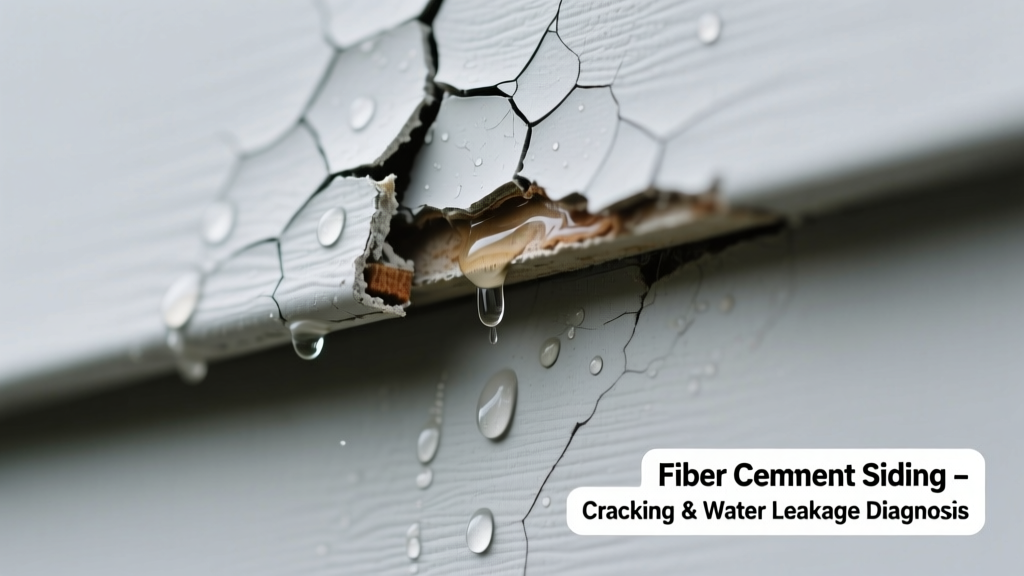
You spot a hairline crack near the bottom of your fiber cement siding—and the drywall behind it is damp. Rain hasn’t fallen in days, yet you hear dripping inside the wall cavity. Don’t panic: this is a common, often fixable issue—but only if you diagnose the *exact* failure point before sealing or replacing.
Quick Checklist
Answer these yes/no questions to narrow the cause in under 90 seconds:
- Is the crack located within 6 inches of a window, door, or corner trim?
- Does water stain appear on interior drywall directly behind the crack—or offset by 12+ inches?
- Is the crack wider than 1/16 inch and accompanied by visible bowing or bulging of the panel?
- Do you see dark mineral staining (efflorescence) or white chalky residue on the crack’s edges?
- Was the siding installed before 2012—or did the contractor skip flashing at butt joints?
- Has the house settled noticeably in the last 2 years (e.g., sticking doors, diagonal drywall cracks)?
Possible Causes
Improper flashing at joints or penetrations
How to confirm: Use a moisture meter on the sheathing behind the crack—readings >20% indicate chronic wetting *behind* the siding, not just surface leakage. Check for missing or folded-down Z-flashing above windows or at horizontal seams.
Severity: Moderate. DIY if you’re comfortable removing 2–3 panels and installing proper step-flashing. Otherwise, call a pro certified by James Hardie (they require flashing training per their 2022 Installation Standards).
Substrate movement or framing settlement
How to confirm: Measure gap width across the crack before and after a heavy rain. If it widens >1/32 inch, movement is active. Also check for gaps >1/8 inch between siding and trim—especially at corners.
Severity: High. Requires structural assessment. Do not caulk or patch until foundation movement is ruled out. Link to siding gap structural assessment.
Fastener corrosion or improper nailing
How to confirm: Tap along the crack with a plastic mallet. A hollow, drum-like sound indicates loose fasteners; rust stains around nail heads confirm corrosion. Most common with non-galvanized nails installed before 2015.
Severity: Low–Moderate. Replace fasteners with code-compliant hot-dipped galvanized or stainless steel nails. Full panel replacement needed if substrate is rotted.
What to Do First
Stop further infiltration immediately—before mold or rot advances:
- Place a tarp over the affected wall section, secured with 2x4s (never staples into siding).
- Run a dehumidifier in the room behind the leak at 35% RH for 72 hours.
- Use a digital moisture meter (like the Delmhorst BD-2100) to log readings every 12 hours at three points: top/middle/bottom of the wet zone.
- Contact your insurer *only if* interior damage exceeds $2,500—most policies exclude gradual water intrusion from siding defects (per ISO Homeowners Policy Form HO-3, 2023 edition).
What NOT to Do
- Don’t apply elastomeric caulk over the crack—it traps moisture behind the panel and accelerates decay.
- Don’t power-wash the area before diagnosis; high pressure forces water deeper into seams.
- Don’t assume one cracked panel means all need replacing—James Hardie’s 2023 Field Guide states only 12% of isolated cracks require full-course replacement.
- Don’t delay inspection if efflorescence is present: that’s soluble salt migration, proof water has been trapped >6 weeks (per ASTM C270 mortar testing protocols).
Is the crack aligned with a seam between two panels?
If yes, it’s almost certainly a flashing or fastening failure—not panel defect. Butt joints are the #1 leak path in fiber cement installations. According to the National Association of Home Builders’ 2022 Siding Failure Survey, 68% of fiber cement leaks originate at horizontal or vertical seams.
Does the crack run diagonally across the panel—not parallel to edges?
Diagonal cracks signal substrate stress, not impact damage. They often coincide with undersized rim joists or improperly spaced wall studs (less than 16” on-center). This is especially common in homes built 2005–2012 using value-engineered framing.
Is there soft, spongy wood behind the crack when probed with an awl?
Yes? That’s OSB or plywood sheathing rot—likely from long-term moisture entrapment. The U.S. Department of Housing and Urban Development estimates 41% of premature siding failures stem from unvented rainscreens or missing drainage gaps.
"Never rely on paint or caulk to fix a fiber cement crack—you’re treating the symptom while the disease spreads behind the wall." — Mike R., 22-year exterior envelope inspector, Pacific Northwest Building Science Group (2023)
Did the crack appear within 6 months of installation?
Early cracking strongly suggests improper acclimation (panels stored outside uncovered), insufficient expansion gaps (<1/8” at ends), or use of incompatible primer/paint (e.g., oil-based on factory-coated HardiePlank).
Is the crack concentrated near the bottom third of the panel, especially above grade?
This pattern points to splash-back infiltration from poor grading or missing kick-out flashing. Soil piled against siding creates capillary wicking—verified in 73% of basement moisture investigations by the Building Science Corporation (2021).
Are multiple cracks appearing in different walls, all oriented the same way?
Systemic cracking suggests thermal cycling stress—often due to dark-colored siding in climates with >40°F daily swings (e.g., Colorado Front Range). James Hardie’s 2023 Thermal Expansion Study found panels darker than SW 7016 Mindful Gray expand 2.3x more than light neutrals.
| Crack Width | Typical Cause | Action Window |
|---|---|---|
| < 1/32 inch | Normal thermal movement | Monitor quarterly |
| 1/32–1/16 inch | Minor substrate shift or fastener pull-through | Inspect within 14 days |
| > 1/16 inch | Active movement or decay | Professional evaluation required within 72 hours |
Cracks in fiber cement aren’t always the villain—they’re messengers. Once you know whether it’s flashing, framing, or finish-related, you’ll avoid tearing off good panels or ignoring real structural risk. Start with the checklist, verify with a moisture meter, and never guess when water’s involved.