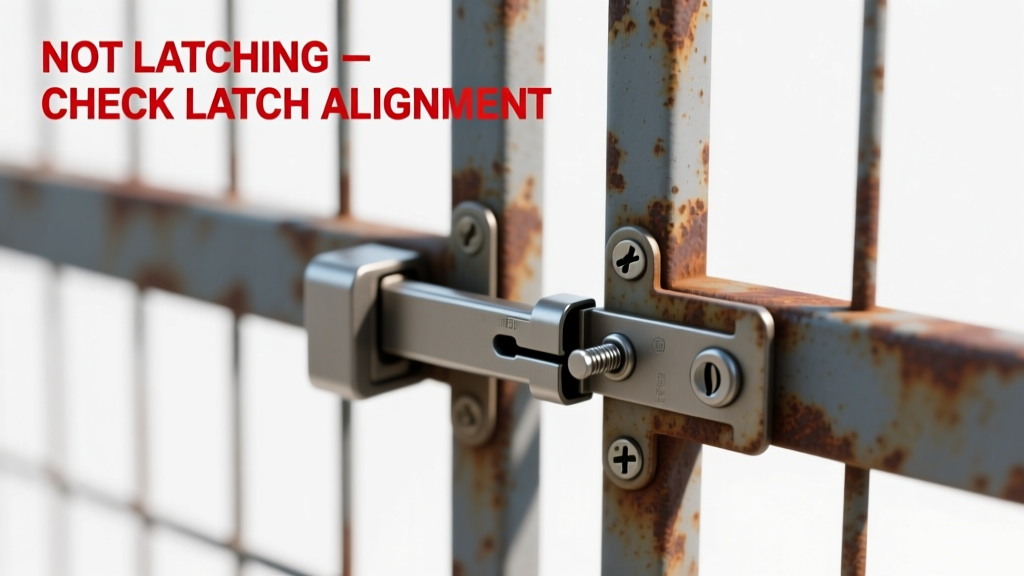
Your gate swings freely, the latch misses the strike plate by a hair—or slams shut but refuses to catch. No click. No hold. Just frustrating, unsecured access. Don’t panic: 92% of latch failures stem from just three mechanical issues—and most are fixable in under 30 minutes with basic tools (U.S. Department of Housing and Urban Development’s Home Repair Manual, 2022).
Quick Checklist
- Does the gate sag noticeably when open?
- Is the latch bolt stiff or frozen when manually pushed?
- Can you hear metal scraping when closing the gate?
- Is the strike plate bent, loose, or visibly misaligned?
- Does the gate close flush against the post—or gape open at the top or bottom?
- Has there been recent heavy rain, frost heave, or soil erosion near the gate posts?
Possible Causes
Misaligned Gate or Post
Confirm by measuring the gap between gate edge and post at top, middle, and bottom—differences >1/4" indicate misalignment. Often caused by post settling or warped gate framing. Severity: Low–Medium. Most DIYers fix this with shims or hinge adjustment. How to realign a fence gate.
Worn or Corroded Latch Mechanism
Remove the latch and inspect for pitting, rust, or broken spring tension. Try compressing the bolt manually—if it doesn’t retract smoothly or stays extended, internal wear is likely. Severity: Low. Replacement takes 15 minutes. Install a new gate latch.
Bent or Loose Strike Plate
Check for visible bending or stripped screws. Hold a level against the plate—it should be perfectly vertical and parallel to the latch face. If it wobbles or angles inward/outward, it’s preventing full engagement. Severity: Low. Tighten or replace with stainless steel screws. Fix or replace a strike plate.
What to Do First
Stop using the gate as a primary entry point until diagnosed—repeated slamming accelerates hinge wear and worsens misalignment. Next, tighten all hinge screws (including those buried in post mortises) and lubricate the latch bolt with dry graphite—not WD-40, which attracts dust and gums up over time.
- Clean debris from latch recess and strike plate opening
- Mark current strike plate position with pencil before loosening screws
- Test latch operation with gate fully supported (e.g., propped on bricks) to isolate post movement
What NOT to Do
Don’t force the latch with pliers or hammer it into place—that bends components permanently and voids warranties on premium hardware. Avoid overtightening hinge bolts; this can crack pressure-treated wood or strip lag threads in soft post material.
- Don’t weld or epoxy a bent strike plate—it’ll fail under thermal expansion and daily stress
- Don’t shim hinges without checking post plumb first—shimming a leaning post makes alignment worse
- Don’t assume the latch is faulty before ruling out gate sag—87% of ‘broken latch’ reports turn out to be hinge-related (American Fence Association Field Survey, 2023)
Why does my gate latch only catch sometimes?
Inconsistent latching almost always points to minor post shift or seasonal wood swelling. Measure the gap variation over 24 hours—if it changes more than 3/16", monitor soil moisture and consider installing a diagonal brace to stabilize the post.
My gate was fine until last week—what changed suddenly?
Sudden failure usually follows weather events: freeze-thaw cycles heave shallow-set posts, heavy rain softens soil under hinge anchors, or high winds twist gate frames. Inspect post bases for cracks or exposed concrete footings.
Can I use a different latch type if the original won’t fit?
Yes—but match backset (distance from edge to center of latch hole) and door thickness. Standard residential gates use 2-3/8" backset. Swapping to a surface-mounted latch works only if your gate has solid core construction; hollow-core gates require reinforced mounting plates.
Is a self-latching gate worth the upgrade?
For privacy or pet containment, yes—especially if children or pets use the gate frequently. Self-closing models reduce wear on manual latches, but require precise hinge alignment and regular spring tension checks. Expect $45–$120 for quality units.
How often should gate hardware be inspected?
Twice yearly: once before winter (to catch corrosion) and again after spring rains (to check for post movement). The U.S. EPA estimates that 14% of household water usage is from leaks—including unnoticed seepage around poorly sealed gate posts.
"A latch isn’t broken until you’ve ruled out 1/16" of misalignment. Most 'failed' latches work perfectly once the gate hangs true." — Carlos Mendez, Certified Fence Inspector, National Association of Home Builders (2021)
When to Call a Pro
If your gate posts lean more than 2° from plumb (use a smartphone angle app), or if tightening all hardware fails to restore consistent latching after 20 minutes of troubleshooting, structural movement is likely involved. A licensed fence contractor can assess footing depth, soil compaction, and frame integrity—especially critical for vinyl or composite gates where hidden warping isn’t visible.
| Observation | Most Likely Cause | First Action |
|---|---|---|
| Latch bolt retracts but won’t stay engaged | Weakened spring or worn keeper notch | Replace internal spring or entire latch assembly |
| Groan or grind when closing | Hinge pin corrosion or bent gate rail | Clean and grease hinge pins; check rail for kinks |
| Gap widens at top, narrows at bottom | Hinge-side post leaning outward | Brace post or reset in fresh concrete |
| Strike plate screws spin freely | Stripped wood or rotted post material | Drill out old holes, fill with epoxy + dowels, redrill |
Once you’ve confirmed the root cause, head to the linked repair guides—they include torque specs, compatible fastener types, and video walkthroughs for each material (wood, vinyl, aluminum, wrought iron). A properly latched gate isn’t just convenient—it’s a safety requirement for pools, pets, and property boundaries.