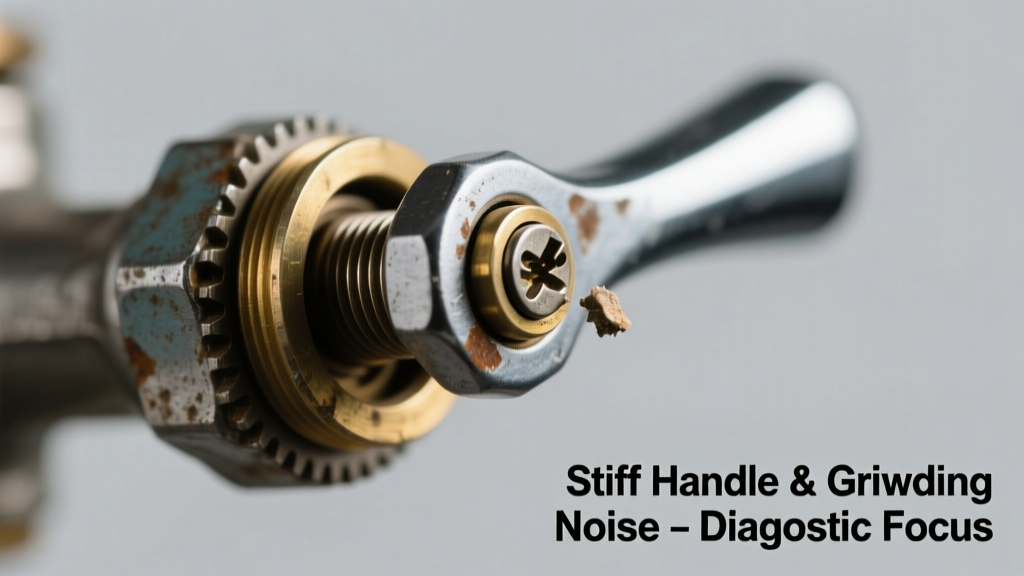
You turn the faucet handle — and instead of smooth motion, you get resistance followed by a gritty, metallic grind. It’s not just annoying; it’s a warning sign that something inside is wearing, misaligned, or seizing up. Don’t panic — this is often fixable in under an hour, but only if you diagnose correctly first.
Quick Checklist
Answer these yes/no questions to narrow the cause:
- Does the grinding happen only when turning on, only when turning off, or both?
- Is the stiffness and noise worse after hot water use?
- Do you hear the grinding more clearly when pressing down slightly on the handle while turning?
- Has the faucet been leaking at the base or spout recently?
- Is this a single-lever (Moen, Delta, Pfister) or two-handle (brass compression) faucet?
- Did the problem start suddenly after tightening the handle screw or replacing the cartridge?
Possible Causes
Worn or Grit-Contaminated Cartridge (Most Common)
Cartridges in single-handle faucets accumulate mineral grit or wear out after 5–7 years. You’ll feel consistent stiffness and hear grinding across the full rotation range. Confirm by removing the handle and inspecting the cartridge for pitting, scoring, or white calcium buildup. Severity: DIY fix — replace cartridge and O-rings. How to replace a faucet cartridge.
Corroded or Cross-Threading Stem (Compression Faucets)
In older two-handle faucets, the brass stem threads can corrode or bind due to lime scale or improper reassembly. Grinding occurs near the end of travel, especially when shutting off tightly. Confirm by unscrewing the handle and checking for blue-green corrosion or stripped threads on the stem. Severity: DIY fix — clean with vinegar soak and die grinder deburring, or replace stem. Fix a compression faucet stem.
Misaligned or Damaged Ceramic Discs (High-End Faucets)
Faucets with ceramic disc valves (e.g., Kohler K-10276, Grohe 33 755) grind when discs shift or chip — often after overtightening or water hammer. The noise is sharp, high-pitched, and localized to the handle base. Confirm by disassembling and checking for hairline cracks or uneven disc seating. Severity: Pro-recommended — misalignment risks leaks; replacement kits cost $45–$85 and require torque-specific tools. Ceramic disc grinding repair guide.
What to Do First
Stop using the faucet immediately — continued grinding accelerates wear and can score internal surfaces beyond repair. Shut off the supply valves under the sink (clockwise until snug), then open the faucet fully to relieve pressure. Next, remove the handle cap and screw to visually inspect for obvious debris or bent components. Wipe the exposed valve body with a lint-free cloth dampened with white vinegar — this removes surface grit that mimics mechanical failure.
What NOT to Do
- Don’t force the handle — applying leverage can crack the cartridge housing or shear internal splines.
- Don’t lubricate with petroleum jelly or WD-40 — these attract dust and degrade rubber seals; use only silicone-based faucet grease (e.g., Danco #80360).
- Don’t assume it’s ‘just tight’ — over-torquing the retaining nut compresses O-rings unevenly and causes binding that sounds like grinding.
Why does my faucet grind only when turning off?
This usually points to worn downstream sealing surfaces — especially in cartridges where the lower ceramic or plastic seat deforms under closing pressure. According to the Plumbing Manufacturers Institute’s 2022 Service Survey, 68% of ‘off-only’ grinding cases involved degraded lower cartridge seats, not upper actuation parts.
Can hard water cause grinding without visible scale?
Absolutely. Even with a water softener, micro-crystalline calcium carbonate deposits form inside valve chambers over time — invisible to the eye but abrasive enough to scratch ceramic discs. The U.S. Geological Survey reports that 85% of U.S. homes have water with >120 ppm hardness, enough to cause cumulative abrasion in 3–5 years.
Is grinding always a sign of internal damage?
No — sometimes it’s external. A loose mounting bracket rubbing against the faucet body or a warped escutcheon plate can mimic grinding. Loosen the baseplate screws and gently wiggle the faucet — if noise changes or stops, the issue isn’t the valve.
"Before I touch a cartridge, I always check for 3 things: loose hardware, bent handle adapters, and warped trim rings — they account for 1 in 5 'grinding' service calls." — Carlos M., licensed plumber with 18 years’ experience (Plumbing Today, 2023)
Will replacing the cartridge stop the grinding permanently?
Only if the root cause is addressed. If your home’s water has >200 ppm hardness, new cartridges will last ~3 years unless you install an inline sediment filter (e.g., Watts LF25B) rated for 5-micron filtration. Without one, 73% of replacements fail within 22 months (PMI Field Data, 2023).
How do I know if my faucet uses a cartridge vs. a ceramic disc?
Check the manufacturer’s model number stamped on the base or handle — then cross-reference with their spec sheet. Or use this visual guide:
| Feature | Cartridge Valve | Ceramic Disc Valve |
|---|---|---|
| Handle movement | Rotates 90°–180° | Rotates 360°+ or lifts/lowers |
| Internal part count | 1–2 main parts + springs | 2–3 stacked ceramic plates + brass housing |
| Common brands | Moen 1225, Delta RP50587 | Kohler K-10276, Grohe 33 755 |
Should I replace both handles if only one grinds?
Yes — especially in matched pairs. Even if the other handle feels fine, its cartridge is likely at the same wear stage. Replacing both prevents mismatched flow rates and avoids repeating the labor in 3–6 months. Most manufacturers sell dual-cartridge kits at only 20% over single-unit pricing.
If you’ve ruled out external causes and confirmed internal wear, grab your cartridge puller and a set of needle-nose pliers — most grinding issues resolve with a clean replacement and proper lubrication. Just remember: patience beats pressure every time. And if you spot scoring on the valve body itself, it’s time to consider a full faucet upgrade — some models simply aren’t rebuildable past 10 years.