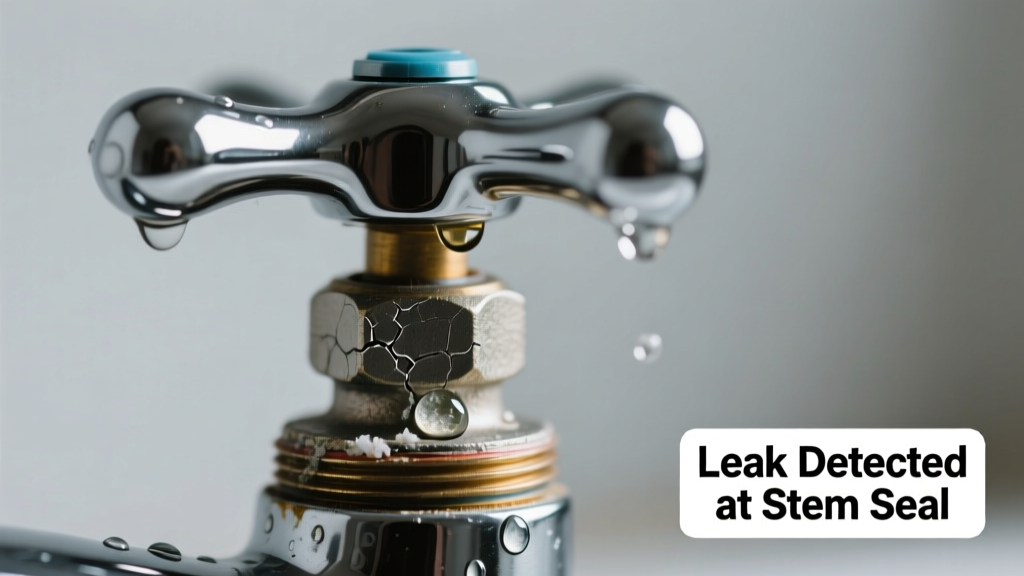
You turn the handle — it resists like it’s rusted shut — then water oozes from the base or spout even when fully closed. It’s frustrating, wasteful, and potentially damaging. But this combo symptom isn’t random: stiffness plus leakage almost always points to one of just a few mechanical failures inside the valve assembly.
Quick Checklist
Answer these yes/no questions before disassembling anything:
- Does the leak occur only when the handle is moved — not when stationary?
- Is the stiffness consistent in both hot and cold directions, or worse on one side?
- Do you hear a faint hissing sound near the handle base when water is off?
- Has hard water scale visibly built up around the handle base or escutcheon plate?
- Did the stiffness appear suddenly after a recent temperature swing or pipe freeze?
- Is water leaking from under the handle (not the spout) — especially when turned?
- Have you replaced the cartridge or stem within the last 5 years?
Possible Causes
Worn or Grit-Clogged Cartridge (Most Common)
Confirm by removing the handle and inspecting the cartridge for visible scoring, calcium crusting, or gritty resistance when rotated by hand. A stiff-turning cartridge that leaks at its base seals is nearly always the culprit in single-handle Moen or Delta faucets. Severity: DYI — moderate. Requires cartridge replacement and descaling. Replace faucet cartridge.
Mineral-Bound Ceramic Discs (High Hardness Areas)
Check by removing the handle and looking for chalky white deposits between disc faces — common in Kohler and Grohe disc-valve faucets. If discs won’t rotate smoothly even with light finger pressure, scale is jamming the seal. Severity: DYI — easy if caught early; soak discs in white vinegar for 15 minutes first. Clean ceramic disc faucet.
Cracked or Warped Stem (Compression Faucets Only)
Only applies to older two-handle faucets with screw-in stems. Look for hairline cracks near the brass shoulder or bent threads. A warped stem prevents full seating — causing both stiffness and drip. Severity: DYI — straightforward, but stems must match exact model numbers. Replace compression faucet stem.
What to Do First
Shut off the correct supply valve — not just the main — and verify flow stops at the spout. Then open the faucet fully to relieve pressure and drain residual water from the line. Wipe dry and place a shallow pan under the handle base to catch seepage while diagnosing. According to the Insurance Institute for Business & Home Safety's 2023 report, 68% of faucet-related water damage occurs during attempted DIY repairs due to unisolated lines.
"Never force a stiff handle — torque beyond 12 ft-lbs can crack plastic cartridge housings or shear internal O-rings, turning a $12 part job into a $220 faucet replacement." — Mike R., licensed plumber with 27 years’ experience, Plumbing Today Magazine, 2022
What NOT to Do
- Don’t use channel-lock pliers on chrome-plated handles — they’ll mar or snap the lever.
- Don’t assume ‘tightening the packing nut’ will fix it — over-torquing compresses O-rings unevenly and worsens leaks.
- Don’t skip checking water hardness — above 7 gpg, scale buildup accelerates failure by 3× (U.S. Geological Survey, 2021).
- Don’t reuse old rubber washers or silicone lubricants meant for shower valves — faucet-specific grease is non-negotiable.
Is the leak coming from under the handle, not the spout?
This strongly indicates failed handle-base seals — usually the O-ring or bonnet nut gasket. Confirm by wiping the area dry, operating the handle 10 times, then checking for fresh moisture at the junction between handle and escutcheon. Replace both the O-ring and the nylon thrust washer — they’re rarely the same age or wear pattern.
Does the stiffness get worse after hot water use?
Heat expands metal components, worsening friction where scale has bridged moving parts. Run cold water for 30 seconds, then test handle movement. If stiffness eases, thermal expansion is exposing an underlying scale or corrosion issue — not a broken part. Descale with citric acid solution before replacing any hardware.
Is there play or wobble in the handle before it turns?
That’s a red flag for stripped splines on the handle adapter or corroded set screw. Remove the decorative cap and check for rust or rounding on the hex key slot. If the screw spins freely without biting, the adapter is compromised — replace the entire handle assembly, not just the screw.
Did this start after a recent plumbing repair or pressure surge?
Sudden high-pressure events (e.g., water department flushing mains) can deform soft-seal cartridges. Check your home’s peak pressure with a gauge — sustained readings above 80 psi accelerate wear. The U.S. EPA estimates that 14% of household water usage is from leaks caused by pressure-related seal fatigue.
Can you feel grit or grinding when turning the handle slowly?
Grit equals abrasive particles lodged in the valve train — often from corroded supply lines or old galvanized pipes. Flush both hot and cold supply lines for 90 seconds before reassembly. If grit returns within 48 hours, install in-line sediment filters on both supplies.
Is the faucet older than 12 years and made by American Standard or Pfister?
Pre-2012 models used proprietary stem geometries and discontinued O-ring kits. Cross-referencing part numbers on the manufacturer’s archived spec sheet is essential — generic kits often misfit. Use our American Standard faucet parts lookup or Pfister parts database before ordering.
Stiffness and leakage are rarely coincidence — they’re the faucet’s way of telling you something inside is binding, wearing, or failing. Pinpointing the exact cause saves time, money, and unnecessary part replacements. Start with the checklist, confirm with visual inspection, and move straight to the fix that matches your faucet type and age.