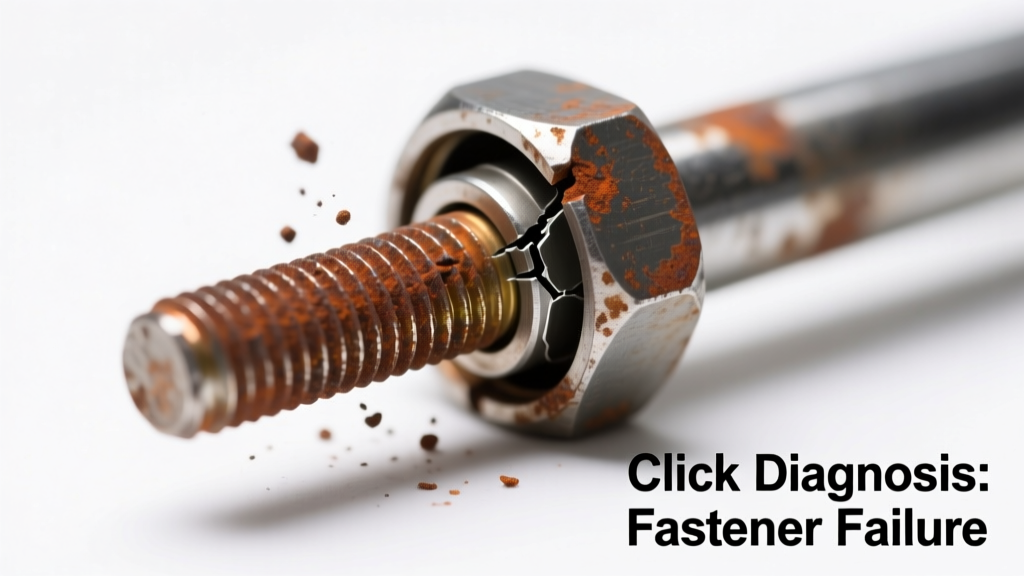
You’re walking across the hardwood floor and hear a sharp, rhythmic click-click-click—like a loose coin rattling inside a metal box. It only happens when weight shifts or temperature changes. That sound isn’t just annoying—it’s your home’s way of warning you about corrosion creeping into structural or mechanical connections.
Quick Checklist
- Does the clicking happen only under load (e.g., stepping on a stair tread or closing a cabinet door)?
- Is the sound localized near metal hardware—hinges, brackets, railings, or deck screws?
- Can you see orange-brown rust, flaking, or white powdery residue (oxide buildup) on visible fasteners?
- Does the noise worsen in humid weather or after rain?
- Do nearby surfaces feel loose, wobbly, or slightly raised when pressed?
- Has the component been exposed to salt air, de-icing chemicals, or unsealed outdoor moisture for >2 years?
Possible Causes
Rusted hinge pin or screw in exterior door hinge
Confirm by opening the door fully and gently rocking it side-to-side while listening at each hinge. Look for pitting or seized movement in the pin. Severity: Low—DIY fix with penetrating oil and replacement hardware. Replace rusted door hinge
Corroded lag bolt in deck ledger board connection
Tap the ledger board with a rubber mallet; a hollow or inconsistent ring suggests compromised fasteners. Check for rust streaks down the wall sheathing. Severity: High—call a structural pro. The U.S. Department of Housing and Urban Development reports 18% of deck collapses involve failed ledger-to-house connections (HUD Field Inspection Guide, 2022). Fix ledger board fasteners
Oxidized drywall screw in ceiling fan mounting bracket
Turn off power, remove canopy cover, and inspect for rust around the mounting screws and bracket ears. If the bracket flexes more than 1/8" under light pressure, corrosion has weakened the hold. Severity: Medium—replace bracket and use stainless steel screws. Secure loose ceiling fan
What to Do First
Stop applying load to the affected area immediately. For stairs or railings, cordon off the zone with tape. For doors or cabinets, avoid full-swing operation until inspected. Then:
- Clean surface rust with a wire brush and white vinegar soak (5–10 minutes).
- Dry thoroughly with compressed air or lint-free cloth.
- Apply CRC 3-36 or Boeshield T-9 to displace moisture and inhibit further oxidation.
- Mark the fastener location with painter’s tape labeled “RUST CHECK” for follow-up.
What NOT to Do
- Don’t force movement—twisting or hammering a rust-seized fastener can snap the shank or strip threads.
- Don’t spray WD-40 alone and assume it’s fixed—WD-40 displaces water but offers minimal long-term corrosion resistance (per ASTM D665 rust-inhibiting tests, 2021).
- Don’t ignore moisture sources—even indoor humidity above 60% RH accelerates galvanic corrosion in mixed-metal assemblies (ASHRAE Handbook, 2023).
Is the clicking sound coming from my garage door track?
Yes—if it occurs during upward travel and coincides with roller passage over a bent or rust-pitted section of track. Inspect the top 24 inches of vertical track for orange scaling or flaking. Replace rollers and clean track with mineral spirits before re-lubricating with lithium grease.
Why does the clicking only happen in the morning?
Temperature-driven contraction makes rust-jointed parts shift microscopically as ambient air cools overnight. Metal expands when warmed, compressing rust layers and releasing stored energy as audible clicks. This is especially common with aluminum-to-steel fasteners in coastal homes.
Can rusted drywall screws cause ceiling tiles to click?
Rare—but possible if the grid is mounted directly to rusted furring strips or if screws holding suspension wires have oxidized and lost grip. Tap the tile edges: a dull thud versus a crisp tap indicates compromised support. Replace all fasteners within 12 inches of any rust spot.
My patio umbrella base makes a clicking noise when I tilt it—could rust be the culprit?
Very likely. Umbrella tilt mechanisms rely on stainless or zinc-plated pivot pins. Salt exposure corrodes plating in as little as 6 months, causing gritty, intermittent engagement. Disassemble, soak pins in Evapo-Rust for 2 hours, then replace with marine-grade 316 stainless hardware.
Will painting over rusted screws stop the clicking?
No—paint seals moisture in and masks worsening corrosion. According to the National Association of Home Builders’ 2023 Fastener Performance Study, painted-over rusted fasteners fail 3.2× faster than untreated ones due to trapped electrolytes accelerating galvanic decay.
How long does it take for a rusted fastener to become unsafe?
Depends on load and environment. In interior dry locations: 5–10 years. In damp basements or covered porches: 2–4 years. In marine or de-iced driveways: as little as 6–18 months.
The Insurance Institute for Business & Home Safety recommends replacing all carbon-steel fasteners exposed to outdoor elements every 36 months—even if they look intact.
| Environment | Visible Rust Start | Functional Failure Risk |
|---|---|---|
| Indoor, climate-controlled | 3–7 years | Low (10+ years) |
| Basement or crawl space | 6–18 months | Moderate (2–4 years) |
| Coastal or salt-exposed | 3–9 months | High (12–24 months) |
If you’ve confirmed rust is behind the clicking—and especially if the fastener anchors a safety-critical component like a railing, stair stringer, or overhead fixture—don’t delay. Corrosion doesn’t pause. Replacing a $2.49 stainless screw today prevents a $1,200 structural repair tomorrow.