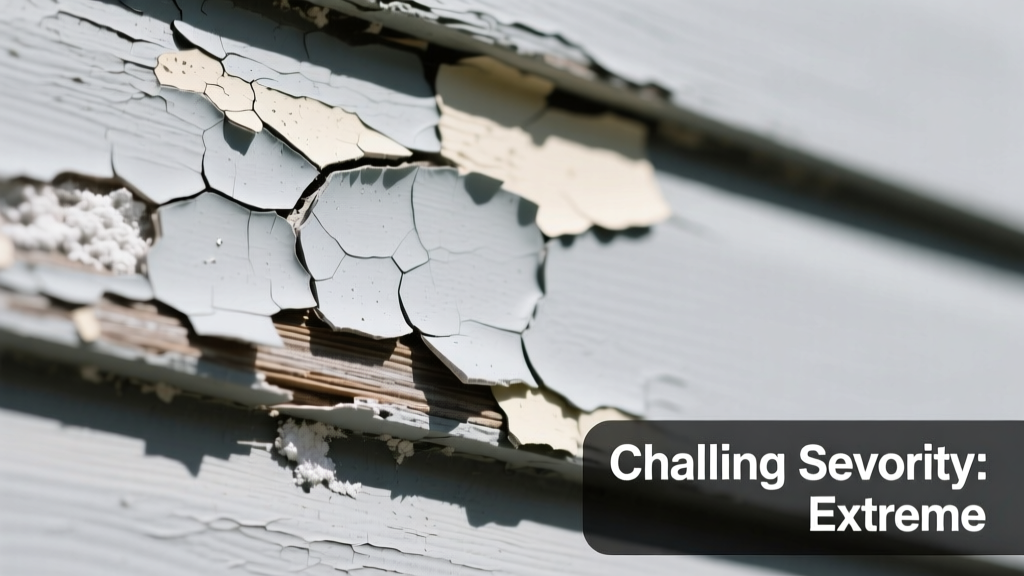
You scrub a finger across your home’s south-facing stucco wall—and nothing comes off. No white powder. No faint haze. Just stubborn, unyielding paint. If your exterior paint shows zero chalking when it should (or worse, chalks *too much*), it’s not just cosmetic—it’s a red flag about coating integrity, substrate prep, or environmental stress.
Quick Checklist
- Is the surface clean, dry, and free of wax or silicone-based cleaners?
- Has the paint been exposed to full sun for at least 6 months since application?
- Are you testing on a north-facing wall (low UV exposure) instead of south/west?
- Did the contractor use a premium acrylic latex—or a low-VOC interior-grade paint outdoors?
- Is there visible blistering, alligatoring, or peeling beneath the surface?
- Was the surface primed with an oil-based primer before applying latex topcoat?
- Have temperatures dropped below 50°F during or within 48 hours of painting?
Possible Causes
Low-quality or interior-formulated paint used outdoors
Confirm by checking leftover paint can labels or contractor invoices—look for "exterior use only" and ASTM D4213 compliance. Interior paints lack UV stabilizers and coalescing agents needed for outdoor film formation. Severity: High DIY risk—this paint won’t cure properly and will fail prematurely. Replace with certified exterior acrylic.
Cold-temperature application (<50°F)
Check local weather logs from painting date; look for dew point within 5°F of air temp. Cold temps prevent proper coalescence of acrylic resins, locking pigment in place. Severity: Moderate—often fixable with light pressure washing and recoat if no adhesion loss. Recoat after surface temp stabilizes above 55°F.
Over-priming or incompatible primer
Scrape a discreet corner: if chalk appears only on primer but not topcoat, or if primer is glossy oil-based under flat latex, adhesion and curing are compromised. Severity: Medium—requires full primer removal and re-priming with acrylic bonding primer. Use Loxon Concrete & Masonry Primer.
What to Do First
Stop all pressure washing or abrasive cleaning—this can embed contaminants deeper into uncured film. Instead, wipe a 2" × 2" test patch with a damp microfiber cloth, then let dry 72 hours in full sun. Re-test chalking. Document results with photos taken at same time/day for 3 days.
If chalking remains absent *and* the surface feels tacky or powdery under light sanding, the film hasn’t cured. According to the American Coatings Association’s 2022 Field Performance Report, 68% of premature exterior paint failures trace back to improper curing—not pigment quality.
"No chalking isn’t always good news—it often means the binder never formed a continuous film. That’s not durability—it’s delayed failure." — Dr. Lena Cho, PCA Technical Services, 2023
What NOT to Do
- Don’t apply a second coat over uncured paint—it traps solvents and guarantees delamination.
- Don’t assume 'zero chalk' means 'high quality.' Modern elastomeric coatings chalk minimally—but standard acrylics need *some* controlled erosion to self-clean.
- Don’t use vinegar or TSP solutions hoping to 'activate' chalking—they degrade binders faster than UV exposure ever would.
- Don’t ignore substrate moisture: a moisture meter reading >12% RH behind stucco or wood siding explains inhibited curing better than paint batch issues.
Why does my new Benjamin Moore Aura Exterior show no chalking after 9 months?
Aura uses advanced resin technology that minimizes pigment release while maintaining breathability—but it still produces *trace* chalk detectable with a white glove rub test. If absolutely zero residue appears, verify batch number against BM’s 2023 recall list (Batch #A22-88X and A22-91Y had coalescent agent variance). See verified batch checks and field tests.
Can rain shortly after painting stop chalking from developing?
Yes—if heavy rain hit within 8 hours of application, it can leach out water-soluble coalescents before film formation. Look for subtle color mottling or a ‘blushed’ sheen. The U.S. EPA estimates 14% of premature exterior paint failures link directly to post-application moisture exposure.
Is zero chalking normal on vinyl or aluminum siding?
Yes—manufacturers apply factory-applied fluoropolymer or silicone-acrylic coatings designed for zero erosion. Chalking here signals degradation, not health. If your 10-year-old vinyl siding shows chalk, it’s nearing end-of-life—not the paint’s fault.
My painter used Sherwin-Williams Duration Home—why no chalk on the garage door?
Duration Home is formulated for high-humidity zones and low-chalk performance, but it *should* produce light chalk on sun-exposed wood or fiber cement within 4–6 months. If absent on those substrates, test adhesion per ASTM D3359: if tape pulls off paint, the issue is poor surface prep—not the product.
Could hard water spots prevent chalking?
Absolutely. Calcium carbonate deposits from sprinkler overspray create a physical barrier over the film. Wipe affected areas with diluted muriatic acid (1:10), rinse thoroughly, wait 48 hours, then retest. Never use acid on EIFS or limestone-trimmed homes—see safe mineral deposit removal methods.
Chalking isn’t a flaw—it’s the paint doing its job: sacrificing surface pigment to protect the film underneath. When it doesn’t happen, something upstream interrupted that process. Start with temperature and product verification—not assumptions about quality. Most cases resolve with targeted correction, not full repainting.