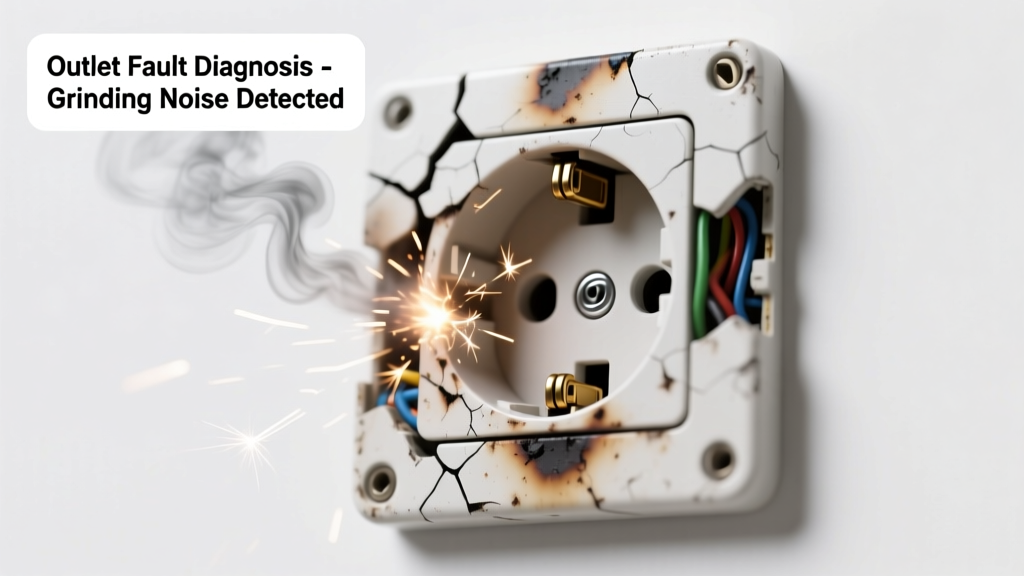
You’re plugging in holiday lights or a power washer, and instead of a click—there’s a low, metallic grind, like gears stripping under load, followed by silence. The outlet feels warm. The GFCI hasn’t tripped. This isn’t just inconvenient—it’s a red flag for serious electrical stress.
Quick Checklist
- Is the outlet located on a circuit protected by a GFCI (inside or outside)?
- Did the grinding noise happen while something was plugged in and operating?
- Do other outdoor outlets on the same circuit work normally?
- Can you smell ozone (sharp, electric-bleach odor) near the outlet cover?
- Is the outlet cover cracked, warped, or showing signs of moisture intrusion?
- Has the outlet been exposed to rain or sprinkler overspray in the last 48 hours?
- Does the breaker for this circuit trip immediately—or only after pressing the test button on the GFCI?
Possible Causes
Loose or Corroded Terminal Connections
Corrosion builds rapidly on aluminum or copper wires in damp exterior boxes—especially where wire nuts meet receptacle screws. You’ll see greenish-white powder or flaking around terminals. Use a non-contact voltage tester first, then inspect with flashlight and mirror. Tighten connections only if power is OFF at the breaker. Severity: Moderate—DIY-able *only* if you’re comfortable de-energizing and re-torquing connections to 14 in-lbs (per NEC 110.14). Otherwise, call a pro. Fix loose outlet connections.
Failing GFCI Receptacle Mechanism
GFCIs degrade after ~10 years or repeated moisture exposure. Internal solenoids wear out and grind when attempting to interrupt current. Test by pressing the TEST button—if it clicks but won’t reset, or grinds during reset, the unit is failing. Severity: Low-Moderate—replaceable DIY task if you follow local code (e.g., weather-resistant rating, tamper-resistant design required since 2017 NEC). Replace a GFCI outlet.
Water Intrusion in the Outlet Box
Even with a cover, rain can pool behind gaskets or enter via unsealed conduit entries. Water + voltage = electrolytic corrosion + arcing. Look for white crystalline residue on contacts or fogging inside the cover. According to the National Fire Protection Association’s 2023 Electrical Equipment Fire Report, 22% of outdoor electrical fires involved water-related insulation failure. Severity: High—do not restore power until box is fully dried and sealed. Call an electrician if conduit entry points are compromised. Dry and seal wet outlet boxes.
What to Do First
- Turn OFF the circuit breaker supplying the outlet—verify with a non-contact tester.
- Unplug everything from the outlet and adjacent outdoor circuits.
- Remove the outlet cover plate and inspect for visible damage, moisture, or discoloration.
- If moisture is present, leave the cover off and use a fan (not heat!) to dry the box for at least 6 hours.
- Check upstream GFCIs—including garage, basement, or bathroom—for tripped status or failed reset behavior.
What NOT to Do
- Don’t press the GFCI reset button repeatedly—the grinding may worsen internal damage.
- Don’t use duct tape or caulk to seal the cover—this traps moisture and accelerates corrosion.
- Don’t replace the outlet without verifying correct amperage, voltage, and WR/TR ratings for exterior use.
- Don’t ignore faint buzzing or warmth before grinding starts—those are early warnings per the U.S. Consumer Product Safety Commission’s 2022 field investigation.
Is the grinding noise coming from the outlet itself—or the wall behind it?
If the sound seems deeper, vibrating through stucco or siding, the issue may be in the junction box or cable run—not the receptacle. That points to damaged NM-B cable (rodent chew, nail puncture) or failing back-wire push-in terminals. A licensed electrician must inspect using thermal imaging or continuity testing.
Does the outlet work intermittently—then grind only when loaded?
This strongly suggests high-resistance arcing at a loose connection. Arcing generates heat that oxidizes copper, increasing resistance further—a runaway cycle. The U.S. EPA estimates that arc faults cause over 28,000 home fires annually.
"A single grinding event at an outdoor outlet should trigger immediate shutdown—not troubleshooting with power applied." — NFPA 70E Electrical Safety in the Workplace, 2023 Edition
Did the outlet stop working after a recent storm or heavy rain?
Yes? Prioritize checking for water in the box and inspecting the cover gasket for compression set (permanent flattening). Replace covers rated WR (weather-resistant), not standard models—even if they fit. Per UL 498, WR outlets undergo 2,000+ hours of salt-spray testing.
Is there a humming or vibrating sensation when touching the outlet cover?
Vibration indicates magnetic fields from severe current imbalance—often caused by shared neutrals or lost neutral connections upstream. This is beyond DIY scope. Shut off the main breaker and contact a licensed electrician immediately.
Does the GFCI test button click but refuse to reset—every time?
That’s a confirmed internal failure. Don’t force it. Replacement is required—and must meet 2023 NEC requirements: WR, TR, and self-test capability. Older non-self-testing units are no longer compliant for new installations.
Are nearby lights dimming or flickering when the outlet is used?
Flickering suggests overloaded or undersized wiring feeding the circuit. Exterior circuits should be dedicated 20A runs. Shared circuits with interior loads increase voltage drop and thermal stress—especially with power tools. Check panel labeling and consider load mapping.
Grinding noises from exterior outlets are rarely benign. They signal mechanical wear, moisture damage, or dangerous arcing—none of which improve with time. Address them promptly, methodically, and safely. If in doubt, consult a licensed electrician before restoring power. For related safety checks, see our guide on GFCI not tripping during ground fault and outlet hot to touch.