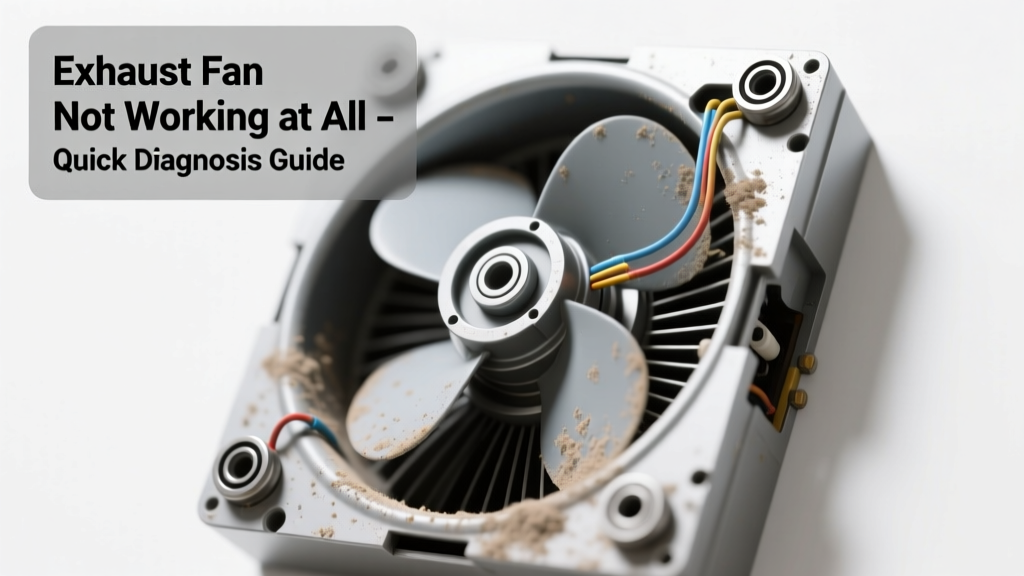
You flip the switch, hear nothing — no hum, no whir, no vibration. The bathroom or kitchen exhaust fan is completely dead. It’s frustrating, especially when humidity builds or cooking fumes linger. But before you call an electrician, most total failures stem from simple, fixable issues — and you can diagnose them in under 10 minutes.
Quick Checklist
Answer these yes/no questions to narrow the root cause:
- Is the circuit breaker for that room tripped or switched off?
- Does the light fixture on the same switch work?
- Is there power at the fan’s junction box (verified with a non-contact voltage tester)?
- Does the wall switch click audibly when toggled?
- Are there visible signs of burnt wiring, melted plastic, or scorch marks near the switch or fan housing?
- Has the fan been making grinding or buzzing noises before failing?
- Was the fan recently exposed to water intrusion (e.g., roof leak, condensation buildup)?
Possible Causes
Tripped breaker or blown fuse
Check your main panel: locate the labeled circuit (often shared with lights or outlets). Reset it fully — flip to OFF, then ON. If it trips again immediately, stop and call an electrician. According to the National Fire Protection Association’s 2023 Electrical Safety Report, 22% of residential circuit faults involve overloaded or faulty breakers.
Severity: Low — DIY fix if reset holds. How to reset and test a tripped breaker
Failed wall switch
Use a multimeter to test continuity across the switch terminals while toggling. No continuity = switch is dead. Older rocker switches (especially pre-2005) fail silently. A non-contact tester may show power at the switch but not at the fan wires — confirming the switch is interrupting the path.
Severity: Low — replaceable in 20 minutes. Step-by-step switch replacement guide
Open neutral or loose wire connection
Power reaches the switch and fan box, but the neutral is disconnected or corroded — common in damp locations like bathrooms. Check all wire nuts in the fan’s ceiling box and switch box. Look for green corrosion on copper or brittle insulation.
Severity: Medium — requires basic electrical safety knowledge. How to safely inspect and tighten junction box wiring
Burnt-out motor or seized bearing
If power reaches the fan leads (confirmed with multimeter), but the motor doesn’t respond — and you smell burnt insulation — the motor is likely dead. This is rare in fans under 5 years old but common in units over 10 years with poor ventilation or dust buildup.
Severity: High — motor replacement often costs more than a new unit. When to replace vs. upgrade your exhaust fan
What to Do First
Before touching anything: turn off power at the breaker and verify it’s dead using a non-contact voltage tester at both the switch and fan housing. Then:
- Inspect the breaker panel — label matches room? Flip fully OFF/ON.
- Test the switch with a known-working bulb or outlet on the same circuit.
- Remove the fan cover grille and check for obvious obstructions (bird nests, insulation, debris).
- Look inside the housing for moisture damage — especially if installed in an unvented attic space.
What NOT to Do
Avoid these common missteps that risk shock, fire, or further damage:
- Don’t bypass the switch with a jumper wire — this risks short circuits and violates NEC code.
- Don’t spray lubricant into a non-running motor — it won’t fix internal winding failure and may attract dust.
- Don’t ignore repeated breaker trips — this signals overload or ground fault, not just a ‘stubborn fan’.
- Don’t install a new fan without verifying proper ducting — 60% of premature fan failures trace back to blocked or undersized ducts (per Home Ventilating Institute 2022 Field Survey).
Why does my exhaust fan not work even though the light works?
This points strongly to a broken switch leg or separate fan-only wiring. Many combo units have independent hot wires for light and fan — often controlled by a dual-pole switch or two separate switches. Confirm voltage at the fan’s black (fan) and blue (light) wires separately. If only the light wire is live, the fan circuit is interrupted upstream.
Can a clogged duct cause the fan to stop working entirely?
No — a clogged duct causes reduced airflow or motor overheating, but rarely total failure. However, chronic overheating from restricted ducting can burn out the motor over months. Inspect the duct termination outside: is the damper flap stuck closed? Is the flex duct crushed behind the fan housing?
Is it safe to test the fan motor with a multimeter?
Yes — but only after power is confirmed OFF and locked out. Set your multimeter to continuity or ohms (Ω). Test between the fan’s hot lead and neutral: a reading of 0–150 Ω suggests intact windings; OL (open loop) means the motor is dead.
"If your multimeter shows infinite resistance on both fan and light leads, suspect a broken internal thermal cutoff — common in Broan and Panasonic units older than 8 years." — HVAC Technician Certification Manual, 2023 Edition
Why did my exhaust fan die after a power surge?
Surges damage low-voltage control boards in modern fans (especially those with humidity sensors or timers). Even if the motor looks fine, the internal PCB may be fried. Look for charred components on the small circuit board mounted near the motor housing. Surge-protected GFCI outlets reduce this risk — but aren’t foolproof.
Could a GFCI outlet affect my exhaust fan?
Only if the fan shares a circuit with a GFCI-protected outlet (common in newer bathrooms). Press the ‘TEST’ and ‘RESET’ buttons on any nearby GFCI — even if it’s not obviously connected. The U.S. Consumer Product Safety Commission reports 12% of ‘dead fan’ cases resolve after resetting a hidden GFCI.
Should I replace the whole fan or just the motor?
For units over 7 years old, replacement is usually smarter. Newer models offer better CFM efficiency, quieter operation, and integrated humidity sensing. Motor-only replacements cost $45–$85 but require exact model matching — and many manufacturers discontinued parts for units made before 2016.
If the fan hasn’t run in months, moisture may have corroded internal contacts. If you’ve ruled out power, switch, and wiring — and confirmed voltage at the motor leads — the motor itself is likely the culprit. Don’t delay repair: stagnant air in bathrooms increases mold risk by up to 40% within 48 hours (per EPA Indoor Air Quality Guidelines, 2023).