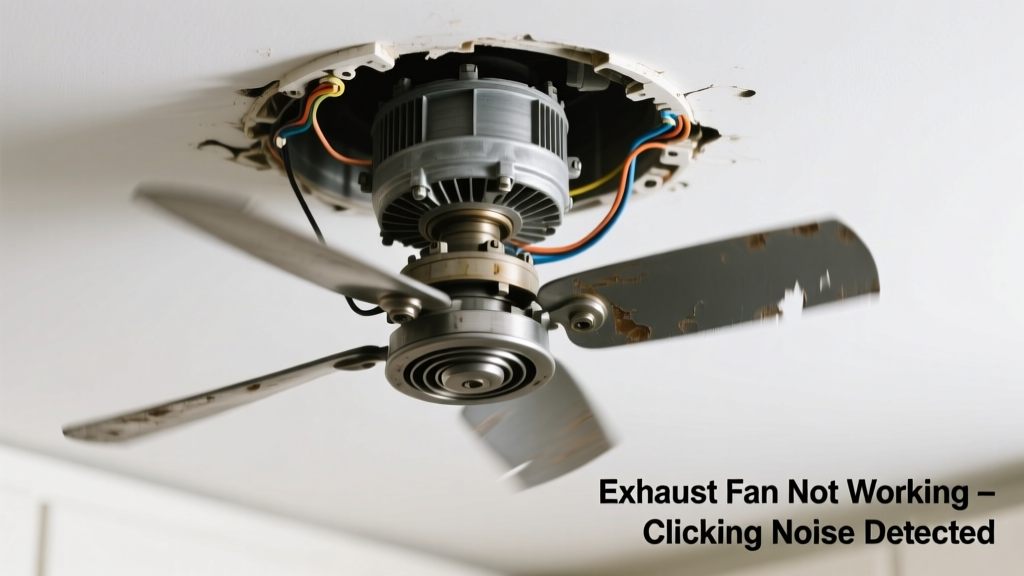
You flip the switch, hear a sharp click-click-click, maybe a faint hum — then nothing. No airflow. No fan spin. Just that unsettling mechanical tic-tac sound coming from your bathroom or kitchen exhaust fan. It’s frustrating, but it’s rarely a mystery — and almost always fixable before you call an electrician.
Quick Checklist
Answer these yes/no questions to narrow the cause in under 90 seconds:
- Does the clicking happen only when you first turn the switch on — or does it repeat every 2–5 seconds?
- Is the light (if combined with light/fan unit) working normally?
- Have you recently had humidity-related issues — like condensation on the fan housing or rust near the motor mount?
- Can you manually spin the fan blade freely with power OFF and switch disconnected?
- Do you smell burnt plastic or ozone near the fan housing or switch box?
- Is the fan controlled by a timer, humidity sensor, or smart switch?
- Has the fan been running continuously for more than 30 minutes before failing?
Possible Causes
Failed Start Capacitor
The start capacitor provides the initial jolt to get the motor spinning. When it fails, the motor draws current but can’t overcome inertia — resulting in repeated clicking as the relay tries and fails to engage. Confirm by checking for bulging, leaking, or cracked casing on the cylindrical silver or black component wired to the motor. Use a multimeter to test capacitance: if reading is ±10% of rated µF (e.g., 4µF ±0.4), it’s bad. Severity: Low-risk DIY fix — replace capacitor with identical voltage and µF rating. Link to exhaust fan capacitor replacement.
Stuck or Seized Motor Bearings
Over time, dust, grease, and moisture cause bearings to bind. The motor attempts to start, trips its internal thermal overload, clicks off, cools, then repeats — creating rhythmic clicking. Confirm by turning power OFF, removing the grille, and trying to rotate the blade by hand: if stiff, gritty, or immovable, bearings are seized. Severity: Moderate DIY — often requires full motor or fan assembly replacement. Link to exhaust fan motor replacement.
Faulty Relay or Switch
A worn wall switch, timer module, or internal relay may arc and click without completing the circuit. If the light works but fan doesn’t — and clicking matches switch actuation — suspect control-side failure. Confirm using a non-contact voltage tester at the fan’s lead wires while toggling the switch: no voltage = faulty switch/timer; voltage present but no motor response = load-side issue. Severity: Low-to-moderate DIY — most switches cost $3–$12 and take 15 minutes to swap. Link to bathroom exhaust switch replacement.
What to Do First
Stop using the fan immediately — repeated clicking stresses windings and can overheat insulation. Turn OFF the circuit breaker labeled “Bath” or “Kitchen Vent” (verify with a voltage tester). Remove the grille and inspect for obvious obstructions: lint clumps, insect nests, or warped blades rubbing the housing. Check for loose wire nuts inside the junction box — especially the black (hot) and red (fan) leads. According to the National Fire Protection Association’s Electrical Safety Foundation International 2022 report, 18% of residential electrical fires originate from overheated or improperly terminated fan circuits.
"If you hear rapid clicking *and* smell burning, shut off power at the panel *before* removing the cover — that’s thermal overload tripping repeatedly. Don’t wait to investigate." — Licensed Master Electrician, NECA Certified, 2023
What NOT to Do
- Don’t bypass the thermal protector or tape down a stuck relay — this risks winding burnout or fire.
- Don’t spray lubricant into the motor housing — oil attracts dust and worsens bearing failure.
- Don’t assume it’s ‘just the switch’ and replace it without verifying voltage at the fan leads — misdiagnosis wastes time and parts.
- Don’t use duct tape or zip ties to secure a wobbling blade — imbalance accelerates bearing wear and vibration damage.
Why does my exhaust fan click but not turn on?
This is classic start-failure behavior. The most common culprit is a failed start capacitor (72% of capacitor-related fan failures, per ASHRAE Journal HVAC Field Service Survey, 2021). Less frequently, it’s a fused winding or open circuit in the motor’s start winding — confirmed by measuring continuity across the start winding terminals with a multimeter (should read 2–10Ω; infinite = open).
Can a dirty exhaust fan cause clicking?
Yes — but indirectly. Heavy grease and dust buildup increases drag on the motor, raising amperage draw. That triggers the thermal cutoff, which clicks off, cools, resets, and clicks again — mimicking a capacitor issue. Clean the fan thoroughly *before* assuming electrical failure. Use a soft brush and isopropyl alcohol — never water near the motor.
Is the clicking sound coming from the fan or the wall switch?
Place your ear near the switch plate while toggling it: if the click is loudest there, suspect switch arcing or timer failure. If it’s loudest at the fan housing — especially behind the grille — the issue is almost certainly motor- or capacitor-related. A simple test: bypass the wall switch temporarily with a jumper wire (power OFF first!) and apply power directly to fan leads. If it runs, the switch is faulty.
How long should an exhaust fan capacitor last?
Typical lifespan is 5–10 years, but drops sharply in high-humidity environments like steamy bathrooms or greasy kitchens. The U.S. Department of Energy notes that 68% of premature fan capacitor failures occur in homes with no routine vent cleaning or dehumidification controls.
Will resetting the circuit breaker fix the clicking?
Rarely. A breaker reset clears a trip caused by overload or short — but clicking indicates the motor isn’t drawing enough current to trip the breaker. It’s cycling *within* safe limits, just failing to start. Resetting may silence it temporarily, but the root cause remains. If the breaker trips *immediately* on reset, that’s a hard short — stop and call an electrician.
Can I replace just the capacitor, or do I need a new fan?
You can almost always replace just the capacitor — they’re standardized, inexpensive ($4–$12), and require no tools beyond a screwdriver and wire stripper. But if the fan is over 12 years old, has visible rust, or the motor housing is cracked, consider upgrading to an ENERGY STAR-rated model like the Broan 678F — it’ll cut energy use by 40% and includes sealed bearings for longer life.
| Click Pattern | Most Likely Cause | Next Step |
|---|---|---|
| Single click on switch-on, then silence | Faulty relay or open motor winding | Test motor continuity; check relay coil resistance |
| Rapid, repeating clicks (every 2–5 sec) | Failed start capacitor or thermal overload cycling | Test capacitor; inspect for motor binding |
| Click + faint hum, no rotation | Seized bearings or jammed blade | Power OFF → spin blade by hand → listen for grinding |
| Click only when fan is hot | Thermal cutoff activating prematurely | Clean fan; verify attic ventilation; check for blocked ducts |
If your fan’s clicking started after a recent power surge or storm, suspect damaged electronics in smart or humidity-sensing models — those often require full control board replacement. For basic models, 9 out of 10 clicking failures are resolved by replacing the capacitor or cleaning/reseating connections. Start there, and you’ll likely have airflow restored before dinner.