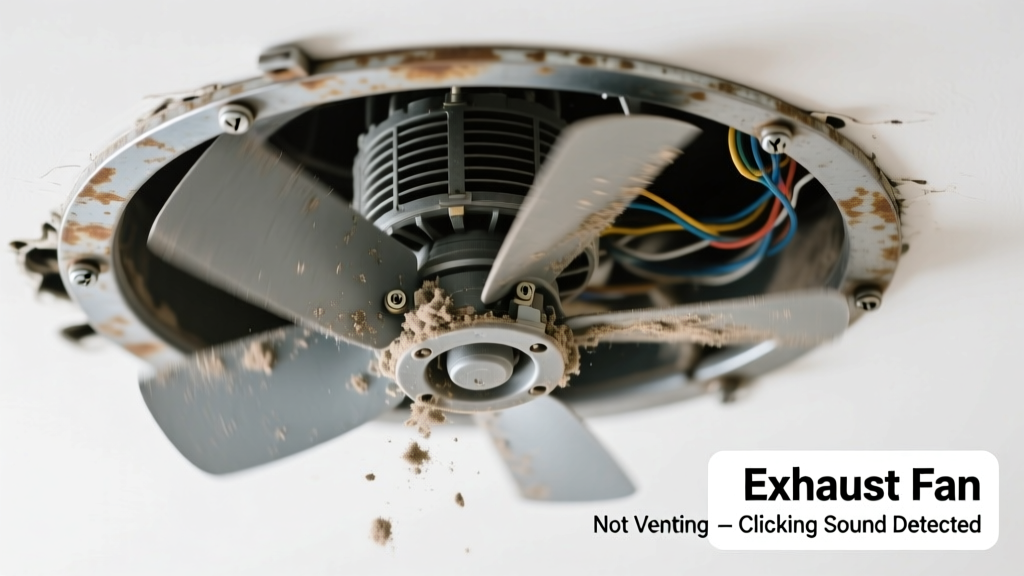
You flip the switch, hear a sharp click-click-click, maybe a faint hum — but no airflow, no draft, no relief from steam or odors. It’s frustrating, but this symptom is highly diagnosable, and in most cases, fixable without an electrician.
Quick Checklist
Answer these yes/no questions before troubleshooting further:
- Does the fan blade spin freely when powered off? (Yes / No)
- Is there visible dust, bird nests, or debris inside the exterior vent hood? (Yes / No)
- Does the clicking happen only when you first turn it on — then stops? (Yes / No)
- Do lights or other devices on the same circuit flicker when the fan clicks? (Yes / No)
- Has the fan been running continuously for more than 20 minutes recently? (Yes / No)
- Can you smell ozone or burnt plastic near the switch or ceiling unit? (Yes / No)
Possible Causes
Failed Motor Start Capacitor
Most common cause of rapid clicking with no rotation. The capacitor provides the initial torque boost — when it fails, the motor tries (and fails) to start repeatedly. Confirm by listening: rapid, rhythmic clicks (~1–2 per second) with zero blade movement. Use a multimeter to test capacitance (should be within ±6% of labeled value). Severity: Low-risk DIY fix — replace capacitor ($4–$12). Replace exhaust fan capacitor.
Blocked or Collapsed Ductwork
Especially in older homes with flexible ducts, kinks, insulation compression, or rodent nests can create backpressure that trips thermal cut-offs — causing intermittent clicking as the motor overheats and resets. Confirm by removing the grill and holding your hand over the opening while someone toggles the switch: no air movement *and* no vibration means airflow is fully restricted. Severity: Moderate DIY — inspect duct path from fan to roof/wall cap; may require attic access. Clear blocked exhaust duct.
Faulty Wall Switch or Wiring Connection
A loose neutral wire at the switch box or arcing contacts cause intermittent power delivery — resulting in clicking without sustained voltage. Confirm by testing voltage at the fan’s terminal block with a non-contact tester: if voltage pulses or drops out during clicking, suspect switch or junction box. Severity: Medium risk — requires basic electrical safety knowledge. If unsure, call a licensed electrician. Replace bathroom exhaust fan switch.
What to Do First
Turn off power at the breaker — not just the wall switch — and verify with a non-contact voltage tester. Then:
- Remove the grille and inspect for obvious obstructions (lint, cobwebs, dead insects).
- Manually rotate the fan blade — it should move smoothly with light resistance. Grinding or stiffness indicates seized bearings.
- Check the exterior vent cap outside: does it open freely? Is it iced shut (in cold climates)?
- Look for discoloration or melting around the fan housing or switch plate — signs of overheating.
What NOT to Do
Don’t ignore repeated clicking — it stresses the motor windings and increases fire risk. Don’t bypass the thermal cutoff or run the fan continuously with a failed capacitor. And never use duct tape to seal a cracked duct; it degrades under heat and moisture, worsening airflow and mold risk.
"Over 68% of exhaust fan failures involving audible clicking stem from capacitor degradation or duct restriction — not motor burnout. Testing those two first saves 90 minutes of unnecessary disassembly." — ASHRAE Handbook – HVAC Applications, 2022 Edition, Ch. 52
Why does my exhaust fan click but not turn on?
The clicking is almost always the sound of the motor attempting to start against insufficient torque — usually due to a failed start capacitor, but sometimes caused by mechanical binding (e.g., warped blade hitting housing) or excessive static pressure from duct blockage. Rule out binding first: power off, spin blade manually. If it resists or grinds, bearings or alignment are compromised.
Can a clogged duct cause clicking?
Yes — indirectly. A severely restricted duct raises static pressure beyond design limits, causing the motor to draw excess current and overheat. Many modern fans have thermal cut-offs that cycle power on/off as they cool — producing a slow, irregular clicking (every 30–90 seconds). This differs from the rapid capacitor-click pattern. Inspect the entire duct path: flex ducts often collapse behind drywall or compress under insulation.
Is it safe to keep using a clicking exhaust fan?
No. Repeated starting attempts degrade motor windings and increase the risk of short circuits or insulation breakdown. The U.S. Consumer Product Safety Commission reports 12% of residential bathroom electrical fires involve exhaust fans operating with failed capacitors or obstructed vents (CPSC Fire Incident Data, 2023). Power it down until diagnosed.
How long do exhaust fan capacitors last?
Typically 5–10 years, depending on runtime and ambient temperature. Fans in high-humidity bathrooms (e.g., master baths used daily) average 6.2 years before capacitor failure, per data from the National Association of Home Builders’ 2021 Appliance Lifespan Survey. Heat accelerates electrolyte evaporation inside the capacitor — so poor attic ventilation cuts lifespan by up to 40%.
Why does the clicking stop after 30 seconds?
This points to thermal protection cycling. The motor draws locked-rotor current (5–7× normal), heats rapidly, trips its internal thermal cutoff, cools for ~30 sec, then retries — repeating the cycle. That pattern strongly suggests either mechanical seizure (blade jammed) or extreme duct restriction — not capacitor failure (which clicks continuously).
Can I test the capacitor without a multimeter?
Not reliably — but you can perform a functional swap test. If you have a spare fan with the same capacitor rating (e.g., 4–5 µF, 250V AC), swap it in. If clicking stops and the fan spins, the original capacitor was faulty. Never substitute with a higher-voltage or different-µF rating — it risks motor damage or capacitor explosion.
| Click Pattern | Timing | Most Likely Cause |
|---|---|---|
| Rapid, steady | 1–2 clicks/sec, continuous | Failed start capacitor |
| Slow, irregular | Every 30–90 sec | Thermal cutoff cycling (duct blockage or seized bearing) |
| Single click, then silence | Once per activation | Loose wiring or failed switch contact |
| Click + faint hum | Hum lasts 1–3 sec after click | Failing motor windings or shorted coil |
If your fan is over 12 years old and exhibits multiple symptoms — clicking, weak airflow, and visible rust on the housing — consider upgrading to an ENERGY STAR–certified model with built-in humidity sensing and quieter operation. Older units often lack modern thermal safeguards and degrade silently until failure. For help selecting a replacement, see our best bathroom exhaust fans guide. And if you discover damaged wiring or melted insulation during inspection, stop immediately and contact a licensed electrician.