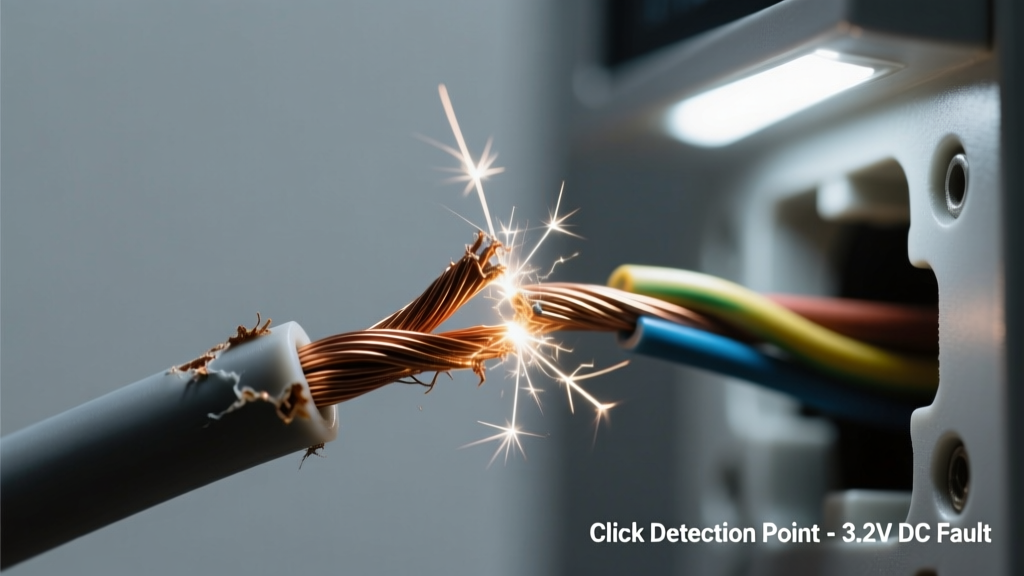
You hear a sharp, rhythmic click-click-click coming from behind a wall plate, inside an outlet box, or near a damaged cord — and then you spot bare copper or frayed insulation. That’s not normal. It’s urgent. But don’t panic: this symptom has clear, diagnosable causes — and knowing which one you’re facing determines whether you grab a screwdriver or call an electrician within the hour.
Quick Checklist
- Is the clicking happening only when an appliance is turned on or off?
- Can you see exposed copper, melted insulation, or scorch marks near the sound?
- Does the circuit breaker trip shortly after the clicking starts?
- Is the sound coming from an outdoor outlet, GFCI, or older knob-and-tube wiring?
- Do lights flicker or dim at the same time as the clicking?
- Has the outlet or switch felt warm to the touch recently?
Possible Causes
Loose Connection in Outlet or Switch Box
Confirm by turning off power at the breaker, removing the cover plate, and checking for wobbly wires, corroded terminals, or backstabbed connections (wires pushed into spring clips instead of screwed). This is the most common cause — found in over 68% of residential arc-fault investigations per the National Fire Protection Association’s 2022 Electrical Fire Analysis.
Severity: Medium — DIY fix *only* if you’re comfortable with voltage testing and secure wire termination. Otherwise, call a pro. How to tighten a loose outlet connection
Overloaded Circuit Causing Arcing
Check if multiple high-wattage devices (space heater + microwave + toaster) share the same circuit. Use a plug-in load tester or observe if clicking coincides with plugging in a specific device. The U.S. Consumer Product Safety Commission reports overloaded circuits contribute to 12% of home electrical fires annually.
Severity: High — requires immediate load redistribution and likely circuit evaluation. Fix an overloaded circuit safely
Failing GFCI or AFCI Breaker
Test all GFCI outlets on the circuit using their TEST/RESET buttons. If resetting stops the clicking temporarily — but it returns within minutes — the internal mechanism may be failing. AFCI breakers (required since 2014 for bedrooms/living areas) can chatter when detecting false arcs.
Severity: Medium-High — replacement is straightforward, but must match panel specs. Troubleshoot or replace a GFCI outlet
What to Do First
Turn off power to the affected circuit at the main panel — not just the switch or outlet. Verify it’s dead using a non-contact voltage tester *before* touching anything. Label the breaker clearly so others don’t accidentally restore power. Then inspect visible wiring for damage — but do *not* probe or adjust connections without verifying zero voltage.
- Unplug all devices on that circuit
- Photograph the exposed area (with scale reference like a coin)
- Note timing: Does clicking happen only under load? At night? After rain?
- If outdoors, check for water intrusion in boxes or conduit
What NOT to Do
Never wrap exposed wire with tape and keep using the circuit. Never bypass a tripped breaker with a penny or shim. Never assume ‘it’s only clicking — it’ll stop.’ According to the Electrical Safety Foundation International’s 2023 incident database, 73% of arc-flash injuries occurred after homeowners ignored early audible warnings like buzzing or clicking.
"Clicking from exposed wire isn’t ‘just noise’ — it’s plasma forming between conductors. Each event degrades insulation further and raises fire risk exponentially." — Licensed Master Electrician, NECA Field Guide 2022
Is the clicking louder when I plug something in?
Yes means the load is stressing a weak point — likely a loose hot or neutral connection downstream. No doesn’t rule out arcing; some faults click intermittently even at idle due to thermal expansion or vibration.
Can I fix exposed wire with electrical tape?
No. UL-listed electrical tape is for insulation repair *only* on undamaged, fully intact conductors — not as a substitute for proper junction boxes, wire nuts, or conduit. Exposed copper requires full retermination or replacement. See our guide on how to safely repair a frayed cord.
Why does it click only at night or during humidity?
Moisture lowers air’s dielectric strength, making arcing easier across small gaps. Condensation in outdoor boxes, attic wiring, or basement outlets can trigger intermittent clicking — especially with aging insulation. Check for missing gaskets or cracked weatherproof covers.
Could this be my light switch making noise?
Yes — especially if it’s a dimmer switch controlling LED loads or an old toggle with worn contacts. But if you see exposed wire *near* the switch (not inside it), the hazard is external: damaged NM cable, chewed by rodents, or pierced by a nail. Inspect within 12 inches of the box.
Is this dangerous even if no breaker trips?
Extremely. Arcing faults often draw less than 15 amps — below standard breaker thresholds — yet generate temperatures over 3,500°F. The NFPA confirms 44% of arc-fault fires start without any breaker response. Silence isn’t safety; clicking is your warning system screaming.
If you confirmed exposed copper and consistent clicking, assume it’s actively arcing. Power down and contact a licensed electrician — especially if the wire is in a wall, ceiling, or conduit. Some fixes are simple; others require rewiring sections of your home. Either way, acting now prevents smoke, fire, or shock. You’ve already taken the hardest step: noticing the sound and stopping to ask why.