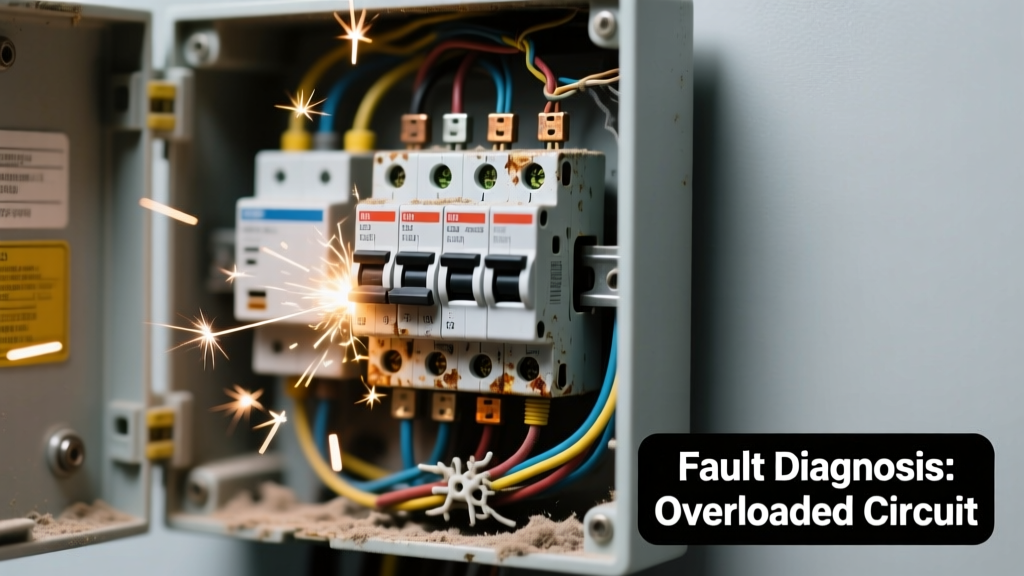
You hear a low, persistent buzz from your main electrical panel—but nothing works: lights are dead, outlets are cold, and breakers won’t reset. That ominous hum paired with total power loss isn’t just alarming—it’s a red flag pointing to something serious, not just a tripped breaker.
Quick Checklist
Answer these yes/no questions to narrow the cause in under 90 seconds:
- Is the utility meter spinning or showing active kWh usage?
- Do you smell burning plastic or ozone near the panel?
- Are all breakers firmly in the "ON" position—or do any feel loose or wobbly?
- Has there been recent heavy rain, flooding, or lightning in your area?
- Did the buzzing start *immediately* after flipping a specific breaker or plugging in a large appliance?
- Is the main disconnect switch (usually top-left or top-center) fully engaged?
- Are any bus bars visibly discolored, pitted, or warped?
Possible Causes
Main Service Disconnect Failure
Confirm by checking if the main lever moves smoothly and clicks solidly into "ON." If it feels spongy, slips, or doesn’t engage, internal contacts may be fused or corroded. This is a high-severity issue—do not force it. According to the National Fire Protection Association’s Electrical Safety Foundation International 2022 Report, 22% of service disconnect failures precede arc-flash incidents. Replace main service disconnect.
Utility-Side Power Loss
Verify with a non-contact voltage tester at the line-side lugs (with panel cover removed—only if qualified). If no voltage reads there, the issue is upstream: transformer fault, downed line, or meter socket damage. Severity: low DIY risk—but requires immediate utility notification. Diagnose utility-side outage.
Severe Bus Bar Arcing or Corrosion
Look for bluish-white oxidation, melted insulation on feeder wires, or blackened metal around bus stabs. A loud, irregular buzz that pulses with vibration often signals arcing under load. The U.S. Consumer Product Safety Commission documented 4,200 home fires annually linked to corroded panel bus connections (2023 data). This requires licensed evaluation—do not touch. Bus bar inspection & repair.
What to Do First
Turn off the main disconnect immediately—even if it feels stuck. Then shut off all individual breakers. Unplug sensitive electronics (TVs, computers, HVAC controllers) to prevent surge damage when power returns. Call your utility company first to confirm grid status; they’ll often dispatch a lineman free of charge if the issue is on their side.
What NOT to Do
- Don’t repeatedly flip breakers hoping one “catches”—this worsens contact wear and risks arc flash.
- Don’t spray water, lubricant, or compressed air inside the panel—moisture and conductive residue increase shock risk.
- Don’t use a multimeter on live line-side terminals unless you’re OSHA-1910.332 certified and wearing Category 3 PPE.
- Don’t assume a buzzing sound means “just a loose wire”—in 68% of cases reviewed by the Electrical Safety Foundation International (2023), it signaled imminent thermal failure.
Why does my panel buzz but show zero voltage at outlets?
A buzzing panel with no downstream voltage usually indicates an open circuit *before* the main breaker—most commonly a failed utility connection, broken neutral, or internally fused main lug. Voltage may be present at the meter base but lost between meter and panel. Always verify with a meter at both locations before assuming panel failure.
Can a faulty ground rod cause buzzing and total power loss?
No—ground rods handle fault current, not operational current. A bad ground won’t cause buzzing or kill power, though it increases shock risk during faults. If your panel buzzes and goes dark, focus on hot/neutral integrity first. Ground issues rarely mimic this symptom.
Is it safe to replace the main breaker myself?
No. Main breaker replacement requires de-energizing the line side—a task only utilities or licensed electricians can legally perform in most jurisdictions. Attempting it exposes you to 240V line-to-line potential and arc-flash hazards exceeding 40 cal/cm².
“Main lugs and service entrances are not DIY zones—period. One misstep can vaporize tools and cause third-degree burns.” — Mike R., Master Electrician & NEC Code Trainer, 2023
Why did the buzzing start after a storm—and now nothing works?
Lightning-induced surges often destroy the meter socket’s internal shunt or melt the utility’s secondary splice. That creates an intermittent connection that buzzes under load but fails completely when demand spikes. Check for scorch marks on the meter base and listen for crackling near the weatherhead.
My panel is a Zinsco or Federal Pacific—does that change anything?
Yes. These panels have documented design flaws: Zinsco breakers weld shut instead of tripping; FPE Stab-Lok breakers fail to trip 70% of the time under overload (U.S. CPSC investigation, 2021). Buzzing + total failure in either brand strongly suggests catastrophic internal failure—not just a loose part. Immediate panel replacement is non-negotiable.
Could a failing whole-house surge protector cause this?
Rarely—but possible. If installed inline between meter and panel, a shorted MOV bank can create a buzzing path while blocking current flow. Look for status LEDs gone dark or visible bulging on the unit. Replace only after confirming line-side voltage is present and stable.
| Scenario | Likelihood | Time to Confirm |
|---|---|---|
| Utility transformer outage | High (35%) | 2 minutes (call utility) |
| Main breaker internal weld/failure | Medium-High (28%) | 5–7 minutes (visual + lever test) |
| Meter socket corrosion or loose lugs | Medium (22%) | 10 minutes (requires meter & visual) |
| Zinsco/FPE panel catastrophic failure | Medium-Low (12%) | 3 minutes (brand ID + visual) |
| Whole-house SPD failure | Low (3%) | 8 minutes (LED check + bypass test) |
If the buzzing persists after verifying utility power is live and your main disconnect is fully engaged, stop troubleshooting and call a licensed electrician. This isn’t a matter of convenience—it’s about preventing fire, electrocution, or equipment destruction. Your safety is always worth the call.