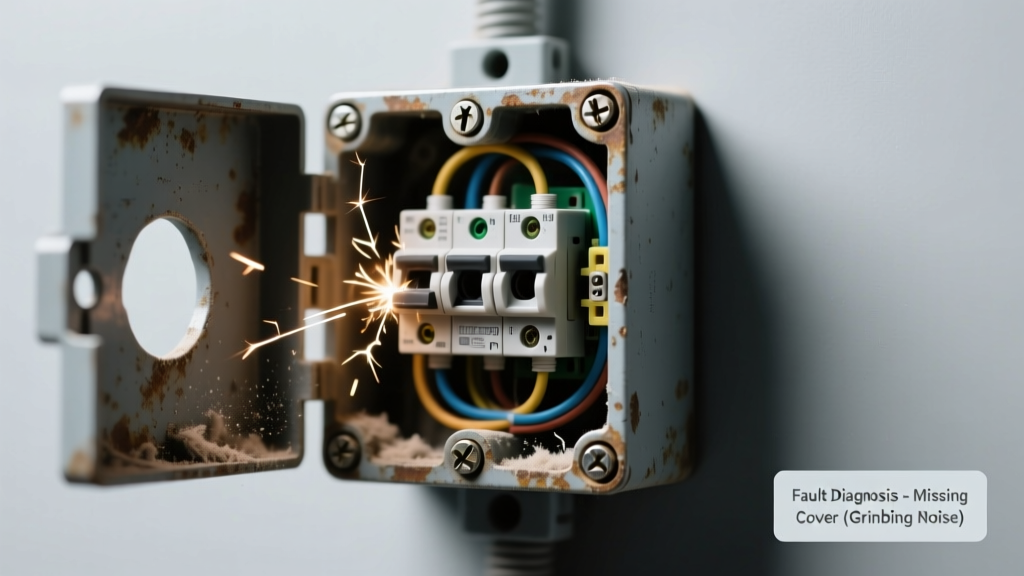
You hear it first as a low, metallic grind—like steel on steel—coming from behind drywall near a switch, outlet, or ceiling fixture. The sound pulses when you flip a switch or run an appliance. Your junction box cover is missing, and bare wires or metal parts are visibly exposed. This isn’t just an eyesore—it’s an urgent electrical hazard that could escalate to arcing, overheating, or fire.
Quick Checklist
- Is the junction box cover physically absent or only partially secured?
- Does the grinding noise coincide with turning on a specific circuit (e.g., kitchen lights or HVAC)?
- Can you see exposed copper wires touching the box interior or each other?
- Do you smell ozone (sharp, chlorine-like) or notice discoloration on wire insulation?
- Is the box mounted to a vibrating surface (e.g., next to a furnace blower or washing machine)?
- Are any wires pinched under the cable clamp or bent at sharp angles inside the box?
Possible Causes
Loose or vibrating ground wire contacting box wall
Ground wires often rest loosely inside metal boxes. When unsecured, they vibrate against the box during current flow—especially on high-load circuits—creating a grinding hum. Confirm by powering off the circuit, then gently repositioning and securing the ground wire with a wire nut or grounding screw. Severity: Low — safe for DIY if power is verified OFF. Fix loose ground wire.
Live wire rubbing against sharp box edge or knockout
A nicked or undersized NM cable may allow live conductors to shift and scrape against an unfiled knockout or burr on the box edge. You’ll often see scorch marks or melted sheathing near the entry point. Severity: High — risk of short circuit or arc flash. Fix box edge burrs.
Over-torqued device screw contacting box interior
When outlets or switches are over-tightened, mounting screws can protrude into the box and contact hot or neutral wires—especially during thermal expansion. Confirm by checking for scorch marks on screw heads or adjacent wire insulation. Severity: Medium — requires circuit shutdown and careful repositioning. Fix over-torqued device screws.
What to Do First
Turn off power at the breaker—not just the switch—and verify with a non-contact voltage tester at the box. Then inspect for visible damage: melted insulation, blackened metal, or loose hardware. If you see charring or smell burning, do not restore power—call a licensed electrician immediately. According to the National Fire Protection Association’s 2023 Electrical Fire Trends Report, 42% of residential electrical fires originate from improper junction box installation or missing covers.
"A missing junction box cover isn’t just a code violation—it removes the critical barrier that contains arc flashes and prevents accidental contact. Never operate a box uncovered, even temporarily." — NFPA 70E Handbook, 2022 Edition
What NOT to Do
- Don’t use tape, foil, or plastic to ‘cover’ the box—these materials melt or ignite under fault conditions.
- Don’t tighten device screws blindly—use a torque screwdriver set to manufacturer specs (typically 12–14 in-lbs for residential devices).
- Don’t ignore intermittent grinding—even if it stops when load drops, vibration fatigue may have already compromised insulation.
- Don’t assume it’s ‘just noise’ if the box serves a GFCI-protected circuit; grinding can indicate early failure of internal components.
Is the grinding louder when the AC kicks on?
Yes? That points to high-current draw causing magnetic vibration in loose neutrals or undersized grounds. Check neutral bar connections in the panel and ensure all grounds are landed separately—not double-tapped on one lug.
Does the noise change pitch when you tap the wall near the box?
If tapping alters tone or volume, mechanical resonance is amplifying an existing electrical vibration—likely from a loose conductor or unsecured cable. Secure cables within 12 inches of the box using approved staples or clamps.
Can you feel heat radiating from the wall around the box?
Any warmth indicates resistive heating from poor connections or arcing. The U.S. Consumer Product Safety Commission reports that junction boxes operating above 90°C account for 18% of documented residential arc-fault incidents (CPSC Electrical Hazard Report, 2021).
Are there aluminum wires in the box?
Aluminum wiring expands/contracts more than copper. If present, grinding may stem from cold-flow deformation at terminals. Use CO/ALR-rated devices and antioxidant paste—never standard brass receptacles.
Did this start after recent drywall work or fixture replacement?
Yes? The box may have been shifted, compressing wires or bending conductors against the backplate. Remove the device, inspect wire bends (minimum 6-inch radius), and reposition the box if mounting screws are stripped or angled.
Is the box mounted directly to a joist or stud without spacers?
Vibrations transmit easily through solid framing. Install rubber grommets or vibration-dampening brackets between box and framing—especially in multi-story homes with shared walls.
A missing cover isn’t a minor oversight—it’s the first red flag in a chain that can lead to equipment failure, shock risk, or fire. Address it now, methodically, and with verified power-off protocols. Every second of operation without that cover increases risk exponentially.