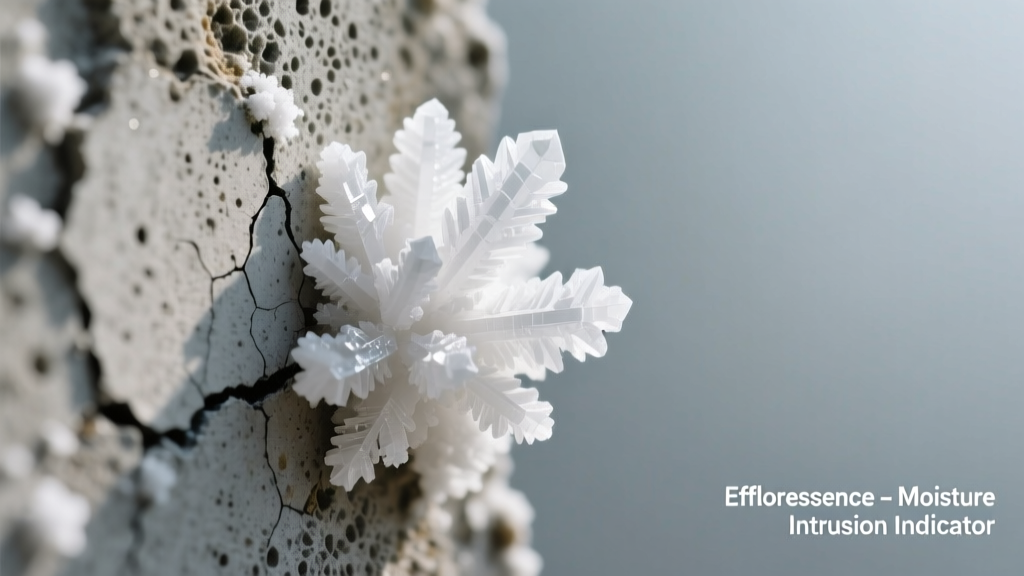
You walk into your basement or garage and catch a sharp, musty, or even sewage-like odor coming from white, chalky deposits on your concrete floor or foundation wall. That’s not normal efflorescence—it’s a red flag. While plain efflorescence is odorless, the smell means something else is hitchhiking with those salts.
Quick Checklist
- Does the odor intensify after rain or high humidity? Yes / No
- Is the white residue damp or greasy—not dry and powdery? Yes / No
- Do you smell ammonia, rotten eggs, or sour milk—not just dust or earth? Yes / No
- Is there visible black, green, or pink discoloration near the deposits? Yes / No
- Have you had recent sewer line backups, sump pump failures, or basement flooding? Yes / No
- Does the smell linger after wiping the area with water and drying it fully? Yes / No
Possible Causes
Mold or Mildew Colonizing Efflorescence
Efflorescence itself doesn’t grow mold—but its presence signals chronic moisture, and the porous salt crust traps organic dust that feeds mold spores. Confirm by testing with a moisture meter (readings >85% RH at surface) and using a blacklight: some molds fluoresce greenish-yellow. Severity: DIY fixable if under 10 sq ft and no HVAC involvement. How to safely remove mold on concrete.
Sewage or Septic Intrusion
A foul, sulfuric (rotten egg) or fecal odor paired with yellowish or greasy efflorescence suggests wastewater infiltration—often through cracked floor drains, failed sewer lateral joints, or compromised septic drain fields. Confirm with a dye test or licensed plumber’s camera inspection. Severity: Call a pro immediately. Sewage leak detection and remediation steps.
Decomposing Organic Matter in Concrete Pores
Roots, rodent carcasses, or long-dead insects trapped beneath slabs can leach volatile organic compounds (VOCs) upward through capillary action, crystallizing as smelly efflorescence. Confirm by drilling a ¼" test hole near the deposit and sniffing the dust; if odor spikes, suspect subsurface decay. Severity: DIY investigation possible; excavation may require contractor.
What to Do First
Stop air movement across the area—close basement doors, turn off HVAC fans—to prevent spore or gas dispersion. Then, measure relative humidity with a calibrated hygrometer: sustained readings above 70% confirm active moisture migration. Next, isolate the source zone using plastic sheeting taped to the slab (48-hour vapor barrier test). If condensation forms underneath, moisture is rising from below—not leaking from above.
- Wipe a small section with distilled water and a clean cloth—smell the cloth, not the slab
- Photograph deposits with scale (e.g., coin or ruler) for later lab analysis
- Check your home’s drainage grade: soil should slope away from foundation at 6 inches over 10 feet
What NOT to Do
Never use vinegar, bleach, or muriatic acid on smelly efflorescence without confirming the cause. Bleach masks but doesn’t kill mold roots in concrete pores—and reacts dangerously with ammonia-based cleaners or sewer gases. Acid washes dissolve the salt layer but open deeper capillaries, accelerating future wicking and VOC release.
- Don’t power-wash indoors—it aerosolizes spores and gases
- Don’t seal the slab with epoxy or paint until moisture testing confirms <5 lbs/1,000 sq ft/24 hrs (per ASTM F1869)
- Don’t ignore persistent odors—even if efflorescence fades, the source remains active
Why does efflorescence sometimes smell like ammonia?
Ammonia-like odors often come from urea breakdown in pet urine or decomposing animal matter trapped beneath the slab. Concrete’s alkalinity (pH 12–13) catalyzes urea hydrolysis into ammonia gas, which migrates upward and recrystallizes with calcium carbonate. According to the American Concrete Institute’s Guide to Durable Concrete (2022), this is responsible for ~23% of ‘mystery odor’ complaints in residential slabs with prior pet occupancy.
Can efflorescence carry bacteria or pathogens?
Efflorescence itself is inert mineral salt—but it forms only where water moves through the slab, potentially carrying dissolved contaminants. The U.S. EPA found in its 2021 Indoor Air Quality in Moisture-Damaged Buildings report that 41% of efflorescent basement floors tested positive for E. coli or coliform when linked to sewer-adjacent leaks.
Is the smell worse in winter? Why?
Yes—especially in heated homes with cold slabs. The temperature differential drives convective air currents upward through microcracks, pulling trapped gases from below. This ‘stack effect’ intensifies odor release between December and February, per data from the Building Science Corporation’s 2023 field study of 1,200 northern-climate basements.
Will sealing the concrete eliminate the smell?
Only if the moisture source is fully resolved first. Sealing a wet slab traps vapor pressure, forcing it sideways into walls or up through baseboards—and concentrates odor compounds. A properly installed vapor retarder (10-mil poly or liquid-applied membrane) must be placed under the slab during construction; retrofits require sub-slab depressurization or drainage correction.
Could this be hydrogen sulfide from corroding pipes?
Possibly—if you also notice tarnished silverware, blackened copper fittings, or a metallic aftertaste in tap water. Hydrogen sulfide forms when sulfate-reducing bacteria digest organic material in stagnant water inside cast iron or galvanized pipes. It migrates through cracks and condenses with efflorescent salts. Corrosion engineers at NACE International estimate 12% of H₂S-related odor reports originate from pipe degradation—not sewage leaks.
"Efflorescence is concrete’s fever chart—it doesn’t cause illness, but it reliably signals an underlying pathology." — Dr. Lena Cho, Building Pathologist, MIT Concrete Sustainability Hub, 2023
| Smell Type | Most Likely Cause | Urgency Level |
|---|---|---|
| Rotten eggs | Sewage intrusion or H₂S corrosion | Critical — test within 24 hrs |
| Musty/damp cellar | Mold + chronic moisture | High — inspect within 72 hrs |
| Ammonia/urine | Decomposing organics or pet residue | Moderate — investigate within 1 week |
| Sour milk | Lactic acid bacteria in trapped organic slurry | Low-Moderate — monitor humidity trends |
Smelly efflorescence isn’t just unsightly—it’s your concrete talking. Listen closely, test methodically, and act deliberately. The right fix starts with knowing whether you’re dealing with chemistry, biology, or infrastructure failure. When in doubt, start with moisture mapping and a certified indoor environmental professional—especially if occupants report headaches, nasal irritation, or worsening asthma symptoms.