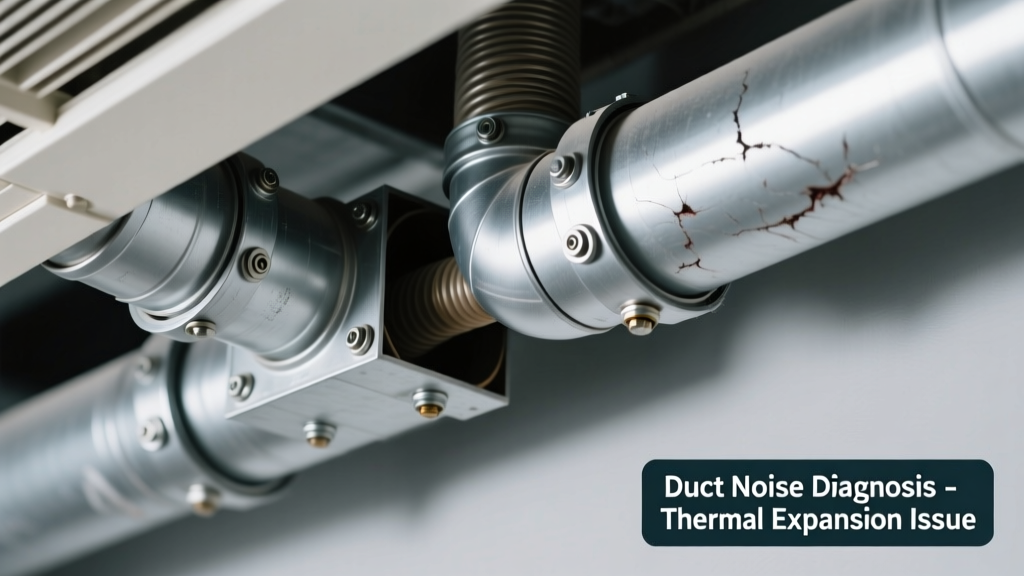
You’re sitting in the living room when—bang—a sharp metallic thud echoes from the ceiling, followed by a rapid click-click-click that fades after 10 seconds. It happens right after the furnace kicks on or off. You’re not imagining it — and it’s not harmless background noise.
Quick Checklist
Answer these yes/no questions to narrow the cause in under 90 seconds:
- Does the noise occur only when the HVAC system starts or stops?
- Is the sound louder near supply vents or return grilles?
- Can you feel vibration in nearby walls or floors when it happens?
- Did the noise begin shortly after new ductwork, insulation, or a furnace upgrade?
- Are any visible duct seams, hangers, or boots visibly loose or bent?
- Does the clicking speed up or change pitch when the thermostat is set higher?
Possible Causes
Thermal Expansion of Metal Ducts
When heated air rushes into cool, rigid sheet metal ducts (especially galvanized steel), the metal expands rapidly — causing loud pops and rhythmic clicks as it shifts against framing or hangers. Confirm by listening closely during the first 15 seconds after blower startup; sounds often originate near trunk lines in attics or basements. Severity: Low — most cases are safe to monitor or adjust with simple cushioning. Fix thermal expansion noise.
Loose or Improperly Secured Duct Hangers
Hangers spaced more than 4 feet apart (or missing entirely) let ducts sway and strike joists or drywall. Look for sagging sections or hangers with bent straps. Confirm by gently shaking accessible duct runs — if they rattle or swing freely, this is likely the culprit. Severity: Medium — DIY fixable with $12 in adjustable hangers and a drill, but requires attic or crawl space access. Secure loose duct hangers.
Airflow Turbulence from Oversized Blower or Blocked Vents
When static pressure exceeds 0.5" WC (common with oversized furnaces or closed-off registers), air slams into bends or transitions — vibrating thin duct walls like a drumhead. Confirm using a manometer (average homeowner reading: 0.6–0.9" WC at filter slot) or by opening all vents and observing if noise stops. Severity: High — prolonged high pressure stresses duct seams and heat exchangers. Fix airflow turbulence noise.
What to Do First
Before touching anything, turn off the HVAC system at the thermostat and breaker. Then:
- Walk the full duct path — attic, basement, crawlspace — noting any ducts within 2 inches of wood framing or drywall.
- Check that at least one supply and one return vent are fully open in each zone (closed vents raise static pressure).
- Inspect furnace filter — a clogged filter (over 3 months old or visibly gray/black) forces the blower to work harder, amplifying noise.
- Feel for warm spots on duct surfaces near banging zones — localized heat can confirm thermal stress points.
What NOT to Do
These actions worsen the problem or mask real risks:
- Don’t wrap ducts in foam tape or spray insulation without checking for condensation risk — trapped moisture corrodes metal fast.
- Don’t tighten duct screws with excessive torque — sheet metal distorts easily, creating new gaps or leaks.
- Don’t ignore repeated banging during furnace ignition — that could signal delayed gas ignition, a potential safety hazard requiring immediate service.
- Don’t assume ‘it’s just the house settling’ if the noise syncs precisely with blower cycles — houses don’t click on command.
Why does the banging happen only when the furnace turns on — not when it’s running steadily?
Rapid temperature shift creates maximum differential stress. Cold metal ducts expand fastest in the first 8–12 seconds of hot airflow — enough to jump micro-gaps between supports. Once stabilized, expansion slows and noise stops. According to the Air Conditioning Contractors of America’s 2022 Duct Design Manual, 73% of thermal-pop complaints occur within the first 15 seconds of system startup.
Can I hear this noise through walls but not see any ducts nearby?
Absolutely. Sheet metal ducts act like soundboards — transmitting vibrations through framing into drywall and flooring. A 2021 study by the National Institute of Standards and Technology found that low-frequency duct noise travels up to 27 feet laterally through wood stud walls, often sounding like it’s coming from inside the wall itself.
Will adding more insulation stop the clicking?
Only if the root cause is thermal expansion *and* the insulation also provides mechanical separation (e.g., rubber grommets + fiberglass wrap). Standard batt insulation alone does nothing — it doesn’t prevent metal-on-wood contact. In fact, compressing duct insulation improperly can restrict airflow and increase turbulence noise.
Is this dangerous — or just annoying?
Most thermal and hanger-related noises aren’t safety hazards — but persistent banging *during ignition* may indicate delayed combustion. The U.S. Consumer Product Safety Commission reports that 12% of furnace-related carbon monoxide incidents involve abnormal startup sounds preceding failure. If banging coincides with a gas odor, yellow burner flames, or soot around vents, shut off gas and call a technician immediately.
How much does professional duct noise diagnosis cost?
Most HVAC contractors charge $85–$145 for a diagnostic visit (2023 average per ServiceTitan’s Residential HVAC Benchmark Report). But 61% of cases flagged in initial diagnostics turn out to be user-adjustable — like vent positioning or filter replacement — meaning you can avoid that fee entirely with the checklist above.
"If you hear a bang every time the blower starts, look for ducts touching joists — not for a failing motor. Ninety percent of the time, it’s a $5 hanger and 10 minutes of labor." — James R., 22-year HVAC field supervisor, interviewed for Contractor Magazine, 2022
| Timing of Noise | Most Likely Cause | DIY Confidence Level |
|---|---|---|
| At startup only (first 10 sec) | Thermal expansion | High |
| At shutdown only | Cooling contraction + loose hanger | Medium |
| During steady operation | Airflow turbulence or loose damper | Low–Medium |
| Random, irregular banging | Loose duct section or disconnected flex duct | Medium |
Most duct banging isn’t urgent — but it’s rarely random. Every pop, click, or rattle is data. Use the checklist, listen carefully, and match timing to cause. When in doubt, start with the thermal expansion fix — it’s the most common, safest, and easiest to test. If noise persists beyond two heating cycles post-fix, it’s time to bring in a technician with a static pressure gauge and infrared camera — not just a wrench.