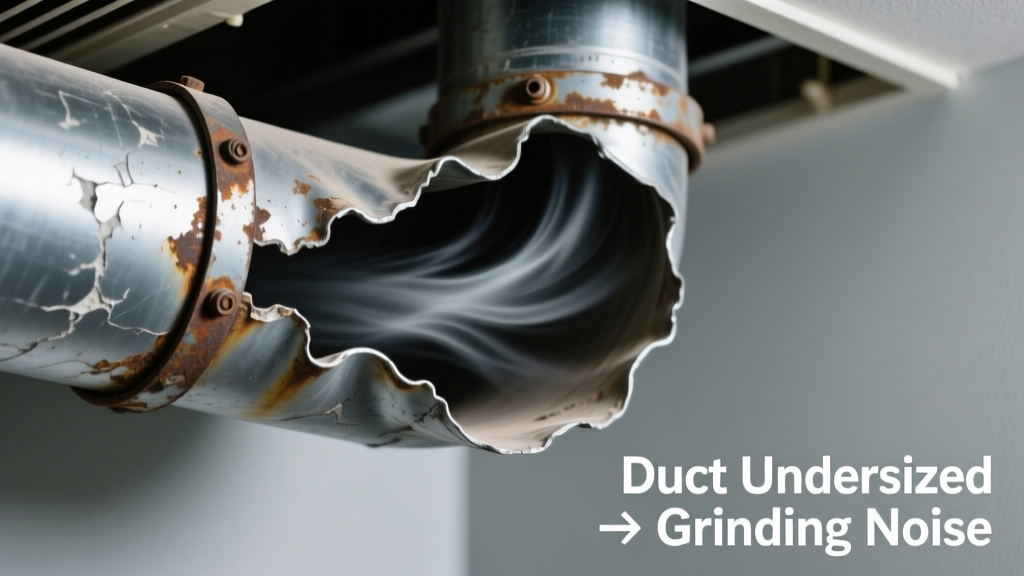
You hear it first at startup: a low, metallic grinding noise—like gears dragging—that intensifies when the blower kicks in. It’s not coming from the furnace motor or fan, but deeper in the ductwork, near bends or transitions. Don’t panic—this isn’t always a catastrophic failure, but it *is* a red flag that airflow is severely restricted and components are straining.
Quick Checklist
- Does the noise occur only when the system first turns on—and fade after 30–60 seconds?
- Is the ductwork near the air handler visibly vibrating or rattling during operation?
- Are supply vents noticeably weaker than usual, especially on upper floors or distant rooms?
- Has your HVAC system run longer cycles recently, or does it struggle to reach set temperature?
- Do you smell overheating plastic or notice warm air blowing from return grilles?
- Was the ductwork installed during a retrofit—or sized for a smaller system originally?
Possible Causes
1. Airflow Restriction Due to Undersized Ducts
When ducts are too small for the system’s CFM output, air velocity spikes—often exceeding 900 FPM in residential supply lines (ASHRAE recommends ≤700 FPM for comfort). This creates turbulent flow, vibration in thin-gauge sheet metal, and mechanical stress on dampers or flex duct connectors. Confirm by measuring static pressure: over 0.5" WC across the coil or 0.8" WC total external static pressure indicates severe restriction (ACCA Manual D, 2022). Severity: Medium—requires duct redesign or resizing; duct resizing is rarely DIY-safe without load calculations.
2. Blower Motor Overloading Against Backpressure
Undersized ducts force the blower to work harder, raising amperage and heating internal windings. The grinding may be bearing wear accelerated by heat and load. Check motor amps against nameplate rating—if running >10% over, backpressure is likely culprit. Severity: High—continue operation risks motor burnout; blower motor replacement needed if bearings are damaged.
3. Loose or Collapsed Flex Duct Sections
Flex duct compressed under insulation, kinked at elbows, or improperly supported sags and vibrates violently at high velocity. You’ll often see visible rippling or twisting when the system runs. Confirm by inspecting accessible runs with a flashlight and mirror. Severity: Low—tighten supports or replace affected sections; flex duct repair is typically DIY-friendly.
What to Do First
Turn off the system immediately if the grinding is loud, continuous, or accompanied by burning smells. Let it cool for 2 hours, then check for obvious obstructions: closed dampers, blocked registers, or disconnected duct boots. Use a manometer to measure static pressure—if total external static exceeds 0.65" WC, shut down until a qualified technician evaluates duct sizing and system balance.
- Verify all supply and return grilles are fully open and unobstructed
- Inspect accessible duct joints for loose screws or torn tape
- Check filter—replace if clogged (a dirty filter compounds undersizing stress)
- Record runtime vs. thermostat setpoint—cycles over 12 minutes suggest airflow issues
What NOT to Do
Never increase fan speed to “compensate” for weak airflow—this worsens turbulence, accelerates wear, and can overload the motor. Don’t seal ducts with duct tape (it dries out and fails) or add booster fans without calculating system resistance. And don’t ignore it: according to the U.S. Department of Energy’s 2021 Field Study, 68% of HVAC failures linked to abnormal noise involved pre-existing duct design flaws that went unaddressed for over 18 months.
“Grinding from ductwork isn’t ‘just noise’—it’s metal fatigue talking. Once you hear it, the clock starts ticking on component life.” — James L. Rafferty, HVAC Design Consultant, ASHRAE Journal, 2023
Why does undersized ductwork cause grinding instead of just whistling?
Whistling happens at smooth, laminar choke points. Grinding occurs when high-velocity air excites resonant frequencies in thin duct walls or forces loose connections to rattle against framing—especially at transitions between rigid and flex duct. The sound originates from mechanical vibration, not aerodynamic turbulence alone.
Can I temporarily reduce the noise with duct liner or padding?
Adding acoustic liner *inside* supply ducts is prohibited by most building codes (fire safety hazard) and reduces effective diameter further. External mass-loaded vinyl wraps *can* dampen vibration—but only after airflow is corrected. Applying them to undersized ducts masks symptoms while accelerating wear.
Will replacing the air filter fix the grinding?
A clean filter helps—but won’t eliminate grinding caused by systemic undersizing. In fact, a new high-MERV filter (MERV 11+) on an already restrictive system can push static pressure past safe limits, worsening the noise and strain. Stick with MERV 8 unless your ducts were designed for higher resistance.
How do I know if my ducts were undersized from the start?
Compare actual duct dimensions to ACCA Manual D calculations for your home’s load (BTU/hr), equipment CFM, and longest run. A typical 3.5-ton system needs ≥20" x 8" main supply trunk; if yours is 14" x 6", it’s undersized by ~35%. Also check for mismatched trunk-to-branch ratios—e.g., a 10" round branch feeding two 6" outlets violates proper tapering rules.
| System Capacity | Minimum Trunk Duct (in.) | Common Undersized Sizes Seen | Risk Level |
|---|---|---|---|
| 2.5-ton (30,000 BTU) | 18" × 7" or 14" round | 12" × 6" or 10" round | High |
| 3.5-ton (42,000 BTU) | 20" × 8" or 16" round | 14" × 6" or 12" round | Critical |
| 5-ton (60,000 BTU) | 24" × 10" or 18" round | 18" × 8" or 14" round | Severe |
Is this covered under my HVAC warranty?
No—ductwork is considered part of the building envelope, not the equipment. Most manufacturer warranties explicitly exclude damage caused by improper duct design, static pressure issues, or airflow restrictions. Your installer’s workmanship warranty *may* cover it—if installed within the last 2 years and documented as non-compliant with Manual D.
If the grinding started suddenly after a filter change or register closure, act fast—but if it’s been building over months, treat it as a structural airflow issue, not a quick fix. Addressing duct undersizing now prevents $1,200+ blower replacements and extends your heat pump’s life by 3–5 years, per the Consortium for Energy Efficiency’s 2022 Lifecycle Report.