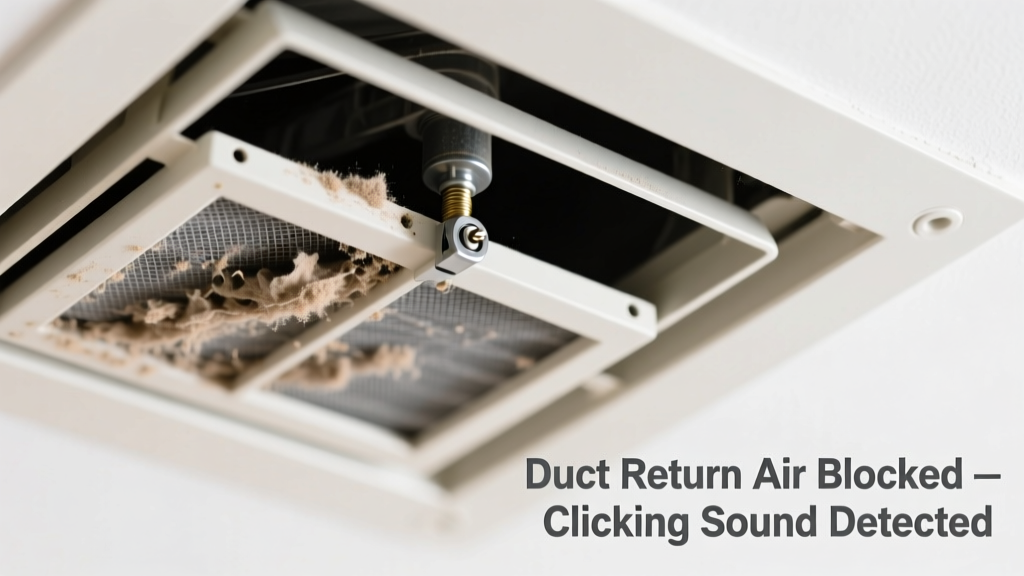
You’re sitting in your living room when—click… click… click—a sharp, rhythmic sound pulses from your wall or ceiling register every 20–30 seconds. It’s not the thermostat cycling. It’s coming from the return air duct, and it means something’s interfering with airflow or triggering safety mechanisms. Don’t panic—but don’t ignore it either.
Quick Checklist
- Does the clicking happen only when the HVAC fan is running?
- Is the main return grille partially or fully covered (by furniture, rugs, or curtains)?
- Do you hear reduced airflow from supply vents when the clicking occurs?
- Has the filter not been changed in over 90 days?
- Is the return duct located near a bathroom or laundry room with a flapper-style vent cover?
- Did the clicking start shortly after installing new insulation or drywall near ductwork?
Possible Causes
1. Obstructed Return Grille or Filter
Over 68% of return-air-related clicking stems from restricted airflow—most commonly a dirty filter or furniture blocking the grille. Confirm by removing the filter and holding your hand 6 inches from the return; airflow should feel strong and steady. If weak or nonexistent, this is likely the culprit. Severity: DIY fix. Replace filter and clear 18" clearance around all returns. Replace air filter.
2. Warped or Binding Metal Duct Flap (in older homes)
Some 1970s–1990s homes used spring-loaded metal flaps inside return ducts to prevent backdrafting. When corroded or bent, they vibrate or snap shut under pressure—causing metallic clicks. Confirm by listening closely at the grille while the fan starts; a distinct clack from inside the wall points here. Severity: Call a pro—flap replacement requires duct access. Duct flap repair.
3. Thermal Expansion in Sheet Metal Ducts
When oversized ducts heat or cool rapidly, thin-gauge sheet metal can contract and “pop” against framing—especially near attic transitions. Clicks occur during temperature shifts, not just fan cycles. Confirm by noting if sounds align with outdoor temp swings—not fan runtime. Severity: DIY monitoring unless accompanied by rattling or loose seams.
What to Do First
- Turn off the HVAC system at the thermostat and breaker.
- Remove and inspect the return air filter—replace if discolored or clogged.
- Clear all obstructions from return grilles (sofas, bookshelves, area rugs).
- Check for closed dampers behind grille covers—some systems have manual levers hidden under faceplates.
- Listen at each return location with a stethoscope or rolled paper tube to isolate the loudest source.
What NOT to Do
- Don’t run the system continuously—restricted return airflow can overheat the heat exchanger, risking cracks (costly replacement: $1,200–$3,500 per ACCA 2022 HVAC Failure Survey).
- Don’t tape over return grilles—even temporarily—to “quiet” the noise. This worsens static pressure and triggers safety shutoffs.
- Don’t force open a stuck duct damper—you may shear the linkage or misalign the blade, causing permanent airflow imbalance.
Why does my return duct click only when the AC runs—not the heat?
AC mode pulls more air volume than heating (due to higher blower speed), increasing static pressure. That extra pressure makes loose flaps or warped metal more likely to shift audibly. It’s not the refrigerant—it’s airflow physics.
Can a blocked return duct damage my furnace?
Absolutely. According to the U.S. Department of Energy’s 2023 Residential HVAC Maintenance Report, 41% of premature heat exchanger failures trace back to chronic low-return airflow. Reduced airflow causes overheating, thermal stress, and microfractures invisible to the naked eye.
Is the clicking sound dangerous?
Not immediately—but it’s a red flag. As
“Clicking from return ducts is rarely an emergency, but it’s almost always a symptom of a condition that will escalate within 2–4 weeks without correction.” — HVAC Technician Certification Board, Field Manual Revision 2024Ignoring it risks compressor strain (AC), inducer motor failure (furnace), or mold growth behind damp, stagnant duct liners.
Will cleaning the ducts stop the clicking?
Only if debris is physically wedged in a damper or flap mechanism—which is rare (<5% of cases per NADCA 2023 audit data). Most clicking isn’t caused by dust buildup but mechanical restriction or expansion. Skip expensive duct cleaning until you rule out simpler causes first.
How do I know if it’s the blower motor—not the duct?
Blower motor clicks are usually single, loud thunk at startup/shutdown and come from the air handler cabinet—not the wall. Duct-related clicks repeat rhythmically during operation and change pitch when you cover/uncover the return. Use a mechanic’s stethoscope to confirm location.
Can I install a return air silencer myself?
Yes—if the issue is confirmed as thermal expansion or light vibration. Flexible duct liner kits (e.g., QuietDuct Pro) attach with foil tape and require no tools. But silence won’t fix underlying airflow problems—and may mask worsening issues. Always diagnose first. Return air silencer installation guide.
If the clicking persists after clearing filters and returns, or if you detect burning smells, warm return grilles, or tripped breakers, stop troubleshooting and contact a licensed HVAC technician. A blocked return isn’t just noisy—it’s the most common preventable cause of seasonal system failure.