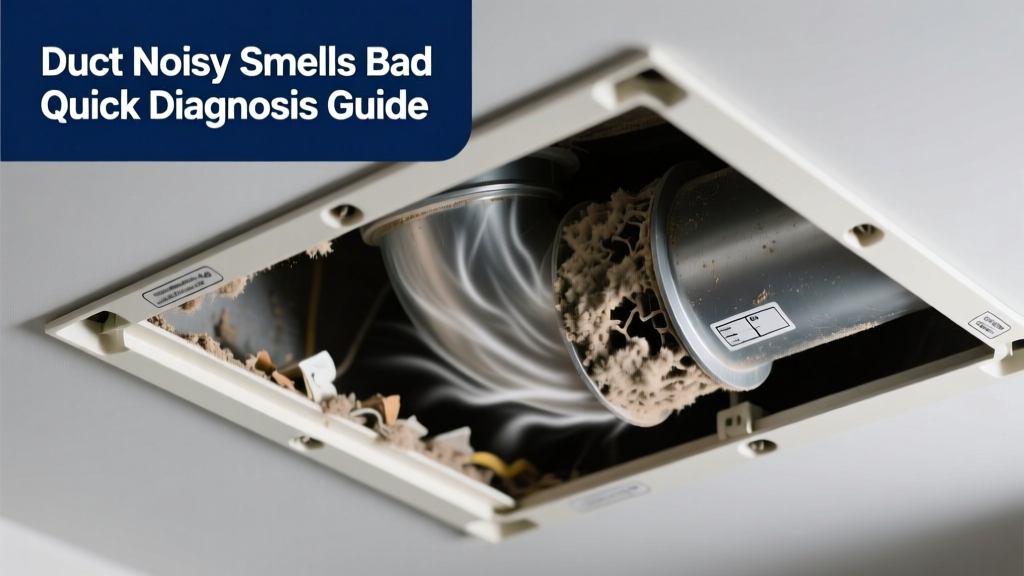
You hear a low rumble, a metallic rattle, or a high-pitched whine from your vents—and then it hits: a sour, musty, or even rotten-egg stench wafting through the living room. It’s unsettling, and it’s urgent. But before you panic or call a technician blindly, most causes are identifiable in under 10 minutes with simple observation and smell mapping.
Quick Checklist
- Does the noise happen only when the fan runs—or also when the system is off?
- Is the odor strongest near one vent, or does it spread evenly across rooms?
- Did the smell start after recent rain, flooding, or HVAC service?
- Do you hear scratching, thumping, or squeaking—not just airflow noise?
- Can you detect burning plastic, ozone, or overheated metal near the air handler?
- Has anyone recently used chemical cleaners, pesticides, or aerosol sprays near returns or vents?
Possible Causes
Mold or Bacterial Growth in Ducts or Drain Pan
Confirm by inspecting the indoor coil and drain pan (turn off power first): look for black slime, green fuzz, or standing water. Smell near the air handler while the blower runs—if it’s damp and earthy, this is likely. Severity: Moderate. DIY clean of accessible drain pan and filter replacement often helps; but if insulation inside ducts is wet or discolored, call a mold-certified duct cleaner. According to the U.S. EPA, 40% of residential HVAC-related odors stem from microbial growth in damp components (EPA Indoor Air Quality Tools for Schools, 2022).
Dead Animal or Nest in Ductwork or Attic
Confirm by checking attic access points, return grilles, and outdoor unit pads for entry holes, fur, droppings, or buzzing flies. Noise may include intermittent scratching or fluttering. Severity: High. Never attempt removal yourself—biohazards and structural risks require licensed wildlife control. Link to animal-in-ducts repair protocol.
Overheating Blower Motor or Wiring
Confirm by turning on fan-only mode for 5 minutes, then carefully feeling (not touching) the air handler cabinet. A sharp, acrid, or burnt-plastic smell means immediate shutdown. Severity: Critical. Turn off power at the breaker and call an HVAC technician—this is not a DIY fix. The National Fire Protection Association reports that 12% of home HVAC fires originate in blower assemblies (NFPA Electrical Equipment Fire Report, 2023).
What to Do First
- Turn off the system at the thermostat and circuit breaker.
- Replace the air filter—even if it looks clean (a clogged filter strains the motor and traps moisture).
- Open windows in affected rooms to ventilate and reduce inhalation exposure.
- Inspect visible duct seams, registers, and the air handler cabinet for obvious gaps, rust, or debris.
- If you suspect mold and see visible growth on accessible surfaces, wipe with a cloth dampened with 70% isopropyl alcohol—not bleach (which spreads spores).
What NOT to Do
- Don’t spray air fresheners, disinfectants, or ozone generators into ducts—they mask symptoms and damage coil coatings.
- Don’t run the system on ‘fan only’ for extended periods if odor persists—it circulates contaminants faster.
- Don’t seal duct leaks with duct tape—it degrades, off-gasses VOCs, and fails under temperature swings.
- Don’t ignore a sulfur (rotten egg) smell—it may indicate a gas leak upstream, not in ducts. If suspected, evacuate and call 911.
Why does the noise only happen when the heat kicks on—but the smell lingers all day?
This points to thermal expansion of contaminated duct lining or a cracked heat exchanger releasing combustion byproducts. The heat activates volatile organic compounds (VOCs) trapped in fiberglass insulation. Confirm by holding a tissue near supply vents during heating cycle—if it flutters strongly only during heat, check for cracked heat exchanger with a certified technician.
Could my new carpet installation cause this?
Yes—especially if installers sealed returns or blocked vents during work. Off-gassing from adhesives, padding, or flame retardants can be pulled into ducts and recirculated. Ventilate aggressively for 72 hours and run the system on ‘fan only’ with MERV-11 filter. Most VOCs dissipate within 5–7 days (California Department of Public Health, Standard Method V1.2, 2021).
Is it safe to keep using the AC if it smells like mildew but runs quietly?
No. Even without noise, persistent mildew indicates chronic moisture—likely from a clogged condensate line or undersized duct insulation. Left unaddressed, it spreads spores to bedding and upholstery. Replace the filter, clean the drain line with vinegar, and monitor for recurrence. If odor returns in 3–5 days, internal coil cleaning is needed.
Why does the smell get worse after I vacuum?
Vacuuming stirs up dust and dander—then your return grille pulls it straight into the duct system. If your filter hasn’t been changed in >90 days or is undersized (e.g., 1-inch MERV-5), contaminants bypass the filter and accumulate in duct walls. Upgrade to a 4-inch MERV-13 filter and replace every 90 days.
"A single mold colony in the evaporator coil can release over 10,000 spores per cubic foot of air—making odor detection a reliable early warning sign." — Dr. Lena Cho, ASHRAE Duct Cleaning Task Force, 2022
Duct Inspection & Contaminant Mapping Table
| Symptom Pattern | Most Likely Location | First Action |
|---|---|---|
| Musty smell + humming noise near bedroom vent | Flexible duct sagging behind drywall (trapping moisture) | Remove register cover and inspect for kinks or pooling condensation |
| Burning smell + fan won’t shut off | Fan limit switch failure or relay sticking | Power down immediately—do not reset thermostat |
| Rotten egg + hissing near furnace | Gas leak upstream of ductwork (not duct issue) | Evacuate and call gas company—do not flip switches |
| Wet-dog smell + dripping sound in attic | Clogged condensate drain line backing up into air handler | Check drain pan for overflow; flush line with 1 cup vinegar |
Once you’ve ruled out fire, gas, or wildlife hazards, most duct noise-and-odor cases resolve with targeted cleaning, component replacement, or airflow correction. Start with the checklist, trust your nose as a diagnostic tool, and remember: no HVAC system should smell like a basement in August—or sound like a freight train at idle.