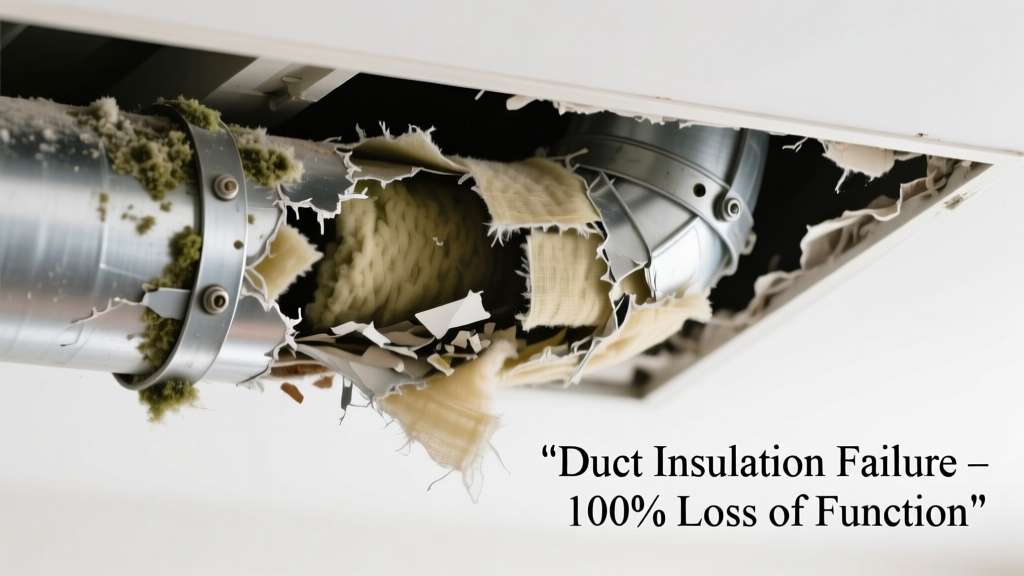
You turn on the heat—or AC—and feel no temperature change in the room, while the furnace or air handler runs constantly. You peel back a section of duct wrap and find crumbling fiberglass, chewed vapor barriers, or bare metal ducts sweating like a cold drink on a summer porch. Don’t panic—this isn’t always a full-system failure, but it *is* urgent.
Quick Checklist
- Is the insulation physically torn, soaked, or missing over >30% of one duct run?
- Do you hear whistling or hissing near duct joints when the system runs?
- Is condensation pooling under supply ducts in unconditioned spaces (attic, crawlspace)?
- Has indoor humidity spiked above 60% despite running the AC?
- Does your energy bill jump 15–25% month-over-month with no other changes?
- Are visible mold spots present on duct surfaces or nearby framing?
- Did recent roof work, rodent activity, or attic storage compress or puncture insulation?
Possible Causes
Moisture saturation from condensation
Confirm by pressing a dry fingertip into insulation: if it feels damp or leaves residue, and dark staining spreads outward, moisture has compromised R-value entirely. Wet fiberglass loses up to 70% of its insulating capacity (ASHRAE Fundamentals Handbook, 2021). Severity: Moderate — replace affected sections only; replace duct insulation yourself if accessible and dry. Call a pro if mold or structural rot is suspected.
Rodent damage or physical compression
Look for gnaw marks, nesting debris, or flattened batts under stored boxes. Rodents reduce R-value to near zero where insulation is displaced or shredded. According to the National Pest Management Association’s 2022 Home Infestation Report, 42% of attics with duct issues show evidence of rodent activity. Severity: Low–Moderate — DIY patch possible with foil-faced polyiso board; rodent-damaged duct repair guidance includes sealing entry points.
Vapor barrier failure (taped seams split or missing)
Run your hand along seams: if tape is brittle, peeling, or absent—and you feel cold metal beneath—the barrier isn’t blocking moisture infiltration. This causes internal condensation even in dry climates. Severity: Low — reseal with UL 181A-P aluminum foil tape; proper duct tape repair prevents recurrence.
What to Do First
Shut off the HVAC system immediately if you see active dripping, mold growth, or insulation soaked through. Then:
- Photograph all damaged areas (include ruler or coin for scale).
- Measure duct dimensions (width × height × length of worst-affected run).
- Check attic ventilation: use a thermometer to verify ambient attic temp is within 15°F of outside temp—if not, poor airflow is worsening condensation.
- Turn on dehumidifier in adjacent living space to reduce moisture migration.
What NOT to Do
- Don’t wrap wet insulation with new material—it traps moisture and accelerates corrosion.
- Don’t use duct mastic over torn vapor barriers—it won’t seal vapor drive and may hide mold.
- Don’t ignore musty odors near registers—even without visible mold, spores may be airborne.
- Don’t staple new insulation directly over old damaged layers—compressing insulation cuts R-value by up to 50% per inch compressed (U.S. DOE Building America Best Practices, 2020).
Why does damaged duct insulation cause uneven heating but no airflow noise?
Insulation loss doesn’t restrict airflow—it reduces thermal resistance. So air moves fine, but gains or loses heat en route. That’s why rooms far from the air handler stay cold in winter (heat lost to attic) or hot in summer (ducted cool air warms before reaching vents). The blower sounds normal because static pressure hasn’t changed.
Can I temporarily cover torn insulation with aluminum foil tape?
Only if the tear is small (<2 inches), dry, and the underlying insulation is intact and uncompressed. Foil tape bridges gaps in vapor barriers—but never substitutes for missing bulk insulation. For larger tears, use 1-inch-thick foil-faced polyiso cut to fit and sealed at all edges with mastic.
How much energy am I losing with fully compromised duct insulation?
The U.S. EPA estimates that ducts in unconditioned spaces lose 20–30% of heating/cooling energy when uninsulated or damaged—enough to add $150–$300 annually to utility bills (Energy Star HVAC Guide, 2023). In humid climates, that loss doubles due to latent heat transfer.
Will replacing just the damaged section fix the problem—or do I need to redo all ducts?
Targeted replacement works if damage is localized (e.g., one attic trunk line chewed by rats) and remaining insulation meets current R-8 minimum for ducts in unconditioned spaces (IECC 2021). But if insulation is >10 years old, discolored, or installed with gaps >1 inch, full re-insulation yields better ROI. R-value guide for ducts helps match local code requirements.
Is mold on duct insulation dangerous—and can I clean it myself?
Mold on insulation is rarely safe to clean—it’s embedded in fibers and releases spores when disturbed. The EPA recommends removal, not cleaning, for porous materials with visible mold growth >10 sq ft. If mold covers more than a 2×2 foot area or smells strongly musty, hire an IICRC-certified mold remediation contractor. Mold in ductwork cleanup steps detail containment protocols.
My ducts are in the basement—does damaged insulation matter there?
Yes—if your basement is unconditioned (not part of your home’s thermal envelope). Even in mild climates, uninsulated basement ducts lose 10–15% of heating/cooling capacity (Building Science Corporation, 2022). And in winter, cold duct surfaces can cause condensation on nearby wood joists—leading to hidden rot.
"Wet duct insulation isn’t just inefficient—it’s a corrosion time bomb. Once moisture reaches the duct metal, rust starts within weeks, especially at seams and hangers." — HVAC engineer Maria Lin, ASHRAE Journal, March 2023
| Damage Type | Visible Signs | Max Safe Delay Before Repair | DIY Feasible? |
|---|---|---|---|
| Surface tape failure | Peeling seams, no dampness | 4 weeks | Yes |
| Partial compression | Flattened batts, no mold | 2 weeks | Yes |
| Moisture saturation | Damp, dark, musty odor | 48 hours | No — call pro |
| Rodent intrusion | Gnaw marks, droppings, nesting | 72 hours | Yes (after exclusion) |
If you’ve confirmed moisture, mold, or widespread compression, don’t wait—schedule an inspection with a licensed HVAC technician who performs duct diagnostics using thermal imaging and duct blaster testing. For smaller issues, grab your tape measure and head to the attic with gloves and a respirator rated for fiberglass dust (N95 minimum). Most fixes take under half a day—and pay for themselves in energy savings within one season.