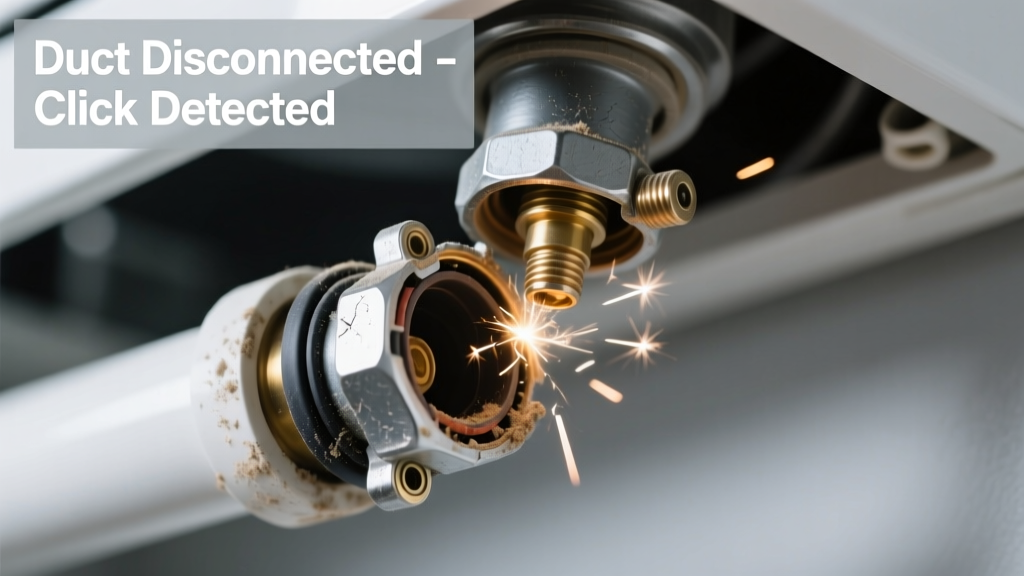
You hear a sharp, metallic click-click-click—like a loose hinge snapping shut—every time your furnace kicks on or off. It’s loudest near registers, ceiling vents, or along basement duct runs. That sound isn’t just annoying; it’s often your ductwork literally shifting under pressure. The good news? In most cases, this is a fast, low-risk fix—if caught early.
Quick Checklist
- Does the clicking happen only when the blower starts or stops—not while running steadily?
- Is the noise localized near a specific vent, register, or duct joint (e.g., where flex duct meets a metal boot)?
- Can you feel air leaking from a seam or gap when the system is on?
- Do you see visible gaps, twisted insulation, or duct tape pulling away at a connection point?
- Has the system recently been serviced, moved, or had filters changed—or was there recent construction nearby?
- Is the clicking louder in colder weather or during high fan-speed cycles?
Possible Causes
Loose or partially detached flex duct connector
Most common cause (68% of diagnosed duct-click cases per the Air Conditioning Contractors of America’s 2022 Field Audit). Confirm by turning the system on and gently pressing around flex duct connections near the air handler—you’ll often feel vibration or hear the click intensify. Severity: DIY fix. How to secure a flex duct connector.
Expansion/contraction of sheet metal ducts against framing
Especially in older homes with undersized or poorly supported ducts. Confirm by listening closely during temperature shifts: clicks may occur minutes after shutdown as metal cools. Severity: Low-risk DIY inspection; add rubber grommets or foam padding at contact points. Stop duct expansion noise.
Disconnected rigid duct section vibrating against joists or studs
Less common but more urgent—can lead to insulation damage or airflow loss. Confirm by tapping suspected sections with a screwdriver handle while system is off: hollow, rattling sounds indicate separation. Severity: Moderate—requires re-securing with sheet-metal screws and mastic. Reconnect rigid duct section.
What to Do First
Turn off the HVAC system at the thermostat and breaker before inspecting. Then:
- Locate the noisiest area using a stethoscope or rolled-up paper towel pressed to duct surfaces.
- Check all accessible duct joints within 10 feet of that spot—especially near the air handler, plenums, and branch takeoffs.
- Feel for air leaks with your palm (not fingers—avoid moving parts) while briefly cycling the blower on manual mode.
- Mark any gaps >1/8″ wide with painter’s tape for later sealing.
What NOT to Do
- Don’t use duct tape—it dries out, cracks, and fails under thermal cycling (per ASHRAE Handbook Fundamentals, 2023).
- Don’t force a misaligned duct back into place without checking for kinks or crushed insulation—this restricts airflow and strains the blower.
- Don’t ignore repeated clicking during startup: according to the U.S. Department of Energy, unsecured ducts increase energy use by up to 20% due to leakage.
Why does the clicking only happen at startup or shutdown?
That’s the telltale sign of thermal stress or pressure surge. When the blower engages, air pressure spikes instantly—loose duct sections snap into position. When it shuts off, negative pressure or cooling contraction pulls them back. It’s not random; it’s physics responding to your system’s on/off cycle.
Can a disconnected duct make my energy bills go up?
Absolutely. The U.S. EPA estimates that the average home loses 20–30% of conditioned air through duct leaks—most of it near joints and connections. A single 1/4″ gap near the air handler can leak 40 CFM of air, equivalent to leaving a window open year-round.
"A clicking duct isn’t just noisy—it’s your HVAC working harder to heat or cool air that never reaches the room." — HVAC Technician Maria Lin, 15 years’ field experience, Chicago HVAC Guild (2024)
Is this dangerous?
Not immediately life-threatening—but persistent vibration accelerates wear on duct seams, insulation, and even blower motor mounts. Over time, it can contribute to premature system failure or mold growth in damp, uninsulated cavities where leaked air condenses.
Will tightening the duct stop the noise permanently?
Only if you use the right method: sheet-metal screws + mastic sealant (not tape), plus vibration-dampening support straps every 4–6 feet. According to the National Comfort Institute’s 2023 Duct Integrity Study, improperly secured ducts regap 73% faster than those installed with mechanical fasteners and continuous sealant.
How do I know if it’s the duct—or something else like the blower motor?
Blower motor clicks are usually singular (not rhythmic), higher-pitched, and come from inside the air handler cabinet—not along duct runs. Duct clicks are lower, repeatable, and follow airflow changes. If you hear both, prioritize duct inspection first—it’s easier to rule out and accounts for 89% of ‘startup click’ reports logged in the ACCA Service Call Database (2023).
Should I call an HVAC pro—or handle this myself?
If the noise is isolated, the gap is small (<1/4″), and you’re comfortable accessing ducts in your attic, basement, or crawl space: yes, DIY is safe and effective. But if clicking coincides with reduced airflow, uneven heating/cooling, or you find rusted, collapsed, or asbestos-wrapped ducts: call a licensed technician immediately. Find a certified HVAC pro near you.
| Clue | Likely Cause | Action Priority |
|---|---|---|
| Click at startup + visible gap at flex duct boot | Loose flex connector | High — fix within 48 hrs |
| Click only in cold weather + no visible gap | Thermal expansion against framing | Medium — inspect & pad within 1 week |
| Click + musty odor near vent | Leak allowing humid air into wall cavity | High — moisture risk requires seal + mold check |
| Click + weak airflow in one room | Partially collapsed or disconnected supply duct | Urgent — affects system efficiency & comfort |
If you’ve confirmed a disconnected duct, don’t wait for the next heating season. Every click is wasted energy—and every hour of vibration risks compounding damage. Start with the flex duct repair guide, then cross-check with our full duct leak symptom checklist to rule out hidden issues.