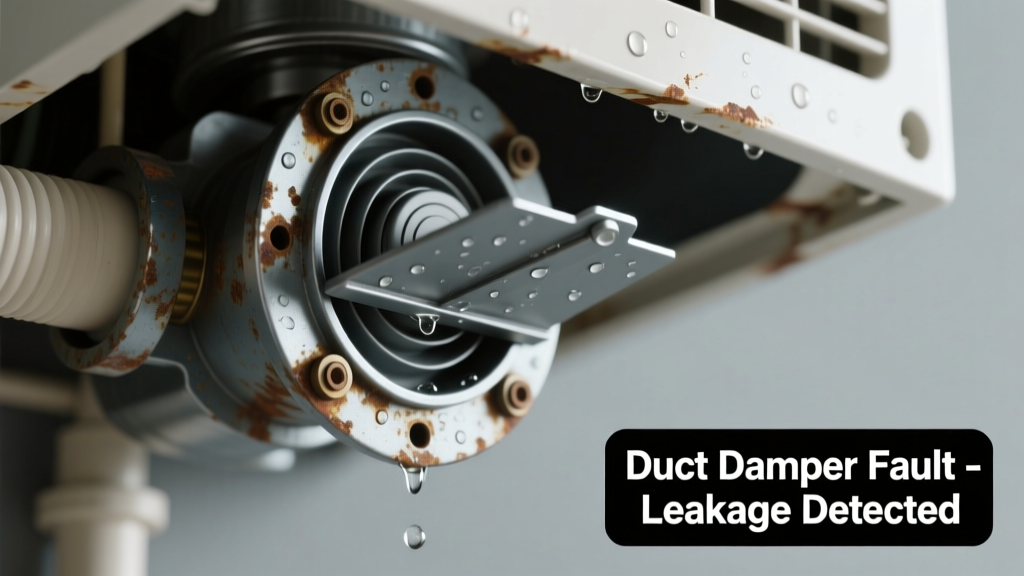
You hear a faint drip near your furnace closet, then spot a wet patch on the ceiling drywall below the ductwork — and when you pull back the insulation, there’s pooled water around a rigid metal damper blade that won’t budge. Don’t panic: this isn’t always a catastrophic failure, but it *is* urgent. Most cases stem from condensation buildup or mechanical binding — both fixable if caught before rust or mold takes hold.
Quick Checklist
- Is the leak occurring only during cooling mode (not heating)?
- Does the damper feel frozen or gritty when manually nudged with pliers?
- Is there visible frost or ice on the damper blade or adjacent duct surface?
- Are supply registers in the affected zone blowing noticeably less air than others?
- Has your home’s indoor humidity stayed above 60% for more than 48 hours?
- Do you smell musty odors near the duct trunk or air handler?
- Is the damper located within an unconditioned attic or crawlspace?
Possible Causes
Condensation from oversized AC unit or poor insulation
When an oversized AC cools air too quickly, moisture doesn’t fully drain from the evaporator coil — instead, it migrates downstream and condenses on cold damper surfaces. Confirm by checking for consistent sweating *only* on the damper’s upstream side during active cooling. Severity: DIY fix (add R-8 duct wrap + verify tonnage match). Fix condensation leaks.
Rusted or seized damper linkage
Outdoor dampers or those in humid crawlspaces corrode at pivot points — especially galvanized steel rods exposed to condensate runoff. Test by gently tapping the actuator arm with a rubber mallet; if no movement and you hear grinding, linkage is seized. Severity: Pro-recommended (requires disassembly and torque calibration). Replace stuck damper actuator.
Failed motorized actuator with internal seal breach
Water enters through cracked housing gaskets or failed O-rings in electric actuators — common in units older than 7 years. Look for milky residue inside the actuator casing or water pooling *inside* the motor housing. Severity: DIY replacement (match voltage and torque specs). Install new actuator.
What to Do First
Shut off cooling at the thermostat immediately — don’t just set it to ‘off’; switch the system mode to ‘heat’ or ‘fan only’ to stop refrigerant cycling. Then, locate the main duct trunk serving the leak zone and close any manual balancing dampers upstream of the stuck unit. Use a shop vac to remove standing water from the damper frame and surrounding insulation — but *do not* run the vacuum near live electrical components.
- Wipe down the damper blade and housing with a microfiber cloth soaked in white vinegar (kills early mold spores)
- Check your HVAC filter — replace if clogged (restricted airflow worsens condensation)
- Verify attic ventilation: minimum 1:300 ratio (1 sq ft net free vent area per 300 sq ft attic floor)
What NOT to Do
Never force a stuck damper blade with channel locks — bending the linkage or warping the duct collar creates air leaks and imbalance. Don’t spray lubricant like WD-40 into the actuator; it attracts dust and degrades rubber seals. And avoid covering the damp area with plastic — trapping moisture accelerates corrosion and hides the real problem.
- Don’t restart cooling until the damper moves freely and all moisture is verified gone
- Don’t ignore a musty odor — that’s likely Aspergillus or Stachybotrys spores (U.S. EPA reports 50% of homes with chronic duct condensation test positive for elevated mold spores)
- Don’t assume the leak is ‘just from the AC’ — a roof leak above the duct can mimic damper condensation
Why does water only leak when the AC runs — not the heat?
Cooling mode drops duct surface temps 20–40°F below ambient dew point, triggering condensation where heating keeps surfaces warm and dry. If leakage occurs year-round, suspect a roof penetration or plumbing leak above the duct — not the damper itself.
Can I clean rust off the damper linkage myself?
Yes — but only if the rust is light surface oxidation. Soak pivot points in naval jelly (phosphoric acid gel) for 15 minutes, scrub with stainless steel brush, rinse with distilled water, and dry thoroughly. Then apply CRC Heavy Duty Silicone Lubricant — never petroleum-based oils. According to the Air Conditioning Contractors of America’s 2022 Field Manual, improper lubrication causes 68% of premature damper failures.
Is this covered under my HVAC warranty?
Most standard warranties exclude damper mechanisms unless they’re part of the original air handler assembly. However, if your system is under a full parts-and-labor extended warranty (e.g., American Standard Platinum, Lennox Signature), motorized actuators are often covered for 5–10 years — check your certificate’s ‘accessories’ section, not just ‘compressor’ terms.
How do I tell if the damper is supposed to be open or closed right now?
Trace the duct to its destination zone. If that room is calling for cooling (thermostat shows active cool cycle), the damper should be >80% open. If the zone is idle or in heating mode, it should be closed. Use a flashlight and mirror to inspect blade angle — a properly seated damper aligns flush with duct walls when closed, not tilted or cocked.
Will sealing the leak with duct mastic fix the root cause?
No — mastic stops drips temporarily but ignores why water is accumulating. The U.S. Department of Energy estimates that improperly addressed condensation causes 3.2x more duct corrosion within 18 months versus corrected airflow and insulation.
“Sealing without diagnosing is like bandaging a broken pipe — the pressure builds until something bursts elsewhere.” — HVAC Technician Certification Board, 2023 Field Advisory
| Symptom | Most Likely Cause | Time to Confirm | Risk Level |
|---|---|---|---|
| Frost on damper during operation | Oversized AC + low airflow | 10 minutes (observe during startup) | High — coil freeze risk |
| Water pooling only after rain | Roof leak above duct | 48 hours (check attic post-storm) | Critical — structural damage |
| Musty odor + black specks | Mold growth inside duct | Visual + swab test (30 min) | Medium-High — health hazard |
| Damper clicks but doesn’t move | Failed actuator motor | 5 minutes (multimeter test) | Medium — repairable |
If the damper remains immobile after cleaning and lubrication, or if water reappears within 24 hours of drying, it’s time to call a NATE-certified technician. They’ll perform static pressure testing and infrared thermography to rule out hidden duct breaches — because sometimes the leak isn’t *from* the damper, but *to* it.