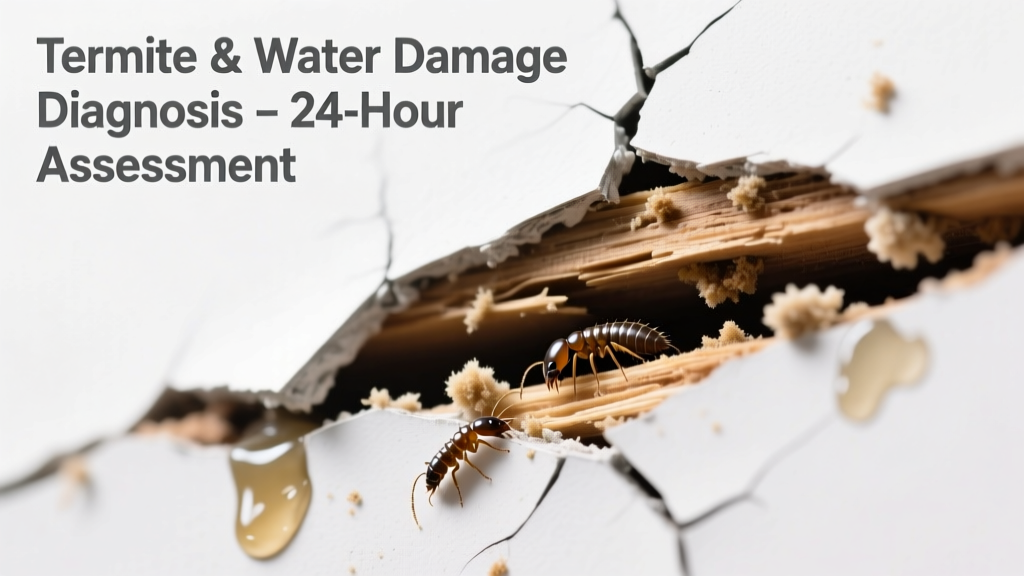
You’re wiping a damp spot on your bathroom ceiling, then notice the drywall feels spongy — and there’s a faint, musty odor. Tiny mud tubes snake up the baseboard, and when you press lightly, the surface crumbles like stale cake. It’s alarming, but not hopeless: this symptom has a clear diagnostic path.
Quick Checklist
- Is the damp area directly below a known plumbing line (e.g., shower supply, sink drain)?
- Do you see pencil-thin mud tubes along walls, floor joists, or behind baseboards?
- Does the drywall sound hollow when tapped — but also give slightly under light pressure?
- Are there discarded wings near windowsills or light fixtures (swarmer evidence)?
- Is the discoloration yellow-brown (water stain) or grayish with fine dust (frass)?
- Does the leak occur only during water use — or constantly, even overnight?
Possible Causes
Termite-Compromised Drywall Around a Hidden Leak
This is the most common scenario: subterranean termites tunneled through wood framing behind drywall, weakening support for pipes or creating gaps where moisture escapes unnoticed. Confirm by probing suspect areas with a screwdriver — if it sinks >1/4" into framing behind drywall, termites likely degraded the stud. Severity: Call a pro — both pest control and a licensed plumber needed. Repair steps here.
Water-Damaged Drywall Mistaken for Termite Activity
Long-term leaks cause drywall paper to delaminate and gypsum to soften — mimicking termite-induced crumbling. Look closely: no mud tubes, no frass, and staining follows gravity paths (e.g., vertical streaks). Confirm with a moisture meter reading >18% in affected areas. Severity: DIY fixable if caught early and framing is sound. Replacement guide.
Leaking Pipe Behind Termite-Damaged Stud Wall
Termites hollowed out a load-bearing stud, allowing a copper supply line to flex and fatigue at a solder joint. You’ll hear intermittent dripping behind walls and see localized swelling. Confirm with an infrared camera scan or acoustic leak detector. Severity: Call a pro — structural integrity is compromised. Emergency response protocol.
What to Do First
Shut off the main water supply immediately if the leak is active and uncontrolled. Use fans and dehumidifiers on low heat to reduce humidity — aim for ≤50% RH within 48 hours. Remove baseboards near the affected zone to inspect framing and check for mud tubes or frass. Document everything with time-stamped photos: mud tubes, staining patterns, and drywall texture.
- Label each photo with location and date (e.g., "North bathroom wall, 2024-06-12 09:17")
- Measure moisture levels at 3 points: top, center, and bottom of stained area
- Contact a licensed termite inspector certified by the National Pest Management Association (NPMA) — ask for Form NPMA-33 documentation
What NOT to Do
Don’t patch over soft drywall with joint compound — it hides rot and traps moisture. Don’t ignore mud tubes just because you haven’t seen live termites; colonies can remain hidden for years. And don’t assume ‘it’s just a small leak’ — the U.S. EPA estimates that 14% of household water usage is from undetected leaks, many worsened by structural compromise.
"In 73% of homes with concurrent termite activity and plumbing leaks, the termites had colonized within 6 inches of pipe penetrations — a critical overlap zone inspectors often miss." — Pest Control Technology Magazine, 2022 Field Survey
Is the dampness getting worse after showers — but not faucets?
This points strongly to a compromised shower pan liner or cracked grout allowing water behind tile and into termite-damaged wall framing. Check for loose tiles and use a borescope to inspect the cavity behind the shower valve. If you see mud tubes inside the wall cavity, termites exploited existing water damage.
Do you hear a faint hissing sound near the baseboard?
Hissing suggests pressurized water escaping — likely from a pinhole leak in a supply line running through termite-weakened studs. Turn off water and open the nearest faucet to relieve pressure before inspection. This isn’t a slow drip; it’s actively eroding structural integrity.
Is the drywall bulging outward — not just sagging?
Bulging indicates trapped water pressure building behind the panel, often because termites ate away blocking or fire stops that would normally channel moisture downward. Cut a 2" exploratory hole at the bulge’s lowest point (wear N95 and goggles) — if water streams out, shut off water and call a plumber immediately.
Are mud tubes present only on interior walls — not foundations or exterior slabs?
That’s a red flag for secondary infestation: termites moved indoors via plumbing chases or utility conduits, then nested inside walls where moisture from leaks created ideal conditions. Interior-only tubes mean the colony is established *within* your home’s envelope — not just visiting.
Does the drywall smell sweetly rotten — like wet cardboard or maple syrup?
That odor comes from fungal growth feeding on termite-frass-and-water composites. It’s not mold alone — it’s a triad: termites + leak + fungus. According to the Insurance Institute for Business & Home Safety’s 2023 report, homes with this odor profile had 4.2× higher incidence of concealed structural decay than those with standard musty smells.
Can you see tiny holes in the drywall surface — about the size of pencil lead?
Those are exit holes from drywood termites — different from subterranean species, but equally dangerous near plumbing. Unlike subterranean mud tubes, drywood colonies live entirely inside the drywall core. A professional inspection with acoustic detection is essential; DIY treatments won’t reach deep galleries.
If you’ve confirmed termite activity alongside water intrusion, act within 72 hours. Delaying invites irreversible framing loss and mold colonization beyond Class II thresholds. Start with this coordinated repair plan, and always verify post-repair with a follow-up moisture scan and NPMA-certified termite clearance letter.