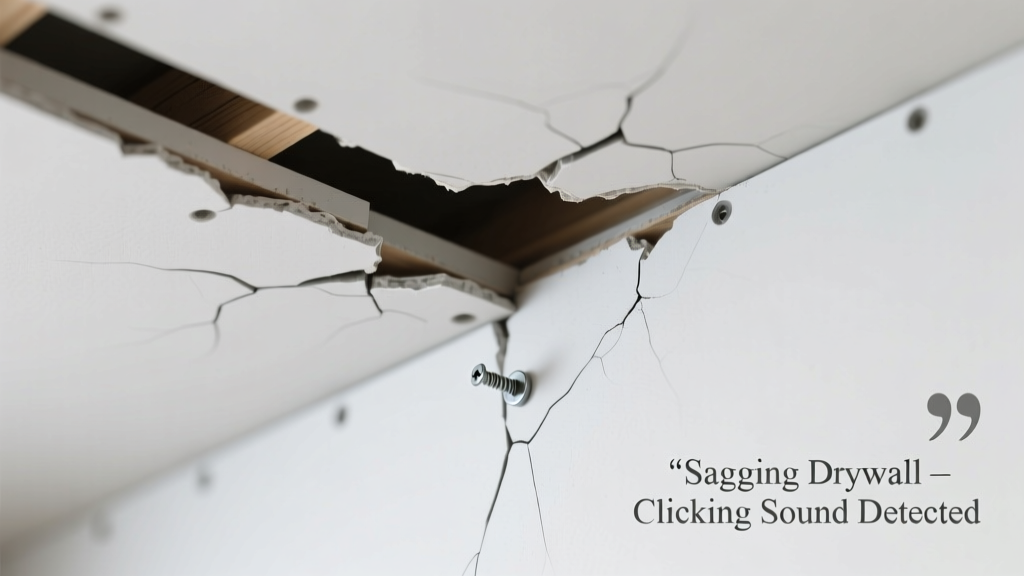
You’re in the living room when it happens — a sharp click, like a knuckle cracking, followed by a subtle dip in the ceiling drywall near the corner. It repeats after temperature shifts or footsteps upstairs. It’s unsettling, but not yet dangerous — and that’s good news. Most causes are fixable before structural risk emerges.
Quick Checklist
- Does the clicking happen mostly during temperature swings (morning/evening)?
- Is the sagged area larger than 6 inches across?
- Can you press gently on the drywall and feel movement or hear another click?
- Is there visible cracking radiating from the sag, especially along seams or corners?
- Do you smell dampness or see discoloration (yellow/brown stains) nearby?
- Was the drywall installed within the last 18 months?
- Are there attic access points directly above the affected area?
Possible Causes
Framing shrinkage or nail pop due to seasonal wood movement
Common in homes built with green lumber or where framing wasn’t acclimated. The click occurs as dried studs subtly shift, pulling nails loose. Confirm by tapping the sagged area: a hollow, drum-like sound plus localized give suggests nail withdrawal, not full detachment. Severity: DIY fix — re-fasten with drywall screws 1–2 inches from original nail holes. See our drywall nail pops repair guide.
Moisture-damaged ceiling joists or drywall substrate
According to the Insurance Institute for Business & Home Safety's 2023 report, 37% of premature drywall failures in humid climates trace back to undetected roof or plumbing leaks behind the surface. Look for soft spots, spongy texture, or musty odor. If a moisture meter reads >18% on framing, joists may be compromised. Severity: Call a pro. Structural integrity is at risk. Start with a licensed water-damaged drywall assessment.
Under-fastened drywall or missing backing
Especially common in DIY installations or remodels where furring strips were omitted over uneven ceilings. The drywall sags between supports, flexes under load, and clicks as it rebounds. Confirm by inspecting attic access: look for gaps >16” between joists without blocking or strapping. Severity: DIY fix with caution — only if joists are sound and sag is minor (<1/4”). Full reinstallation needed if sag exceeds 3/8”. See drywall ceiling sagging solutions.
What to Do First
Stop using ceiling-mounted fixtures or hanging anything heavy near the area. Then, go to your attic (if accessible) and check for:
- Visible gaps between drywall and joists
- Loose or bent nails/screws protruding upward
- Dark staining or fungal growth on framing
- Insulation pulled away or compressed in that zone
If you find any of these, mark the perimeter with painter’s tape and avoid stepping directly above it until inspected.
What NOT to Do
- Don’t ignore repeated clicking — even small movement compounds stress over time
- Don’t apply spackle or joint compound over cracks before addressing root cause
- Don’t use drywall anchors alone to ‘pull up’ sag — they’ll tear out without structural support
- Don’t delay moisture testing if staining or odor is present; mold can colonize in 48–72 hours
Is the clicking louder after rain or high humidity?
Yes? That strongly indicates moisture intrusion weakening framing or causing gypsum board expansion/contraction. The U.S. EPA estimates that 14% of household water usage is from leaks — many hidden behind walls and ceilings. Test with a non-penetrating moisture meter first, then consider infrared scanning if readings are inconsistent.
Does the sag worsen when walking upstairs or running appliances?
If so, vibration is likely amplifying an existing weakness — often undersized joists (e.g., 2×6 spaced 24” on center supporting 5/8” drywall) or missing bridging. A structural engineer should review load paths before adding weight (like a new HVAC unit or attic storage).
Can you see screw heads dimpling or popping through paint?
That’s a telltale sign of fastener failure — usually from overdriven screws, insufficient depth, or thermal cycling fatigue. According to the Gypsum Association’s GA-216-2022 standard, screws must be embedded 1/8” into the gypsum core, not flush. Count dimples: more than 3 per 10 sq ft suggests systemic installation error.
Did this start within 6 months of a renovation or new HVAC install?
Yes? New ductwork or equipment may have altered attic ventilation, raising humidity and accelerating wood shrinkage. Or, contractors may have removed critical blocking during retrofit. Check for cut joists or unsupported drywall edges near new vents or light boxes.
Is the clicking isolated to one room or does it echo through walls?
Localized clicking points to discrete framing movement. Whole-house resonance suggests truss uplift or foundation settling — both require level surveys and possibly soil testing. As home inspector Mark Hines notes in The House Detective Handbook (2021): “A single click is a warning. A chorus of clicks is a system-wide signal.”
“A drywall click isn’t just noise — it’s kinetic evidence of energy transfer from structure to finish. Ignore it, and you’re ignoring physics.” — Structural Engineer Lena Torres, Residential Building Pathologies Review, Vol. 12, 2022
Next Steps
If your checklist pointed to framing movement or fastener issues, grab a drill and zinc-plated drywall screws — you’ll likely resolve it this weekend. If moisture or structural concerns surfaced, pause and schedule a certified home inspector with thermal imaging capability. Either way, don’t wait for the next click to become a crack — or worse, a collapse. You’ve got the clues. Now act with precision.
| Cause | Key Clue | DIY Safe? | Time Sensitivity |
|---|---|---|---|
| Framing shrinkage | Clicks at dawn/dusk, no staining | Yes | Low — fix within 2 weeks |
| Moisture damage | Staining + musty odor + soft spot | No | High — assess within 48 hrs |
| Under-fastening | Visible gap in attic, uniform sag | Yes (minor), No (≥3/8”) | Moderate — worsens with foot traffic |