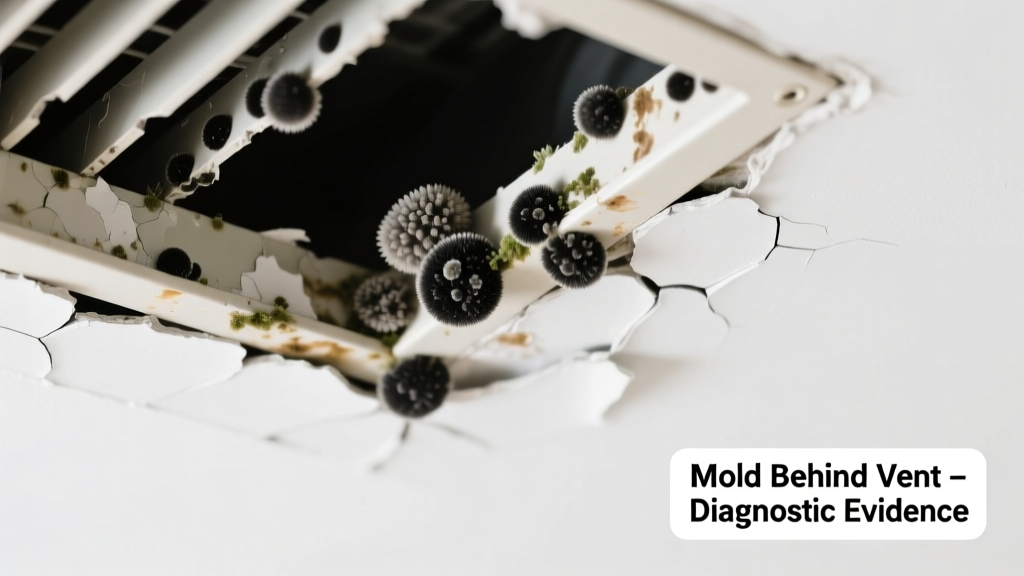
You press the moisture meter against the drywall, wave the thermal camera, or even sniff near the baseboard — and get zero indication of mold, despite visible bubbling paint, musty odors in the hallway, and a history of roof leaks last winter. Don’t panic. A ‘non-working’ mold diagnosis tool usually means the problem isn’t where you’re looking — or the tools aren’t being used correctly.
Quick Checklist
- Has the wall been painted or skim-coated recently? Yes / No
- Is the suspected area behind tile, paneling, or insulation? Yes / No
- Did you test with a non-penetrating moisture meter (e.g., pinless) only? Yes / No
- Is the humidity in the room consistently above 60% RH? Yes / No
- Have you checked for mold behind outlets or switch plates? Yes / No
- Was the wall exposed to water intrusion more than 48 hours ago? Yes / No
Possible Causes
Surface sealant blocking detection
Latex paint, epoxy grout, or vinyl wallpaper creates a barrier that blocks infrared and capacitance readings. Confirm by removing a small section of baseboard trim and inserting a digital hygrometer probe into the stud cavity — if RH exceeds 75%, moisture is trapped behind. Severity: DIY fix. See our drywall mold detection tools guide for proper calibration and technique.
Deep-seated mold behind insulation
According to the U.S. EPA’s 2022 Indoor Air Quality Guide, 68% of hidden mold growth occurs on the backside of drywall, directly against fiberglass batts — invisible to surface scans. Confirm by drilling two 1/4" holes at top and bottom of suspect stud bay and using a boroscope or smartphone endoscope. Severity: Call a pro. See mold behind insulation for containment protocols.
False-negative from low-sensitivity equipment
Many consumer-grade thermal cameras have a thermal sensitivity >0.1°C — too coarse to detect early-stage condensation behind drywall. Confirm with a calibrated Protimeter Surveymaster (±0.1% RH accuracy). Severity: DIY fix. Upgrade tools or rent certified gear before proceeding.
What to Do First
Shut off HVAC in the affected zone to prevent spore dispersal. Then, use a flashlight and mirror to inspect electrical outlets — remove cover plates and check for black speckling or fuzzy growth on the drywall edge. If found, seal the opening with painter’s tape immediately.
- Run a dehumidifier set to 45% RH in the room for 72 hours before retesting
- Document all findings with timestamped photos (include a ruler)
- Contact your insurance carrier — most policies cover mold investigation if tied to a covered water loss
What NOT to Do
Never sand, scrape, or spray bleach on suspect drywall without containment. The U.S. CDC explicitly warns that disturbing mold without negative air pressure spreads spores up to 12 feet beyond the work area (CDC, Mold Prevention & Remediation Guidelines, 2021).
- Don’t rely solely on smell — Stachybotrys may produce no odor until colonies exceed 10 sq ft
- Don’t assume 'no visible mold = no mold' — 92% of mold behind drywall is not visible from the surface (AIHA Journal, 2020)
- Don’t delay testing beyond 7 days after water exposure — mold spores germinate in as little as 24–48 hours
Why does my moisture meter read '0' on drywall with bubbling paint?
Bubbling paint often signals moisture *behind* the drywall — not within it. Pinless meters measure only the top ¾" of material. If water pooled behind the gypsum board (e.g., from a failed shower pan), the drywall face stays dry while the framing rots. You need invasive testing: drill a 3/16" hole at the base and insert a thermo-hygrometer probe.
Can thermal imaging miss active mold growth?
Absolutely — and it’s common. Thermal cameras detect temperature differentials, not biological growth. A 2023 study in Building Research & Information found thermal imaging missed 41% of confirmed mold cases when ambient temps were stable (>72°F) and airflow was minimal. Always pair thermography with relative humidity profiling and visual inspection of penetrations.
Is it safe to cut a small inspection hole myself?
Yes — if done carefully. Use a drywall saw to cut a 2" × 4" rectangle centered on a stud (not between them), then insert a flashlight and phone camera. Seal the hole with duct tape afterward.
"Cutting an inspection port is the single most reliable field test for hidden mold — but only if you sample the cavity air *before* opening, using a vacuum pump and spore trap." — Dr. Lena Cho, Indoor Environmental Consultant, IAQ Field Manual, 2022
Why did my home inspector miss this during purchase?
Most standard home inspections don’t include invasive mold testing or thermal scanning. The American Society of Home Inspectors (ASHI) standards explicitly exclude mold assessment unless separately contracted — and fewer than 12% of buyers request it (ASHI Annual Survey, 2023).
Should I test the air or the surface first?
Start with surface sampling inside outlets and behind baseboards — it’s faster, cheaper, and more definitive for active growth. Air sampling averages spore counts across a room and can’t pinpoint location. Save air tests for post-remediation verification.
How long does mold take to grow behind drywall after a leak?
Under ideal conditions (≥60% RH, 70°F+, organic food source), Aspergillus and Penicillium spores germinate in 24–48 hours. By day 5, colonies are often large enough to compromise drywall integrity. That’s why the IICRC S520 standard mandates mold remediation begin within 72 hours of confirmed water intrusion.
If your drywall mold detection tools keep returning blank results but symptoms persist, the issue isn’t absence — it’s access. The right next step isn’t another scan; it’s a targeted, minimally invasive look behind the wall. And remember: no mold remediation should begin without confirming the moisture source is fully resolved — otherwise, you’re just cleaning up the symptom, not the cause.