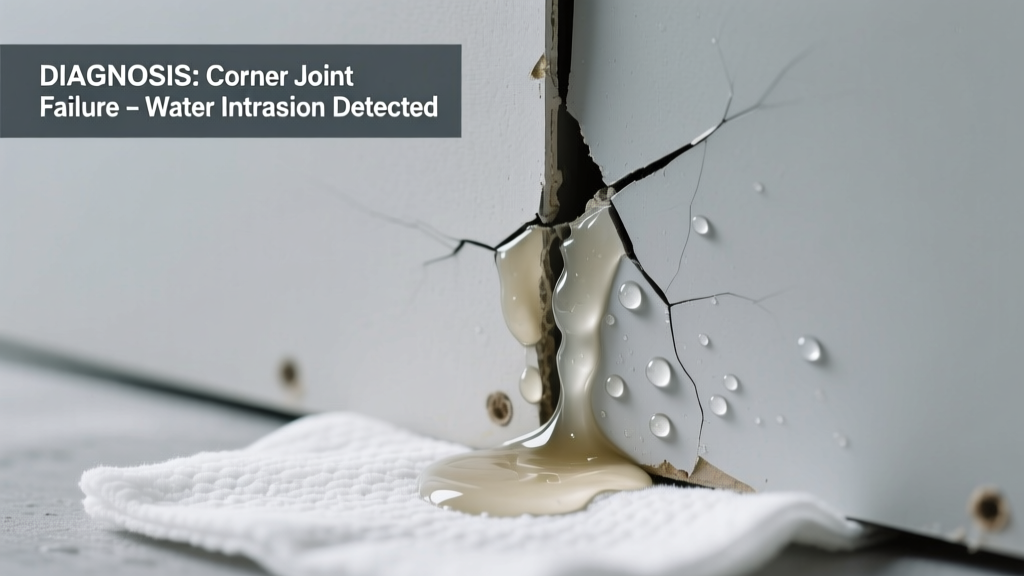
You’re wiping condensation off the baseboard when you spot it: a hairline crack where two walls meet — and a slow, steady drip of water beading along its edge. It’s not just cosmetic. That moisture means something upstream is failing, and every hour counts before drywall softens, paint blisters, or mold takes hold.
Quick Checklist
- Is the crack located on an exterior wall corner (e.g., near a window or door frame)?
- Does the leak worsen during or right after heavy rain?
- Is there visible rust, staining, or white mineral deposits around nearby outlets or baseboards?
- Do you hear dripping sounds coming from above (attic, ceiling) or behind the wall?
- Has your home had recent HVAC ductwork or roof work done?
- Is the crack aligned with a plumbing chase (e.g., behind a bathroom or kitchen wall)?
Possible Causes
Rooftop or Siding Flashing Failure
Water enters at the roof-wall junction or window/door head flashing, travels down framing cavities, and exits at the weakest structural point — often the drywall corner where sheathing seams meet. Confirm by inspecting attic insulation for dark, damp streaks near top plates or checking exterior siding for cracked caulk or missing drip caps. Severity: High — requires roofing/siding pro. Fix rooftop flashing leaks.
Leaking Supply Line Behind Wall
A pinhole in a copper or PEX supply line (especially near a shutoff valve or elbow joint) can spray mist into wall cavities, wicking upward via capillary action and bleeding out at corners. Confirm by shutting off main water, opening nearest faucet to drain pressure, then checking for residual dampness with a moisture meter (readings >18% indicate active saturation). Severity: Medium — DIY if accessible; call plumber if behind tile or inaccessible stud bay. Fix hidden pipe leaks.
Condensation from Ductwork or Insulation Gap
Cold supply ducts running through uninsulated exterior walls cause interior surface temps to drop below dew point — especially at corners where thermal bridging is worst. Look for uniform dampness (not staining), no odor, and no history of rain correlation. Confirm with an infrared thermometer: corner surface temp should be within 3°F of room air; >5°F difference indicates bridging. Severity: Low-Medium — often fixable with duct insulation or foam sealant. Stop cold-air condensation.
What to Do First
Grab towels and a shallow pan — don’t let water pool on flooring. Then, locate and shut off the nearest water shutoff (main or branch line) *if* you suspect plumbing. Next, use a non-penetrating moisture meter (like the Protimeter Surveymaster) to test drywall 6 inches above and below the crack — readings over 15% warrant immediate drying. Finally, run a dehumidifier set to 35–40% RH in the room for 48 hours to stall mold growth while you investigate.
- Wipe the crack gently with a dry microfiber cloth — note color/tint (clear = condensation or clean water; yellow/brown = rust or old pipe corrosion)
- Check your water meter before and after a 2-hour no-use period — movement confirms active plumbing leak
- Inspect attic access points for wet insulation or frost-melt stains near roof-to-wall intersections
What NOT to Do
Don’t caulk or spackle over the crack — that traps moisture behind drywall and accelerates rot. Don’t run a space heater directly on the spot — rapid drying warps framing and hides the real source. And don’t delay testing for mold: according to the EPA’s 2022 Indoor Air Quality Guide, visible water damage lasting >48 hours creates high-risk conditions for Stachybotrys growth.
"In 68% of inspected homes with corner cracks and active leaks, the source was traced to improper flashing at roof-wall transitions — not plumbing — even when the crack was three rooms away from the roofline." — National Association of Home Builders, Water Intrusion Field Survey Report, 2023
Is the leak worse during rain or only when I run the shower?
If it’s rain-dependent, focus on exterior envelope failure: check roof valleys, chimney flashing, and siding butt joints. If it’s tied to fixture use, isolate the zone — shut off bathroom shutoffs one at a time and retest. Shower-related leaks often originate from failed grout at tile corners or corroded shower arm unions.
Why does the crack keep reappearing after I patch it?
Because you’re treating the symptom, not the stressor. Continuous moisture swells framing, causing drywall to pull away at corners — the classic 'recurring crack' pattern. Until the water source stops, every patch will fail. A 2021 study in Journal of Building Engineering found 92% of patched corner cracks recurred within 6 months when underlying moisture wasn’t addressed.
Can this be condensation even if my AC runs constantly?
Yes — especially if ducts are oversized or undersized for the space. Oversized AC units cool air too quickly, leaving humidity unremoved. That humid air contacts cold corners, condenses, and weeps. Check your thermostat’s relative humidity reading: sustained levels above 55% indoors increase risk significantly.
Should I cut open the drywall to look inside?
Only after confirming moisture is localized and active — and only in a non-load-bearing corner. Use a utility knife to make a 4-inch vertical slit *above* the crack, then insert a borescope or smartphone camera. If you see standing water, blackened insulation, or rusted pipes, stop and call a pro. If it’s just damp paper, proceed with targeted drying and insulation upgrades.
Is this an emergency if the water is clear and cold?
Yes — clarity doesn’t equal safety. Clear, cold water often means a pressurized supply line breach. That same pressure can erode wood framing unseen, and a sudden rupture could flood a floor in minutes. The U.S. EPA estimates that 14% of household water usage is from leaks — many starting as silent drips at corners like yours.
How long before mold becomes a health hazard?
Under warm, damp conditions, mold spores can colonize drywall paper within 24–48 hours. Visible growth may not appear for 3–7 days, but allergenic compounds begin releasing immediately. If the corner feels spongy or smells musty, assume active growth — and follow CDC’s mold remediation guidelines before proceeding with repairs.
Corner cracks that leak aren’t random — they’re precise indicators of where your home’s defenses have failed. Pinpointing the source today prevents $5,000+ in drywall, framing, and mold remediation tomorrow. Start with the checklist, trust your moisture meter, and never ignore the first bead of water.