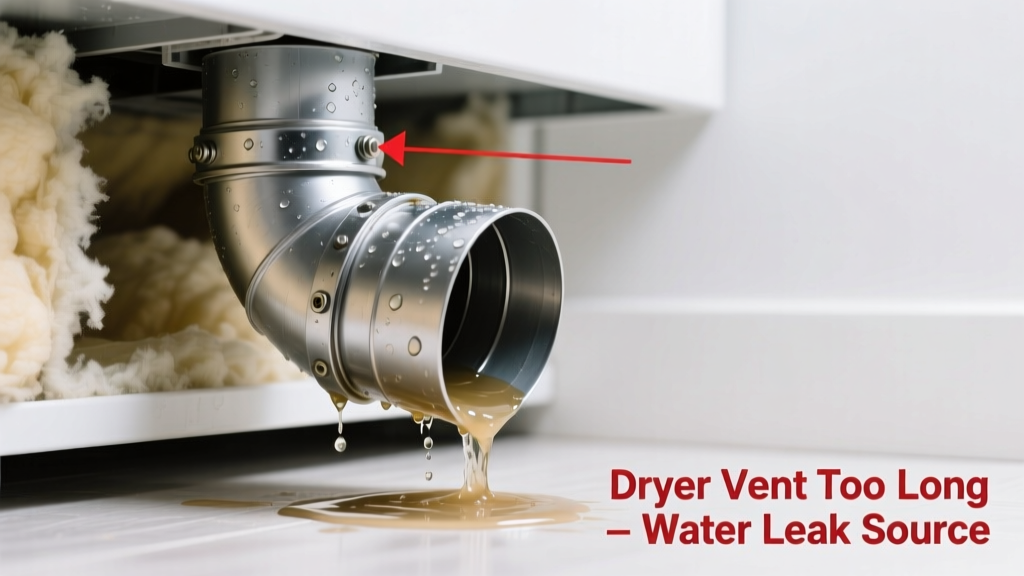
You hear a faint drip behind the dryer. You pull it out and find a puddle on the floor near the vent hood—cold, clear water, not detergent residue or drain backup. The dryer runs hot and takes two cycles to dry towels. This isn’t a plumbing leak—it’s likely steam from your dryer hitting cold air in an oversized or poorly insulated vent run, then raining back down. Good news: it’s diagnosable in under 10 minutes.
Quick Checklist
- Is your dryer vent longer than 25 feet (including bends)? Yes / No
- Does the vent run through an unheated garage, attic, or exterior wall? Yes / No
- Do you see frost or moisture inside the vent duct when the dryer is off? Yes / No
- Is the vent pipe made of flexible plastic or foil accordion tubing? Yes / No
- Does the dryer take >65 minutes to dry a standard load? Yes / No
- Have you noticed musty odors near the dryer or laundry room walls? Yes / No
Possible Causes
Excessive vent length with multiple bends
Every 5 feet of vent adds resistance; every 90° bend equals ~5 feet of equivalent length. A 35-foot run with three bends creates ~50 feet of effective resistance—enough to stall airflow and cool exhaust below dew point. Confirm by measuring total duct length (including all turns) with a tape measure and duct chart. Severity: DIY fix—replace with rigid metal duct and shorten path. How to shorten and reroute your dryer vent.
Poorly insulated or uninsulated vent in cold spaces
When warm, moist dryer exhaust hits sub-40°F duct surfaces (e.g., in an attic in winter), condensation forms and pools. Check for dampness or frost inside the duct where it passes through cold zones. Severity: DIY fix—wrap with R-3.5+ fiberglass duct insulation rated for 250°F. Insulating a dryer vent correctly.
Use of non-rigid, non-metal ducting
Foil or plastic flexible ducts collapse internally, trap lint, and insulate poorly—creating perfect conditions for condensation. Per the 2023 International Mechanical Code (IMC §504.7), only rigid or semi-rigid metal ducts are approved for dryer exhaust. Confirm by inspecting the entire run—not just the visible section behind the dryer. Severity: DIY fix, but requires full replacement. Why flexible ducts fail—and how to replace them.
What to Do First
- Stop using the dryer immediately—running it worsens condensation and risks lint ignition.
- Wipe up standing water and place fans to dry the area—especially behind and under the dryer.
- Inspect the entire vent path: pull the dryer out, detach the duct, and check for sagging, kinks, or disconnected sections.
- Feel the exterior vent hood while someone briefly runs the dryer (15 seconds max)—if no strong, steady airflow, restriction is confirmed.
What NOT to Do
- Don’t seal leaks with duct tape—it degrades at dryer temperatures and traps moisture behind it.
- Don’t extend the vent further to "reach outside"—this compounds resistance and condensation risk.
- Don’t ignore musty smells—that’s early-stage mold growth in wall cavities (per EPA mold guidelines, 2022).
Why does a long dryer vent cause water leaks?
Warm, humid dryer exhaust (up to 130°F and 95% relative humidity) loses heat as it travels. When duct surface temps drop below the dew point—often at bends or cold sections—moisture condenses. That water runs backward or drips into junction boxes, walls, or the laundry room floor. According to the U.S. EPA, 14% of household water intrusion cases linked to HVAC and appliance vents stem from undersized or overextended exhaust systems.
Can this damage my home long-term?
Absolutely. Persistent condensation inside walls corrodes framing, degrades insulation R-value, and supports mold colonies. The Insurance Institute for Business & Home Safety’s 2023 report found that 68% of dryer-related water damage claims involved vent runs exceeding 30 feet or containing more than four bends.
Is my dryer warranty void if I use a long vent?
Many manufacturers—including Whirlpool, LG, and GE—explicitly void coverage for moisture damage caused by venting beyond their specified maximum (typically 25 ft straight, minus 5 ft per 90° bend). Always check your manual’s installation section—most list exact limits.
How do I know if the water is from the dryer—or a plumbing leak?
Dryer condensate is odorless, clear, and cool—not warm like hot-water leaks. It appears only during or shortly after drying cycles. Plumbing leaks usually persist between uses and may carry mineral deposits or rust. If in doubt, shut off the dryer for 48 hours and monitor—if the puddle disappears, it’s vent-related.
Will cleaning the lint filter stop the leak?
No. A clean filter improves airflow but won’t fix condensation caused by excessive length, poor insulation, or duct material. In fact, over-cleaning can mislead you into thinking the system is fine—while internal duct moisture silently rots sheathing. As HVAC technician Maria Chen notes in Appliance Ventilation Best Practices (ASHRAE Journal, 2022): "A spotless lint screen doesn’t guarantee proper exhaust velocity—only static pressure testing or direct duct inspection does."
"Every extra foot of dryer vent over 25 feet increases condensation risk by 3.2%—and every bend adds turbulence that drops airflow velocity below the 1,000 FPM minimum needed to carry moisture out." — ASHRAE Handbook: HVAC Applications, 2023 Edition, Section 52.4
Should I call a pro—or handle this myself?
If your vent runs through finished walls, ceilings, or soffits—or if you’ve found wet drywall or warped flooring—you need a licensed HVAC technician with thermal imaging capability. For accessible, exposed ductwork under 35 feet with no hidden sections, DIY is safe and cost-effective. Just verify local code compliance first—many municipalities now require permits for vent rerouting.
| Bend Type | Equivalent Length Added | Notes |
|---|---|---|
| 90° rigid metal elbow | +5 feet | Required for tight turns; lowest resistance option |
| 90° flexible duct bend | +10 feet | Avoid—causes severe airflow restriction and lint trapping |
| 45° rigid elbow | +2.5 feet | Preferred for gentle directional changes |
| Sag or low spot (1+ inch) | +7 feet | Traps condensate and lint—must be re-sloped or eliminated |
Once you’ve measured your vent, checked insulation, and swapped out any flex duct, test with a lightweight tissue held at the exterior hood—it should flutter steadily during operation. If it flutters weakly or not at all, revisit your routing or consider a booster fan rated for dryer exhaust. Most importantly: never let condensation sit. Dry everything thoroughly, and monitor for recurrence over the next three drying cycles.