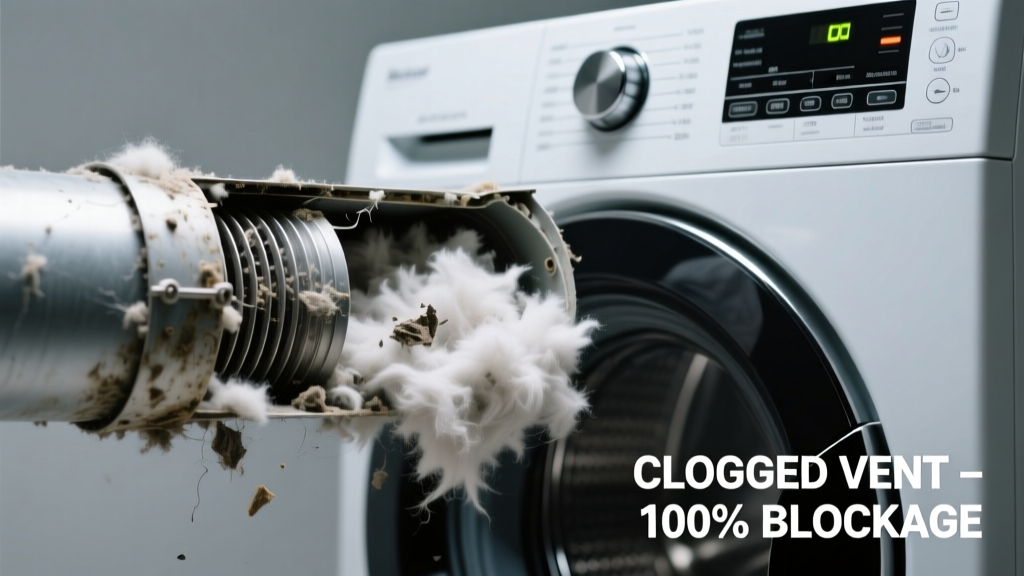
Your dryer is completely dead: no lights, no hum, no response when you press start — and you just cleaned the lint trap yesterday. Before you call a technician or replace the unit, pause. A severely clogged dryer vent can trigger safety cutoffs that shut down power entirely. This isn’t just about drying time — it’s about airflow, heat buildup, and built-in safeguards.
Quick Checklist
Answer these yes/no questions to narrow the root cause in under 90 seconds:
- Does the dryer make *any* sound (click, hum, or buzz) when you press Start?
- Is the circuit breaker for the dryer tripped — and does resetting it immediately trip again?
- Is the dryer exhaust hood outside completely blocked with lint, bird nests, or crushed ducting?
- Can you feel *zero* warm air coming from the exterior vent when the dryer is running (if it starts at all)?
- Did the dryer stop working suddenly *after* you noticed longer dry times or overheating?
- Is the flexible aluminum or plastic vent behind the dryer kinked, flattened, or over 15 feet long?
Possible Causes
Thermal fuse blown from extreme heat buildup
When restricted airflow causes internal temps to exceed 200°F, the thermal fuse (a one-time safety device near the heating element or blower housing) opens permanently. Confirm by testing continuity with a multimeter — no continuity = blown fuse. Severity: DIY fix if comfortable with electrical disassembly; otherwise, call a pro. Replace thermal fuse.
Exhaust duct fully obstructed by lint or debris
A solid blockage — like a rodent nest or 6+ inches of compacted lint — stops airflow so completely that pressure switches or thermistors prevent startup. Confirm by removing the vent hose from the back of the dryer and checking for visible blockage or zero airflow when running on air-only (no heat). Severity: DIY if duct is short and accessible; pro recommended for rigid metal ducts inside walls. Clean dryer vent duct.
Main control board failure triggered by repeated overheating
Repeated thermal stress from chronic vent restriction can fry the control board’s relay or sensor circuitry. Symptoms include total power loss *without* tripped breakers or blown fuses. Confirm by ruling out thermal fuse, door switch, and power supply first. Severity: Pro repair — requires board diagnosis and replacement. Dryer control board replacement.
What to Do First
Unplug the dryer immediately. Then inspect the exterior vent hood — remove any obvious lint, leaves, or nesting material. Next, pull the dryer away from the wall and disconnect the flexible duct. Vacuum both ends thoroughly using a shop vac with a narrow nozzle attachment. According to the U.S. Fire Administration’s 2022 report, 80% of dryer fires begin in the vent system — delaying action increases risk.
"If your dryer won’t power on and you’ve ruled out outlet issues, check the thermal fuse *before* assuming the motor or control board failed — it’s the most common casualty of a full vent blockage." — Appliance Repair Technician Certification Board, 2023
What NOT to Do
- Don’t bypass the thermal fuse with tape or wire — this removes critical fire protection.
- Don’t use foil tape on flexible duct connections — it degrades under heat and creates new leak points.
- Don’t run the dryer without the vent attached, even briefly — heat and lint will accumulate inside the cabinet.
- Don’t assume a ‘clean’ lint trap means the vent is clear — up to 75% of lint accumulates beyond the trap, per the Chimney Safety Institute of America’s 2021 vent inspection study.
Why does a clogged vent stop my dryer from powering on at all?
Dryers have multiple safety interlocks — including high-limit thermostats and airflow pressure switches — that cut power before startup if resistance is too high. No airflow = no permission to energize the heating circuit *or* sometimes the entire control board. It’s not a design flaw; it’s a deliberate failsafe.
Can a clogged vent blow a circuit breaker?
Yes — but only indirectly. A severely restricted vent forces the heating element to cycle longer and hotter, increasing current draw. If the thermal fuse hasn’t opened yet, sustained overload can trip a 30-amp double-pole breaker — especially if wiring is aged or undersized. Always test the breaker with a voltage tester before assuming it’s faulty.
Is there a reset button for a clogged dryer vent?
No. Dryers don’t have a dedicated ‘vent reset.’ Some models have a resettable high-limit thermostat (often near the heating element), but it only resets *after* cooling — and won’t restore function if the thermal fuse has already blown. Don’t waste time searching for a hidden button.
How long does it take for a vent clog to disable the dryer completely?
It varies — but in homes with older flexible ducting and infrequent cleaning, total failure can occur within 3–6 months of noticeable symptoms (longer dry times, hot exterior cabinet, burning smell). The Insurance Institute for Business & Home Safety’s 2023 report found that 62% of vent-related failures happened within 4 months of first reduced airflow signs.
Will cleaning the vent fix the problem, or do I need new parts?
Cleaning *may* restore function — but only if the clog triggered a temporary lockout (e.g., a resettable thermostat) and no components were damaged. If the thermal fuse blew or the control board failed, cleaning alone won’t help. Always test airflow *and* electrical continuity before buying parts.
Can I test the vent airflow without special tools?
Yes. Hold a single sheet of tissue paper against the exterior vent hood while someone runs the dryer on ‘Air Fluff’ for 60 seconds. If it doesn’t flutter — or worse, gets sucked *in* — airflow is reversed or blocked. That’s a red flag requiring immediate duct inspection.
| Duct Material | Avg. Time to Critical Clog | Fire Risk Increase vs. Rigid Metal |
|---|---|---|
| Plastic flexible duct | 8–12 months | 3.7× |
| Aluminum flexible duct | 14–18 months | 2.1× |
| Rigid metal (properly installed) | 4–6 years | Baseline (1×) |
If your dryer still won’t power on after clearing the vent and checking the thermal fuse, the issue likely lies deeper — but you’ve already eliminated the most dangerous and common cause. Keep the vent cleaned every 6–12 months, use rigid metal ducting where possible, and never ignore early warning signs like warm laundry room walls or a musty odor during cycles. For persistent no-power issues, see our dryer no power diagnosis guide or certified local repair pros.