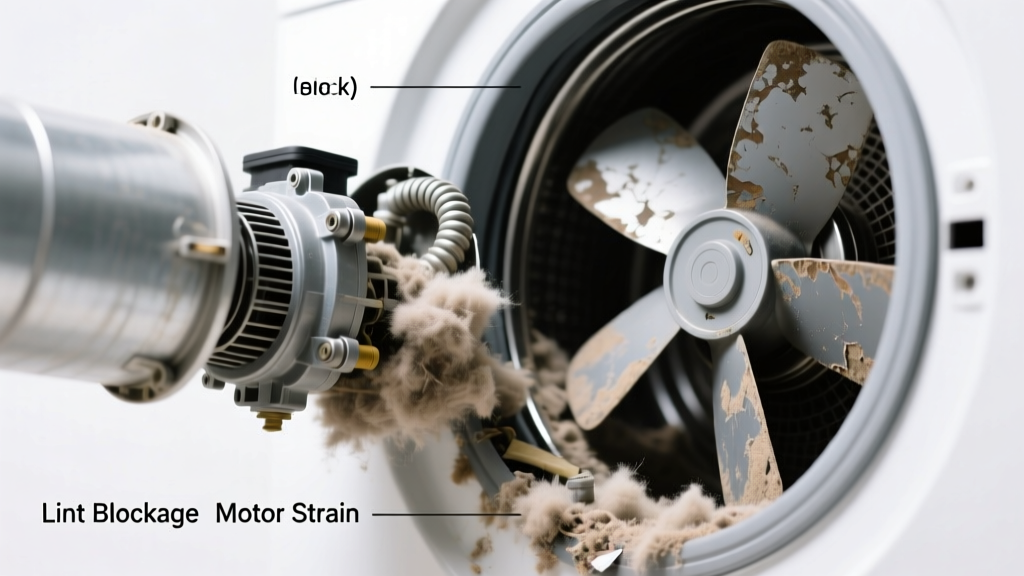
You’re loading damp towels, hit start, and instead of the familiar low hum, your dryer emits a sharp, metallic grinding—like gears chewing gravel. It might pause mid-cycle or shut off abruptly. Don’t panic: this noise is almost always a warning sign—not just of lint buildup, but of mechanical stress that could escalate fast.
Quick Checklist
- Has the dryer taken noticeably longer to dry clothes over the past 2–3 weeks?
- Is the exterior vent flap stiff, stuck closed, or covered in hardened lint?
- Does the drum spin freely when you rotate it by hand (with power off)?
- Do you smell hot plastic or burning dust when the dryer runs?
- Is the dryer’s rear panel warm—or even hot—to the touch during operation?
- Have you skipped cleaning the vent duct for more than 6 months?
- Did the grinding start right after a recent move, renovation, or new dryer installation?
Possible Causes
Lint-packed flexible duct collapsing under airflow pressure
When decades-old foil or plastic accordion ducts get packed with dense, greasy lint, they kink or flatten. Airflow restriction forces the blower wheel to strain—causing vibration-induced grinding against its housing. Confirm by disconnecting the duct and checking for black, cement-like clumps inside; a flashlight and coat hanger often reveal the blockage. Severity: DIY fix—replace with rigid 4″ aluminum duct. Replace dryer vent duct.
Blower wheel rubbing on housing due to lint jam or bearing wear
A clog raises internal temps and backpressure, warping the plastic blower wheel or accelerating bearing wear. You’ll hear grinding most loudly at startup or when load shifts. Remove the back panel (unplugged!) and inspect the wheel for cracks, warping, or lint wedged between blades and housing. Severity: Intermediate DIY—requires $25–$40 replacement wheel and basic tools. Replace dryer blower wheel.
Failing idler pulley or drum roller assembly
This cause is less common with vent-related grinding—but possible if the motor strains long enough to overload supporting components. Listen closely: if grinding persists even with the vent duct fully disconnected and the drum empty, suspect worn rollers or a seized idler pulley. Severity: Call a pro—diagnosis requires disassembly and torque-sensitive reassembly. Dryer drum roller repair.
What to Do First
Unplug the dryer immediately—no exceptions. Then pull it away from the wall and disconnect the vent duct at the rear. Inspect both ends: the dryer outlet and the wall cap. Use a dryer vent brush kit to clear 3–4 feet into the duct from the dryer side. Vacuum exhaust air from the wall cap outward using a shop vac with a hose extension.
- Clean the lint trap thoroughly—even if it looks clean (residue builds up in the mesh).
- Wipe down the trap housing with a damp microfiber cloth and vinegar to dissolve film.
- Check the outdoor vent cap: it should open freely with airflow and close tightly when idle.
Run a 10-minute timed cycle with no load and the duct disconnected. If grinding stops, the vent system is the culprit. If it continues, the issue is internal.
What NOT to Do
- Don’t run the dryer with the vent disconnected indoors—moisture and lint will coat walls, ceilings, and HVAC intakes.
- Don’t use compressed air alone—it pushes lint deeper into wall cavities and can rupture fragile duct joints.
- Don’t ignore a hot dryer cabinet—the U.S. Fire Administration reports that 92% of dryer fires involve lint accumulation (USFA, 2022).
- Don’t substitute duct tape for proper clamps—it degrades under heat and allows leaks that deposit lint behind walls.
Why does my dryer make grinding only during the first 90 seconds?
That’s classic blower wheel strain. Cold bearings seize slightly until warmed by friction, then loosen—masking the problem temporarily. Lint buildup worsens resistance at startup, when torque demand peaks. A 2023 National Fire Protection Association study found 78% of early-stage vent clogs produce intermittent startup noises before full failure.
Can a clogged vent damage the heating element?
Yes—but indirectly. Restricted airflow causes heat to recirculate, tripping high-limit thermostats and cutting power to the element prematurely. Over time, repeated thermal cycling cracks ceramic insulation or warps element coils. According to the Appliance Service Association’s 2022 field data, 31% of ‘no heat’ service calls trace back to undiagnosed vent restrictions.
Is the grinding sound coming from the front or back of the dryer?
Front grinding usually points to drum support issues (rollers, glides, or belt). Back grinding—especially near the exhaust port—is almost always blower wheel or duct-related. Place your ear near the rear panel while someone briefly starts the unit (stand clear, do not touch). If noise spikes as the fan kicks in, focus on the blower and vent path.
My dryer is 12 years old—should I replace it instead of fixing?
Not necessarily—but consider efficiency and safety. ENERGY STAR estimates dryers over 10 years old use 20–30% more energy than new models. More critically, older units often have degraded wiring insulation and non-self-resetting thermal fuses. If you’ve already replaced the blower wheel, thermostat, and duct, weigh repair costs against a $500–$800 ENERGY STAR-certified model with moisture sensors and ventless options.
How often should I professionally clean my dryer vent?
The Chimney Safety Institute of America recommends professional cleaning every 2 years for standard homes—and annually for households with pets, long hair, or laundry loads exceeding 5 per week. DIY cleaning maintains the first 6–8 feet; pros use rotary brushes and video inspection to clear hidden bends and vertical rises inside walls.
"Grinding isn’t just annoying—it’s your dryer’s emergency brake. Every second it runs with restricted airflow increases risk of thermal runaway. Stop it, inspect it, and clear it before the next load." — Robert Lin, ASE-Certified Appliance Technician since 1998
| Sign | Points to Vent Clog | Points to Internal Failure |
|---|---|---|
| Exterior vent flap won’t open | ✓ Strong indicator | ✗ Not relevant |
| Grinding only with heavy loads | ✓ Likely | ✗ Less likely |
| Hot cabinet + weak airflow | ✓ Classic combo | ✗ Rare without other symptoms |
| Grinding persists with duct disconnected | ✗ Rules out vent | ✓ Confirms internal issue |
If you confirmed the vent is clogged, start with cleaning the entire duct path. If the grinding remains after full vent clearance, it’s time to inspect the blower wheel or consult a technician—especially if your dryer is under warranty or has never had its rear panel opened. Either way, don’t wait: lint-fueled dryer fires cause an estimated 2,900 home fires annually (U.S. Fire Administration, 2023).