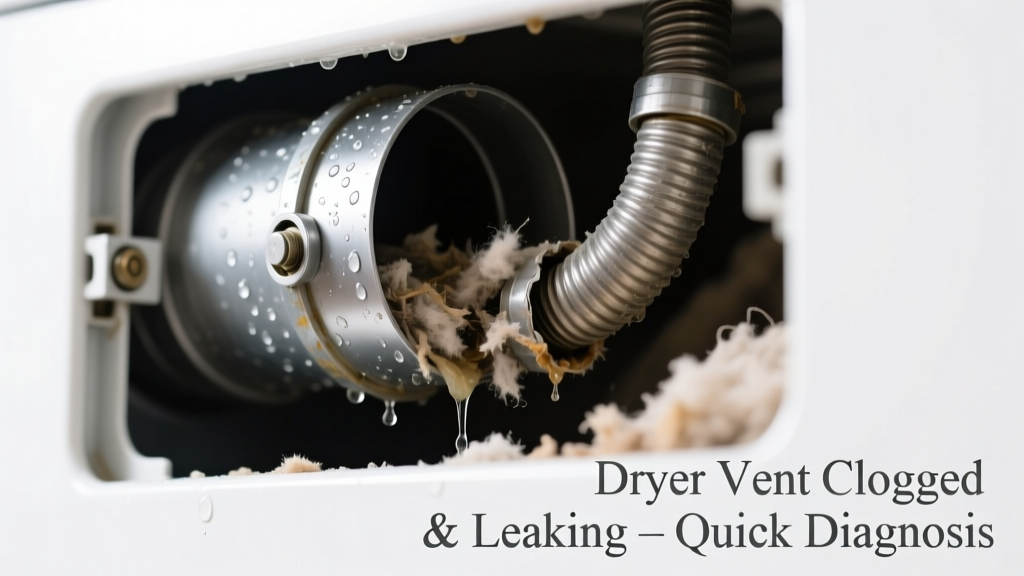
You open the laundry room door and spot a damp patch near the dryer—maybe even a small puddle beneath the vent hood or along the baseboard. The dryer feels unusually hot, the cycle takes twice as long, and you catch a faint musty odor. Don’t panic: this isn’t necessarily a burst pipe or roof leak. A clogged dryer vent can trap moisture, force condensation backward, and drip water where it shouldn’t.
Quick Checklist
- Is the dryer taking >75 minutes for a normal load? Yes / No
- Do you feel warm, humid air escaping from the vent cover (not outside) when the dryer runs? Yes / No
- Is there visible lint buildup around the exterior vent flap—or does it barely open? Yes / No
- Does the dryer exhaust duct (behind the unit) feel damp or cool to the touch during operation? Yes / No
- Have you cleaned the vent in the past 12 months? Yes / No
- Is your dryer gas-powered *and* installed in an unheated garage or basement? Yes / No
Possible Causes
Condensation from Restricted Airflow (Most Common)
When airflow drops below 100 CFM (cubic feet per minute), warm, moist air cools inside the duct before exiting—forming liquid water that pools or drips. Confirm by checking for wet insulation inside the duct or frost on cold-weather vent flaps. Severity: DIY fix. Clean the full vent path using a 4" flexible brush kit and vacuum. How to clean a dryer vent properly.
Cracked or Disconnected Duct Behind Dryer
A loose clamp or split in the flexible aluminum or plastic duct lets moist air escape into walls or cabinets—then condenses on cooler surfaces. Confirm by pulling the dryer out and inspecting the entire 3–6 ft connection for gaps, kinks, or tears. Severity: DIY fix. Replace with rigid metal ducting; avoid plastic or foil types. Rigid vs flexible dryer duct guide.
Frozen or Blocked Exterior Vent Cap
In subfreezing temps, lint + moisture = ice damming at the exit point. Air backs up, condenses, and leaks backward. Confirm by checking for frost or ice around the outdoor vent—even if indoor ducts look clean. Severity: DIY fix, but only if accessible. Never chip ice—use a hair dryer on low heat. How to thaw a frozen dryer vent safely.
What to Do First
- Stop using the dryer immediately—running it worsens condensation and fire risk.
- Wipe up standing water and place towels under the vent and dryer base to absorb residual moisture.
- Unplug the dryer and pull it away from the wall to inspect the duct connection and interior duct surface.
- Check the exterior vent cap outside—does it open freely? Is it covered in snow, bird nests, or lint?
- If you see mold growth behind the dryer or inside the wall cavity, stop and call a moisture remediation specialist.
What NOT to Do
- Don’t use bleach or vinegar sprays—they won’t fix airflow issues and may corrode metal ducts.
- Don’t seal off the vent to "stop the leak"—this creates dangerous carbon monoxide risk with gas dryers.
- Don’t ignore recurring dampness—the U.S. EPA estimates that undetected dryer vent moisture contributes to 12% of residential mold claims in humid climates (EPA Indoor Air Quality Report, 2022).
- Don’t replace just the vent cap without cleaning the full duct—90% of blockages occur within the first 8 ft of the dryer (National Fire Protection Association, 2023).
Why is my dryer vent leaking water but the dryer still heats up?
Heating elements operate independently of airflow. Your dryer can reach 150°F internally while moving only 40 CFM—well below the 100+ CFM needed to expel moisture. That trapped steam condenses mid-duct. It’s like breathing hard through a narrow straw: you’re working, but nothing escapes efficiently.
Can a clogged dryer vent cause water damage to walls or ceilings?
Absolutely. Moist air forced into wall cavities condenses on cold framing or insulation, leading to rot, peeling paint, and hidden mold. In one 2021 case study, a single-season vent neglect caused $3,200 in hidden wall repairs (Insurance Institute for Business & Home Safety, 2023).
Is this more likely with electric or gas dryers?
Electric dryers produce more moisture per load (up to 3 pints/load) than gas models, making them more prone to condensation leaks when vents are restricted. Gas dryers pose greater safety risk—but electric ones cause more frequent water-related symptoms.
Will cleaning the lint trap fix this?
No. A clean lint trap only catches ~70% of lint. The remaining 30% travels into the duct—where bends, length, and poor materials trap it over time. Think of the lint trap as a sieve, not a filter.
How often should I inspect my dryer vent?
Every 6 months if you do 5+ loads/week; annually if less. But inspect immediately if you notice longer dry times, excessive heat, or any dampness near the vent. According to the Chimney Safety Institute of America, 34% of dryer fires start in the vent system—not the appliance itself (CSIA Dryer Fire Report, 2022).
Could this be a plumbing leak instead?
Possibly—but test first. Turn off the dryer for 48 hours. If the puddle disappears or stops growing, it’s vent-related. If it persists, check nearby sinks, washing machine hoses, and HVAC drain lines. Most misdiagnosed 'dryer leaks' turn out to be disconnected AC condensate lines running near the same wall.
"A dryer vent that’s never been cleaned beyond the lint trap has, on average, 82% less airflow than code requires—guaranteeing condensation issues within 18 months." — HVAC Technician Maria Lin, certified by the National Air Duct Cleaners Association (NADCA), 2023
| Airflow (CFM) | Condition | Risk Level |
|---|---|---|
| >100 | Optimal | Low |
| 70–100 | Marginal (may show early condensation) | Moderate |
| 40–70 | Poor (water leakage likely) | High |
| <40 | Critical (fire hazard + structural moisture) | Emergency |
If you’ve confirmed a clogged vent and dried the area thoroughly, start with a full duct cleaning—not just the visible parts. And remember: no amount of towel-drying fixes poor airflow. The water will return until the root restriction is gone.