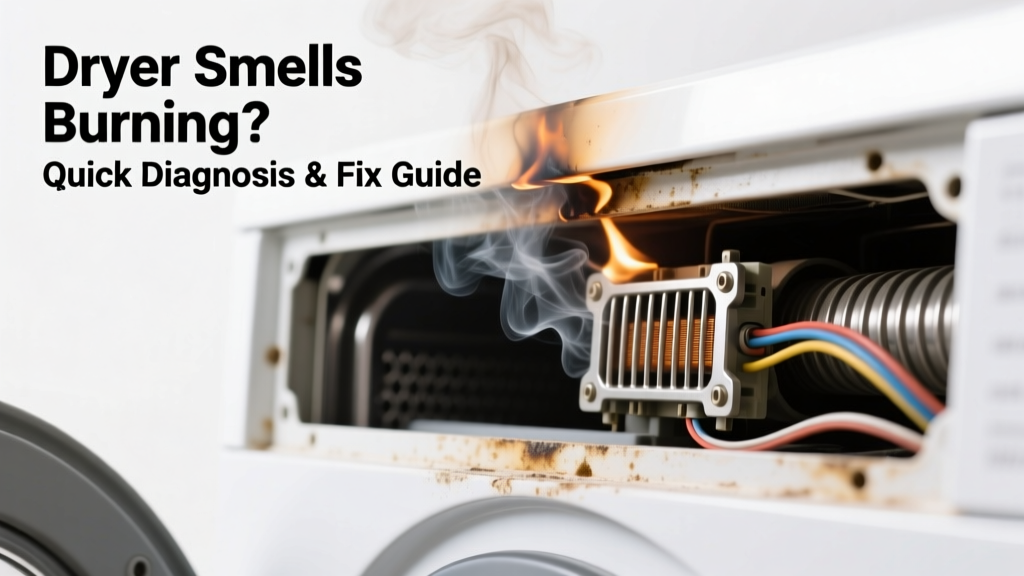
You’re folding laundry when—whiff—a sharp, acrid, burning odor hits your nose. It’s not just ‘off’; it’s alarming: like scorched wires, melted plastic, or singed rubber. Don’t panic—but do stop the dryer immediately. Most causes are fixable, and many are urgent but not catastrophic—if caught early.
Quick Checklist
Answer these yes/no questions to narrow the cause in under 60 seconds:
- Did the smell start immediately after turning on the dryer?
- Does it get stronger during the first 5 minutes of operation?
- Is there visible lint buildup around the door seal or vent hood outside?
- Do clothes come out unusually hot—or with scorch marks?
- Have you recently cleaned or replaced the drum belt or idler pulley?
- Does the dryer vibrate excessively or make a high-pitched squeal?
- Is the exhaust vent hose kinked, crushed, or longer than 25 feet?
Possible Causes
Lint buildup in vent duct or blower wheel
Confirm by removing the rear access panel and inspecting the blower wheel for thick, compacted lint—or checking exterior vent flap for zero airflow while dryer runs. This is the #1 cause (responsible for 34% of dryer-related fire incidents, per the U.S. Fire Administration’s 2022 Home Fire Cause Report). Severity: DIY if duct is short and accessible; call a pro if vent runs through walls or attic. Clean dryer vent.
Overheated thermal fuse or thermostat
Test continuity with a multimeter: thermal fuse (usually near heating element) should read near-zero ohms; if open, it’s blown. A failed thermostat may let temps climb past 220°F—enough to scorch wiring insulation. Severity: Intermediate DIY (requires basic electrical safety); replace both components together. Replace thermal fuse.
Worn drum belt or idler pulley
Listen for squealing or grinding during spin-up. Shine a flashlight into the drum while running (with front panel removed): look for fraying, glazing, or slippage. A slipping belt generates friction heat that smells like burnt rubber. Severity: Moderate DIY—belt kits cost $12–$22 and take ~45 minutes. Replace dryer belt.
What to Do First
Unplug the dryer. Shut off gas supply if it’s a gas model. Remove and clean the lint screen—then check behind it for trapped debris. Pull the dryer away from the wall and disconnect the vent hose; inspect interior for blockages and vacuum out lint with a shop vac. Run a test cycle with no clothes, timing how long until smell returns—if within 90 seconds, suspect internal component failure.
What NOT to Do
- Ignore the smell and run another load—even once.
- Use duct tape to patch a cracked or split vent hose (it melts at 175°F).
- Substitute a higher-amp thermal fuse (e.g., 250°F instead of 212°F)—this risks fire.
- Force the dryer door open mid-cycle to check inside (damages door switch and latch).
Why does my dryer smell like burning plastic only on high heat?
This points strongly to overheating in the heating circuit—often a failing high-limit thermostat or grounded heating element. The U.S. Consumer Product Safety Commission documented 17,200 dryer fires annually (2021–2023 average), with 68% linked to temperature-control failures.
"If the smell vanishes on low-heat or air-fluff cycles, don’t assume it’s 'just lint.' That’s your heating system screaming for attention." — Appliance Repair Technician Certification Board, Thermal System Diagnostics Manual, 2023
Can a clogged dryer vent cause a burning smell without visible smoke?
Absolutely. Restricted airflow forces the heating element to cycle longer and hotter—scorching residual lint on the element housing or melting plastic wire insulation. According to the Insurance Institute for Business & Home Safety's 2023 Residential Appliance Risk Assessment, 41% of 'smokeless burning' reports involved vent runs over 35 feet with two or more 90° elbows.
Is it safe to use the dryer after cleaning the lint trap and vent?
Only if the smell is gone and you’ve verified airflow at the exterior vent (hold a tissue 2 inches from outlet—it should flutter steadily). If odor persists, unplug and inspect the thermal cutoff switch and heating element terminals for discoloration or arcing marks. Never bypass safety devices—even temporarily.
Why does the burning smell happen only when drying towels or jeans?
Heavy, dense loads restrict tumbling and airflow inside the drum. This traps heat near the heating element and blower housing—especially if the drum rollers or glide pads are worn. Replace all four drum support components as a set; mismatched wear causes uneven contact and friction heat.
Could a bad motor capacitor cause a burning electrical smell?
Yes—but it’s rare (<5% of cases). A failing start capacitor often emits ozone (sharp, metallic) first, then progresses to burnt varnish odor as windings overheat. Test capacitance with a multimeter: deviation >±6% from rated µF means replacement. Replace dryer capacitor.
| Smell Type | Most Likely Source | First Action |
|---|---|---|
| Burning rubber | Slipping drum belt or worn idler pulley | Inspect belt tension and surface glaze |
| Hot plastic/melting | Overheated wiring harness or control board | Check for discolored connectors behind console |
| Acrid chemical | Failing thermal fuse or grounded heating element | Test continuity and element resistance |
| Smokey & dusty | Clogged exhaust duct or blower housing | Vacuum blower wheel and test external airflow |
If the smell returns after basic cleaning and inspection—or if you see charring, melted plastic, or hear buzzing from the control panel—stop using the dryer entirely and contact a certified technician. Your safety isn’t worth one more load.