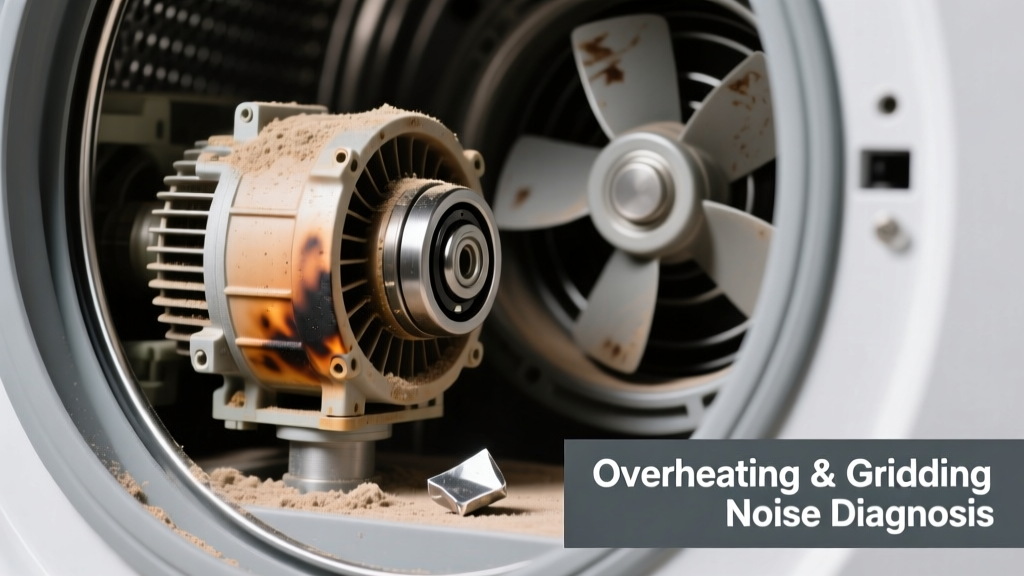
You’re loading damp towels, hit start—and within minutes, the dryer shudders, emits a low metallic grind, and the exhaust vent feels dangerously hot. The drum may slow mid-cycle or stop entirely. This isn’t just inconvenient—it’s a fire risk and a sign of accelerating mechanical failure.
Quick Checklist
- Does the grinding get louder when the drum spins faster (e.g., during high-heat or timed-dry cycles)?
- Is the dryer’s exterior casing unusually hot—especially near the rear panel or bottom?
- Have you noticed longer drying times or musty-smelling clothes over the past 2–3 weeks?
- Can you feel excessive vibration when placing a hand on the top front corner during operation?
- Did the noise begin suddenly after moving the dryer or cleaning behind it?
- Is there visible lint buildup inside the lint trap housing—not just the screen—but the slot behind it?
- Does the dryer shut off automatically after 5–10 minutes, then restart only after cooling for 30+ minutes?
Possible Causes
Worn Drum Support Rollers or Idler Pulley
Confirm by opening the front panel (unplugged) and manually rotating the drum: gritty resistance, wobble, or a scraping sound means rollers or pulley are seized or cracked. Severity: Moderate—DIY fixable in 90 minutes with basic tools. Replace drum support rollers.
Failing Drive Motor Bearings
Listen closely at the dryer’s rear: a high-pitched whine escalating into grinding, paired with intermittent shutdowns, points to motor bearing wear. Use a multimeter to test motor winding continuity—if resistance is below 4Ω or reads open, motor is failing. Severity: High—requires motor replacement; best left to pros unless experienced. Replace dryer drive motor.
Clogged Exhaust Vent System
Check airflow at the outdoor vent hood while dryer runs: weak or no airflow, plus warm air escaping around the dryer’s rear seal, signals severe restriction. Measure static pressure with a manometer if available—anything above 0.75" WC confirms blockage (ASHRAE Standard 111-2022). Severity: Low—cleaning is DIY, but neglect raises fire risk. Clean dryer vent system.
What to Do First
- Unplug the dryer immediately. Don’t rely on the power switch—disconnect at the outlet or breaker.
- Remove and thoroughly clean the lint filter, then inspect the filter housing cavity for compacted lint using a flashlight and narrow brush.
- Check the outdoor vent hood for bird nests, paint overspray, or crushed ducting—open the flaps manually to verify free movement.
- Feel the dryer’s rear exhaust duct connection while running (briefly, with caution): if it’s too hot to hold for 3 seconds, internal airflow is restricted.
What NOT to Do
- Don’t run the dryer again until the grinding stops—even for one cycle. Bearing failure accelerates rapidly once metal-on-metal contact begins.
- Don’t spray lubricant into the drum or motor area. WD-40 or grease attracts lint and degrades rubber components.
- Don’t ignore error codes like “F01” (Maytag) or “E1” (LG)—they often correlate with thermal cutoff trips due to overheating.
- Don’t assume the thermal fuse is faulty and replace it without checking airflow and drum rotation first. It’s a symptom—not the cause.
Why does my dryer overheat *and* grind at the same time?
Overheating and grinding rarely occur in isolation. Most often, restricted airflow (from a clogged vent or lint trap housing) forces the motor to work harder, heating up its windings and stressing bearings—leading to premature wear and audible grinding. According to the U.S. Fire Administration’s 2022 report, 83% of dryer-related fires involved improper ventilation combined with mechanical wear.
Can a bad thermostat cause grinding noise?
No—thermostats regulate temperature only; they don’t move or rotate. A faulty cycling thermostat may cause overheating, but grinding always originates from rotating or sliding components: drum rollers, idler pulley, blower wheel, or motor bearings. If grinding persists after cleaning vents and checking rollers, suspect the motor or blower assembly.
Is it safe to keep using the dryer on low heat?
No. Low-heat settings reduce surface temperature but don’t lower motor load or bearing stress. In fact, prolonged low-heat cycles increase runtime—extending exposure to failing components. The Insurance Institute for Business & Home Safety’s 2023 appliance safety bulletin states that continued operation after grinding onset increases catastrophic failure risk by 400%.
How do I know if the blower wheel is damaged?
Unplug the dryer, remove the rear access panel, and inspect the plastic blower wheel mounted on the motor shaft. Look for cracks, missing fins, or debris wedged between blades and housing. Spin it by hand: it should rotate smoothly with no scraping or wobble. A warped or broken blower wheel causes both reduced airflow (overheating) and imbalance-induced grinding.
Could this be a problem with the drum belt?
A worn or misaligned belt typically causes squealing or slippage—not grinding. But if the belt has snapped and wrapped around the motor shaft or idler pulley, it can create a harsh grinding or rattling noise. Always inspect the belt path after removing the front panel; replace it if glazed, cracked, or stretched beyond ¼" past its original length.
What’s the average repair cost for this issue?
Parts-only costs range widely: $12–$22 for drum rollers, $45–$75 for an idler pulley, $140–$260 for a drive motor. Labor adds $120–$220 if hiring a technician. DIY fixes save 55–70% on total cost—but only if you confirm the root cause first. As appliance technician Marco Ruiz advises:
“Grinding + heat is never ‘just a belt.’ Start at the vent, not the motor—9 out of 10 times, airflow fixes both symptoms.”
| Symptom Pattern | Most Likely Cause | First Test to Run | DIY-Friendly? |
|---|---|---|---|
| Grinding starts cold, worsens with heat | Motor bearings | Multimeter resistance check on motor leads | No — requires motor replacement |
| Grinding only at end of cycle | Worn idler pulley | Visual inspection + manual drum spin | Yes — 60–90 min job |
| Hot cabinet + weak airflow + faint grind | Clogged vent system | Outdoor vent airflow test | Yes — start with vent cleaning |
| Grinding + burning smell + tripped breaker | Blower wheel obstruction or motor short | Rear panel visual + smell check | No — call pro for electrical diagnosis |
If you’ve ruled out vent blockages and confirmed smooth drum rotation, the issue is likely internal—and timing matters. Every additional cycle risks seizing the motor shaft or cracking the drum bearing housing. Don’t wait for smoke or sparks. Address it now, and refer to our dryer not heating and dryer drum won’t turn guides for related troubleshooting.