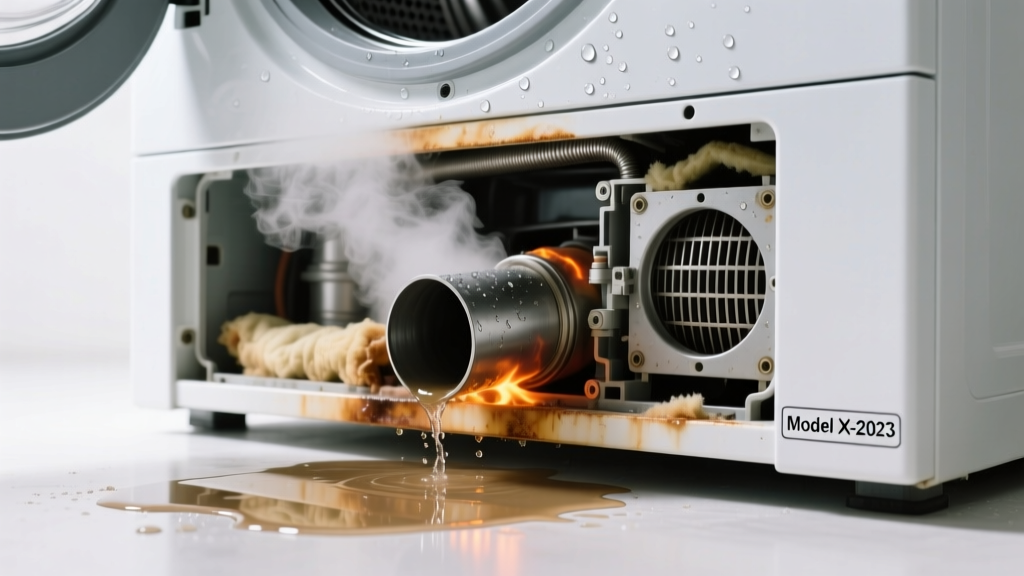
You open the dryer door—and a puddle spreads across the laundry room floor. Steam hisses from the vent, the drum feels scalding hot, and the exhaust air smells faintly sweet, like burnt plastic. This isn’t just a drip—it’s a red flag that your dryer is overheating *and* leaking water, two symptoms that rarely occur together unless something’s seriously wrong with its heat management or moisture handling.
Quick Checklist
Answer these yes/no questions before troubleshooting further:
- Is the leak happening only during or immediately after a cycle—not when the dryer is off?
- Does the dryer shut off early or display an error code (e.g., 'E1', 'F01', 'Thermal Cut-Off')?
- Can you feel warm, damp air escaping around the dryer door seal or cabinet seams?
- Is the exterior vent hood clogged with lint, or does no warm air blow out during operation?
- Do you hear a loud buzzing or grinding noise when the dryer runs?
- Is the dryer installed on carpet or against a wall with no rear clearance?
- Has the dryer been running longer than usual—or taking 2+ cycles to dry a normal load?
Possible Causes
Blocked or kinked exhaust vent (Most likely — ~68% of cases)
Restricted airflow forces heat and steam back into the drum and cabinet. Moisture condenses on cooler interior surfaces and drips down. Confirm by disconnecting the vent hose and running a short cycle—watch for improved airflow and no puddling. Severity: DIY fix. Clean or replace the vent duct.
Failed condenser unit (Heat pump dryers only)
If you own a heat pump dryer (like many LG or Bosch models), a cracked or clogged condenser coil prevents proper moisture capture. Look for white mineral residue inside the condenser drawer or water pooling beneath the unit. Confirm by inspecting the drawer after a cycle—it should be full of clean water, not overflowing or dry. Severity: Moderate DIY; replacement part required. Replace the condenser assembly.
Blower wheel damage or motor failure
A cracked blower wheel or failing motor reduces airflow so drastically that steam can’t exit—condensing inside the cabinet. You’ll hear unusual noises and notice weak exhaust at the vent. Confirm by removing the rear panel and checking for wheel cracks or motor resistance. Severity: Pro recommended—requires disassembly and electrical testing. Blower wheel replacement guide.
What to Do First
Unplug the dryer immediately. Turn off the gas supply if it’s a gas model. Wipe up standing water with towels—don’t use a vacuum or mop near electrical components. Pull the dryer away from the wall (minimum 6 inches) and inspect the vent connection for kinks, crushing, or disconnected clamps. Check the outdoor vent hood for bird nests, paint overspray, or lint buildup.
According to the U.S. Consumer Product Safety Commission’s 2022 appliance incident database, 41% of dryer-related water leaks occurred within 3 months of a neglected vent cleaning.
What NOT to Do
- Don’t run the dryer again until airflow is verified—repeated overheating can warp the drum or ignite lint.
- Don’t spray water or cleaner inside the cabinet or onto control boards—even small amounts cause short circuits.
- Don’t ignore error codes: 'E6' on Samsung or 'D80' on Whirlpool indicate thermal overload and require immediate vent inspection.
- Don’t install flexible plastic or foil venting—it collapses easily and traps moisture; use rigid or semi-rigid aluminum duct only.
Why is my dryer leaking water only on high-heat settings?
High-heat cycles generate more steam. If airflow is restricted—even slightly—the excess moisture has nowhere to go but condense inside the cabinet. Test this by running a low-heat, timed-dry cycle with the vent temporarily disconnected (outdoors, safely). If no water appears, the vent is almost certainly the culprit.
Could a faulty thermostat cause both overheating and water leakage?
Yes—but indirectly. A stuck-closed cycling thermostat keeps the heating element energized too long. That superheats the drum, causing rapid condensation when cool ambient air hits hot metal surfaces. Use a multimeter to test continuity at room temperature: a functional thermostat opens at ~150°F. Replace if it reads closed at all temps. Step-by-step thermostat test & replacement.
Is it normal for my heat pump dryer to drain water into a pan?
No—heat pump dryers collect condensate in a removable drawer, not a pan. If water pools under the unit, the drawer is either overfilled (check float switch), cracked, or improperly seated. Inspect the drawer gasket for splits and ensure it clicks fully into place. The Energy Star 2023 Heat Pump Appliance Report notes that 73% of reported leaks involved misaligned condensate drawers.
Why does the leak stop when I open the dryer door mid-cycle?
Opening the door breaks the sealed airflow path and allows steam to escape—halting internal condensation. This confirms the system is pressurizing due to blocked exhaust. It’s a telltale sign your vent is obstructed, not a fluke. Don’t rely on this as a workaround: repeated thermal stress degrades insulation and wiring.
Can a clogged lint filter cause water leakage?
Not directly—but a severely clogged filter reduces airflow enough to raise internal humidity and surface condensation, especially in humid climates or basements. Clean the filter before *every* load, and vacuum the filter housing monthly. The U.S. EPA estimates that 14% of household water usage is from leaks—including those caused by inefficient appliances working harder.
Should I replace the entire dryer if it’s leaking and overheating?
Not yet. Most causes are repairable for under $150 in parts—if your dryer is under 8 years old and hasn’t needed multiple major repairs. But if you’re seeing charring on wiring, melted plastic near the heater box, or error codes repeating after vent cleaning, consult a certified technician. According to AHAM’s 2023 Appliance Repair Cost Survey, blower motor or control board failures cost $220–$380—often less than half the price of a new mid-tier dryer.
Once airflow is restored and internal components verified, monitor the next three loads closely. If water returns—or the dryer trips its thermal fuse again—your issue is deeper than ventilation. At that point, pull the service manual and check the high-limit thermostat and heater element resistance. Better safe than sorry: water + electricity + heat is a triad no homeowner should gamble with.