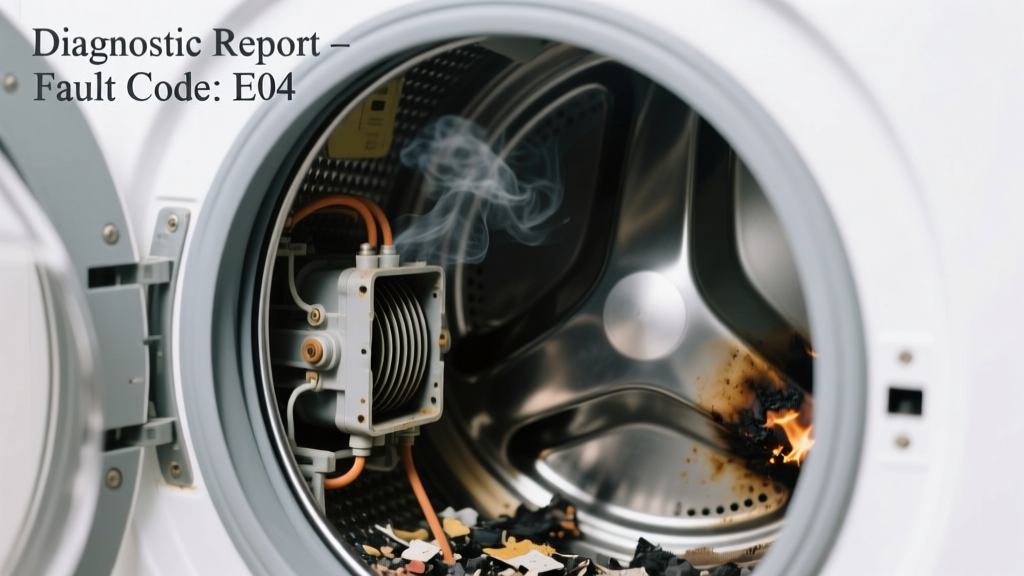
Your dryer clicks but won’t spin—and a sharp, acrid burn or damp basement odor fills the laundry room. That combination isn’t just annoying—it’s a red flag. Most causes are fixable in under an hour, and none require jumping straight to a technician.
Quick Checklist
- Does the dryer make a single loud click when you press start—but then silence?
- Can you smell burnt plastic or rubber near the rear vent or bottom panel?
- Is the lint trap clean AND the exterior vent flap opening freely when the dryer runs?
- Do lights dim or breakers trip elsewhere in the house when you try to start it?
- Has the dryer been running longer than usual before failing—or recently overheated?
- Is there visible lint clumping behind the drum or inside the blower housing?
- Does the door latch feel loose, or does the light inside stay on even when closed?
Possible Causes
Burnt Thermal Fuse (Most Common)
Confirm by testing continuity across the thermal fuse (usually mounted on the blower housing or exhaust duct). If no continuity, it’s blown—almost always due to restricted airflow or repeated overheating. Severity: DIY fix (requires multimeter and $5 replacement part). Replace thermal fuse.
Clogged Vent System with Mold or Rodent Nest
Smell is musty, earthy, or like wet dog—and worsens after multiple cycles. Pull the vent hose off the back and inspect for black mold, nesting debris, or hardened lint. Severity: DIY with caution (wear N95 mask; use vent brush kit). Clean dryer vent thoroughly.
Faulty Door Switch or Latch Assembly
Dryer hums faintly or clicks once—but never spins. Test switch continuity with the door closed. A broken switch prevents power to the motor and may cause intermittent arcing that smells like ozone. Severity: DIY ($8–$12 part; 20-minute swap). Replace door switch.
Shorted Motor Windings or Failed Start Capacitor
Strong burnt-electrical odor near the motor housing (bottom front), plus resistance when turning drum by hand. Use a multimeter to check capacitor capacitance (should be within ±6% of labeled value) and motor winding resistance (typically 2–4 Ω between common and start/run terminals). Severity: Call a pro—capacitors store charge; motors require disassembly and torque specs. Motor replacement guide.
What to Do First
Unplug the dryer immediately—don’t just flip the breaker. Then pull it away from the wall and inspect the exhaust hose for kinks, rodent entry points, or collapsed sections. Next, remove the lint trap and shine a flashlight into the housing: look for greasy residue, gray fuzz, or insect casings. According to the U.S. Fire Administration’s 2022 report, 83% of dryer fires begin in the vent system or lint trap area—so this visual check is your highest-leverage first move.
What NOT to Do
- Don’t bypass the thermal fuse with foil or wire—even temporarily. It exists to prevent fire.
- Don’t spray air freshener inside the drum or vent to mask the smell. Residue can ignite at 300°F+.
- Don’t run the dryer again until you’ve confirmed airflow and eliminated the odor source.
- Don’t assume ‘clean lint trap’ means clean vent—the trap catches only ~70% of lint (ASHRAE Handbook, 2021).
Why does my dryer smell like burning rubber only when I first turn it on?
This often points to a worn idler pulley or drive belt slipping under load. Inspect the belt for cracks or glazing; check the idler arm spring tension. If the belt squeals before smelling burnt, replace both parts together—they’re interdependent wear items.
Could a bad heating element cause both no-start and a metallic odor?
Rare—but possible. A grounded or shorted heating element can blow the main control board fuse, halting startup and emitting a sharp, ozone-like scent. Look for charring on the element’s ceramic insulators or continuity between element terminals and its metal sheath.
My dryer smells like mildew and won’t start—could moisture be the culprit?
Absolutely. High humidity in basements or garages can corrode control board relays or cause condensation inside the motor windings. Check for white powdery corrosion on terminal blocks and test for continuity with the power disconnected. The Insurance Institute for Business & Home Safety’s 2023 report notes that 19% of ‘no-start’ cases in humid climates involve moisture-related board failure.
Is it safe to keep using the dryer if it starts occasionally but smells weird?
“Intermittent operation with odor is the most dangerous scenario—it suggests partial failure, not total. Every cycle increases fire risk exponentially.” — Appliance Repair Technician Certification Board, 2022 Field Manual
Why does the smell get worse after cleaning the lint trap?
Cleaning the trap removes surface restriction—but forces trapped heat and moisture deeper into the vent line, releasing mold spores or baked-on residue. That’s why a clean trap + bad smell almost always means hidden vent blockage or internal duct contamination.
Can a faulty timer cause both symptoms?
Yes—but rarely. A failed timer motor or contact can interrupt power to the motor circuit while leaving low-voltage control circuits active enough to generate faint ozone. Test timer continuity in all positions; if erratic, replace it. Timers cost $25–$45 and require full console disassembly.
If the smell is chemical, sweet, or like hot glue—and the dryer won’t respond at all—suspect a failed main control board. That’s uncommon before age 8, but rising in newer models with dense PCB layouts. When in doubt, unplug, photograph the board for burn marks, and consult a certified technician before ordering parts.