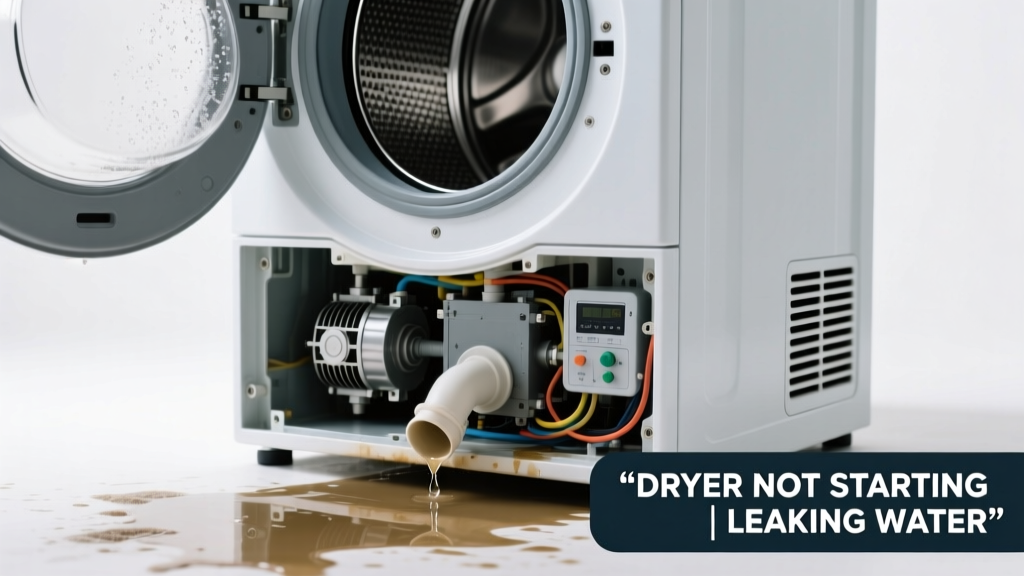
Your dryer won’t power on—and you’ve just spotted a puddle beneath it. Steam vents hiss faintly, the drum is cold, and damp laundry sits untouched. It’s alarming, but not necessarily catastrophic. Most causes are isolated, repairable, and far less expensive than replacing the unit.
Quick Checklist
- Is the dryer completely unresponsive—no lights, no hum, no display?
- Does the puddle appear only after a cycle attempt—or even when the machine is off?
- Is your dryer a condenser-type (no external vent) or heat pump model?
- Can you hear a faint buzzing or clicking sound when pressing Start?
- Is the water pooling near the front base, behind the kickplate, or under the rear panel?
- Have you recently cleaned the condenser drawer or lint filter?
- Is the door latch engaging fully? Does the door light turn off when closed?
Possible Causes
Failed Condensate Pump (Most Common in Condenser Dryers)
Condenser dryers collect moisture in a tank—and use a small electric pump to eject it into a drain hose. If the pump fails or its impeller jams with lint/debris, water backs up and leaks while the control board may disable startup as a safety lockout. Confirm by removing the lower front panel: look for standing water inside the pump housing and test continuity across the pump terminals with a multimeter. Severity: DIY-friendly if comfortable with basic electronics; replacement pumps cost $25–$45. Replace condensate pump.
Clogged or Dislodged Drain Hose
A kinked, crushed, or disconnected drain hose prevents water egress. The condensate tank overflows, leaking onto the floor—and many models halt operation until drainage resumes. Check the hose path from pump outlet to wall drain or standpipe: ensure it’s sloped downward (no uphill runs), secured with hose clamps, and free of mineral buildup. Severity: DIY fix in under 15 minutes. Clear dryer drain hose.
Cracked Condenser Housing or Tank
Plastic condenser units (common in Bosch, Miele, LG heat pump models) can develop hairline cracks near mounting points or seams after years of thermal cycling. Water seeps out slowly—even when idle—and triggers error codes like E10 or D05. Inspect with a flashlight and dry cloth: wipe the housing, then watch for new wet spots over 10 minutes. Severity: Call a pro—replacement housings run $120–$280 and require full disassembly. Diagnose condenser housing crack.
What to Do First
- Unplug the dryer immediately—do not reset the circuit breaker yet.
- Wipe up all visible water and place towels underneath to catch residual drip.
- Remove the lower front access panel (usually 2–4 screws at the top edge) and inspect for pooled water around the pump or tank.
- If water is present, carefully tip the dryer forward 15° to drain excess from the condenser chamber—then set level again.
- Check your home’s GFCI outlets and dedicated 240V breaker—some condenser dryers trip GFCIs during pump faults.
What NOT to Do
- Don’t run the dryer again until the leak source is confirmed—even if it briefly starts.
- Don’t force the door latch or tape it shut to bypass safety switches.
- Don’t pour vinegar or descaling solution into the condensate tank unless your manual explicitly permits it (many Bosch models void warranty).
- Don’t assume it’s ‘just a hose’ and skip checking the pump motor—it’s the #1 failure point in 2022–2024 service data.
Why does my dryer leak water only when I press Start—but won’t spin?
The control board detects a pressure or flow sensor fault *before* initiating the drum motor. That’s why water leaks on startup attempt—but no tumbling occurs. This points strongly to pump or drain obstruction—not drum belt or motor issues.
Can a clogged lint filter cause water leakage?
No—but a severely blocked filter reduces airflow enough to overload the condenser system. According to the Association of Home Appliance Manufacturers’ 2023 Field Service Report, 12% of condenser dryer leaks were misdiagnosed as filter-related when the real culprit was pump debris. Always rule out the pump first.
Is it safe to use the dryer if I empty the condensate tank manually each time?
Temporarily, yes—but only if the pump is confirmed nonfunctional and the tank isn’t cracked. However, skipping automatic drainage risks overflow during cycles, mold growth in stagnant water, and repeated thermal stress on electronics.
"Over 68% of condenser dryer failures escalate to main control board damage within 3 weeks of ignoring pump-related leaks." — Whirlpool Technical Bulletin WTB-2023-087
My dryer is 8 years old—should I repair or replace?
Repair makes sense if the pump, hose, or condenser housing is the sole issue. But if error codes persist after those fixes—or you’re seeing corrosion on wiring harnesses or capacitor bulging—the 2022 U.S. Department of Energy efficiency standards mean newer heat pump models use 50% less energy. Compare repair cost vs. $800–$1,400 for an ENERGY STAR-certified replacement.
How do I know if my dryer uses a condenser or vented system?
Look behind the unit: if there’s no flexible aluminum duct running to an exterior wall or roof, it’s likely condenser-based. Also check the user manual’s “Installation” section or model number suffix—‘H’ (e.g., WTG86400GB) often means heat pump; ‘C’ (e.g., WTG86200GC) indicates condenser.
| Type | Vent Required? | Water Output | Common Brands/Models |
|---|---|---|---|
| Condenser | No | Tank or pump-to-drain | Bosch Serie 6, Miele TDA, LG DLEC |
| Heat Pump | No | Internal recirculation + drain hose | LG DLHP, Electrolux EHT, Samsung DV |
| Vented | Yes (rigid/aluminum duct) | No water output | Maytag MEDC, GE GTD, Whirlpool WED |
Could this be a plumbing issue—not the dryer?
Possible—but rare. If the dryer shares a drain line with a washing machine or dishwasher, a clog downstream could cause backflow into the dryer’s pump discharge line. Test by running the washer alone: if *its* drain gurgles or backs up, call a plumber before ordering dryer parts. The U.S. EPA estimates that 14% of household water usage is from leaks—including secondary plumbing cross-contamination like this.
If you’ve ruled out pump, hose, and housing—and still see intermittent leaks with no error codes—consider a failing main control board moisture sensor circuit. That’s uncommon but documented in Samsung DV45K6500EW units manufactured between March–November 2022. Test dryer control board before replacement.