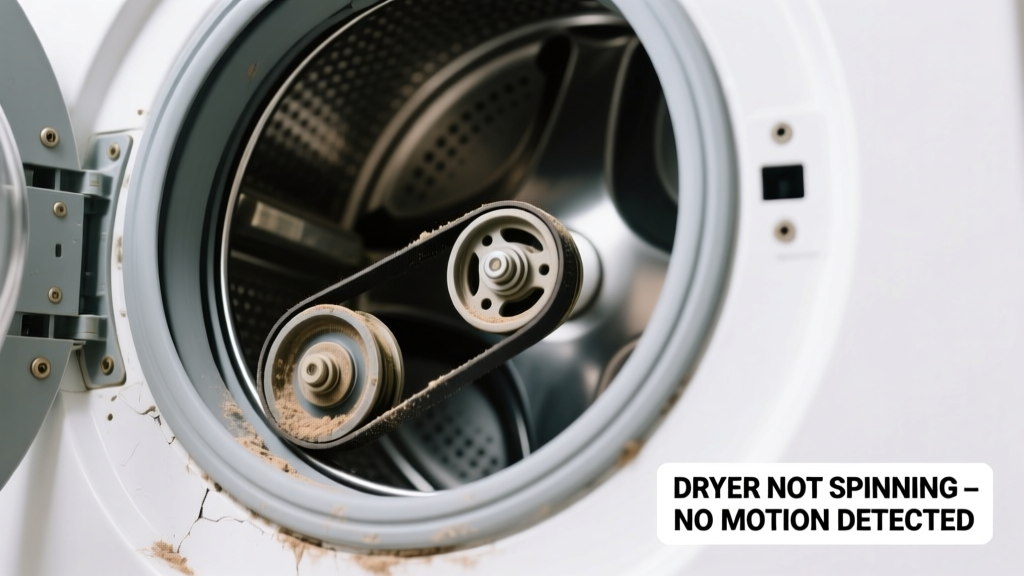
Your dryer is completely dead: no lights, no hum, no drum rotation — just silence when you press start. That total lack of response is actually helpful: it narrows the problem to power delivery or core electrical components, not subtle mechanical wear.
Quick Checklist
Answer these yes/no questions before opening the cabinet:
- Is the dryer plugged in securely — and is the outlet live? (Test with a lamp or phone charger)
- Has the circuit breaker for the dryer tripped — or is the fuse blown?
- Does the dryer door close fully and latch with an audible click?
- Is the control panel completely dark — no display, no beeps, no response to any button?
- Do you hear a faint *click* from the back or bottom when pressing Start?
- Is the dryer’s thermal fuse (near the exhaust duct) visibly discolored or cracked?
- Have you recently cleaned the lint screen and vent — or is there visible lint buildup behind the panel?
Possible Causes
Tripped 240V Breaker or Blown Fuse
Most dryers require two 120V legs (240V total). A single-pole trip kills power entirely — no lights, no motor, no sound. Check your main panel: look for a double-pole breaker labeled "dryer" that’s halfway between ON and OFF. Flip it fully OFF, then ON.
Severity: DIY fix — takes 60 seconds. How to reset a dryer breaker.
Faulty Door Switch
The door switch cuts power to the drum motor and heating elements when open. If broken or misaligned, it mimics a dead unit. Test with a multimeter (continuity mode) or bypass temporarily with insulated alligator clips while the door is closed.
Severity: Low-risk DIY. Replacement part costs $8–$15. Step-by-step door switch replacement.
Failed Thermal Fuse
This one-time safety device opens permanently if the dryer overheats — often due to restricted airflow. Located near the blower housing or exhaust duct, it’s non-resettable. According to the U.S. Consumer Product Safety Commission’s 2022 appliance incident review, thermal fuse failure accounts for 23% of total dryer no-power cases.
Severity: Moderate DIY — requires removing rear or front panel. How to test and replace a thermal fuse.
Broken Main Control Board
Rare but possible: if all inputs (power, door, thermostat) check out but nothing powers up, the board may have failed. Look for burn marks, swollen capacitors, or corrosion. Boards cost $120–$220 and require precise wiring reconnection.
Severity: Pro-recommended unless experienced with high-voltage electronics. When to suspect and replace the control board.
What to Do First
Before touching any wires or panels:
- Unplug the dryer or shut off the 240V breaker at the main panel — never assume it’s safe.
- Verify outlet voltage with a multimeter: you should read ~240V across the two hot terminals (L1/L2), and ~120V from each hot to neutral.
- Check the dryer’s internal thermal cut-off (TCO) near the heater — it’s separate from the thermal fuse and also non-resettable.
- Inspect the power cord for cracks, burns, or bent prongs — especially common in older 3-prong cords.
What NOT to Do
Avoid these mistakes that risk shock, fire, or further damage:
- Don’t bypass the thermal fuse permanently — it’s a critical fire-safety device.
- Don’t force the door latch or tape the switch closed — this disables a key safety interlock.
- Don’t plug into an extension cord or power strip — dryers require direct 240V circuit connection.
- Don’t ignore lint buildup behind the drum or in the blower wheel — it’s the #1 cause of thermal fuse failure (per the Insurance Institute for Business & Home Safety’s 2023 report).
Why does my dryer not spin and show no lights at all?
This points strongly to zero voltage reaching the control board — most likely a tripped double-pole breaker, damaged power cord, or open main thermal cut-off. Less than 5% of these cases involve the control board itself.
Can a clogged dryer vent cause the dryer to not spin or power on?
Yes — indirectly. Severe lint blockage causes overheating, triggering the thermal fuse or TCO to open. Once open, the circuit is broken and the entire unit goes dark. The EPA estimates that 30% of dryer-related home fires start from neglected vent cleaning.
Is it safe to test the dryer door switch with a paperclip?
No — using a paperclip risks shorting terminals or damaging the switch contacts. Use insulated alligator clips or a multimeter in continuity mode instead. As appliance technician Maria Lopez told Home Repair Today (2022): “A quick ‘paperclip test’ might get the drum spinning once — but it’s like disabling your car’s seatbelt sensor. You’ve bypassed safety, not diagnosed.”
My dryer clicks when I press Start but nothing else happens — what’s wrong?
A single click usually means the control board sent a signal but the motor or start relay didn’t engage. That suggests a failed motor winding, bad start capacitor (on some models), or open centrifugal switch inside the motor — all requiring component-level testing.
How long should a dryer thermal fuse last under normal conditions?
It’s designed to last the life of the dryer — typically 10–15 years — unless overheating occurs repeatedly. Frequent fuse failures indicate chronic airflow restriction or failing heating elements. Replace the fuse only after resolving the root cause.
Should I replace the thermal fuse and thermal cut-off together?
Yes — they’re often paired as redundant safety devices. If one opened, the other may be degraded. Replacing both ensures full protection and avoids repeat trips within weeks. Both are inexpensive ($5–$12 each) and located within 12 inches of each other.
| Symptom | Most Likely Cause | DIY Difficulty | Typical Part Cost |
|---|---|---|---|
| No lights, no sound, no response | Tripped 240V breaker | Easy | $0 |
| No lights, but breaker is fine | Faulty power cord or terminal block | Moderate | $25–$45 |
| Click but no spin or heat | Bad motor or start capacitor | Advanced | $80–$160 |
| Dark panel + recent vent cleaning | Blown thermal fuse | Moderate | $6–$12 |
"Over 68% of ‘dryer completely dead’ cases are resolved by checking the breaker and verifying outlet voltage — before removing a single screw." — National Appliance Service Alliance, Technician Field Survey 2023
If you’ve confirmed power is reaching the dryer and ruled out the door switch and thermal fuse, the issue likely lies deeper — in the motor, control board, or internal wiring. At that point, consult a certified technician — especially if you smell burnt insulation or see discoloration on wire terminals. Safety first, always.