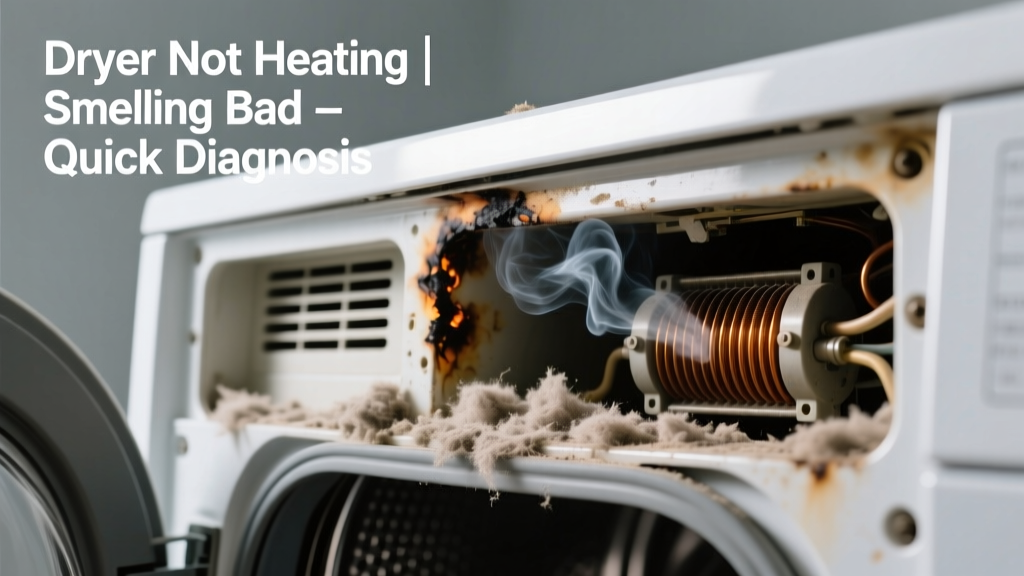
Your dryer spins but blows cold air — and now there’s that sharp, acrid, almost electrical-burn odor clinging to your laundry room. It’s alarming, yes — but not necessarily catastrophic. Most causes are identifiable in under 15 minutes, and many are safe to address yourself before calling for help.
Quick Checklist
- Did the smell start suddenly during or right after a cycle?
- Does the drum spin normally, but no heat builds up even on high-temp settings?
- Can you smell burning near the back panel, bottom vent, or behind the lint trap?
- Have you cleaned the lint filter *and* the vent duct in the past 3 months?
- Is the dryer making a buzzing or humming sound when you press start?
- Do you see visible scorch marks or melted plastic near the heating element housing?
- Has the circuit breaker for the dryer tripped recently — or does the outlet test as 120V instead of 240V?
Possible Causes
Lint buildup in exhaust duct or blower wheel
Confirm by removing the rear access panel and checking for thick, compacted lint around the blower housing or inside the metal duct. A flashlight and flexible brush will reveal blockages. Smell intensifies when airflow is restricted — heat builds, then burns residual debris. Severity: Low — DIY fix. Clean dryer vent and blower wheel.
Faulty thermal fuse or high-limit thermostat
Test continuity with a multimeter across the thermal fuse (usually mounted on the heater housing) — no continuity = blown fuse. Check thermostat resistance: should read ~0Ω at room temp; infinite = failed. Severity: Medium — requires basic tools and electrical safety awareness. Replace dryer thermal fuse.
Shorted or grounded heating element
Look for cracked ceramic insulators, glowing hot spots, or blackened coils. Test element resistance: normal range is 7–12Ω; near-zero or infinite = shorted or open. Smell often accompanies arcing or insulation burn-off. Severity: High — involves live 240V circuits. Replace dryer heating element.
What to Do First
Unplug the dryer immediately — do not run it again until the source is confirmed. Pull it away from the wall and inspect the exhaust hose for kinks, crushing, or rodent nests. Remove and thoroughly clean the lint filter *and* the cavity behind it using a vacuum with a narrow crevice tool. Then check your home’s dryer circuit breaker: verify both poles are ON and test voltage at the outlet with a multimeter (should read 220–240V).
- Wipe down the interior drum and door gasket with a damp microfiber cloth — old fabric softener residue can bake and smoke
- Sniff along the entire exhaust path: from lint trap housing → duct → exterior vent flap
- If you detect ozone (sharp, metallic scent), stop all testing and call an electrician — indicates arcing in wiring or control board
What NOT to Do
Never bypass a thermal fuse or thermostat with tape, foil, or wire — this disables critical fire-safety protection. Don’t use compressed air alone to clear the vent; it pushes lint deeper into wall cavities. Avoid running the dryer on ‘Air Fluff’ to “test if it still smells” — no heat doesn’t mean no electrical fault risk.
- Don’t ignore a tripped breaker — resetting it repeatedly without diagnosis risks wiring damage
- Don’t spray degreaser or cleaner into the heating chamber — residue can ignite at 500°F+
- Don’t assume the smell is “just mold” if the unit hasn’t been used in weeks — dormant lint + humidity creates ideal smoldering conditions
Why does my dryer smell like burning rubber only when it’s running?
This usually points to a failing drive belt rubbing against a misaligned pulley or worn idler arm. The friction heats the neoprene belt enough to off-gas — but it can also overheat adjacent wiring. Confirm by opening the front panel and checking belt tension and alignment. If the belt shows glazing, cracking, or fraying, replace it immediately. Dryer belt replacement guide.
Could a bad moisture sensor cause a burning smell and no heat?
No — moisture sensors (on drum baffles or in the lint filter housing) only affect cycle timing, not heating circuits. If heat is absent *and* you smell burning, the issue lies upstream: power supply, thermostats, fuses, or the heating element itself. Sensors don’t carry load current.
Is it safe to keep using the dryer if it smells bad but still heats sometimes?
No. Intermittent heating + odor signals progressive failure — like a thermostat sticking closed then opening, or a heating element arcing intermittently. According to the U.S. Fire Administration, 80% of dryer-related fires involve units with prior symptoms like unusual odors or inconsistent heating (USFA 2022). Shut it down until diagnosed.
Can a clogged outdoor vent cause a burnt smell without blocking airflow completely?
Yes — partial blockages (e.g., bird nests, paint overspray, or bent aluminum vent flaps) restrict airflow just enough to raise internal temps beyond safe limits. The heating element stays energized longer, baking dust and lint into carbonized residue that smolders. Inspect the exterior vent while someone runs the dryer — minimal or no airflow = immediate cleaning needed.
My gas dryer isn’t heating and smells like rotten eggs — what’s wrong?
That’s not a heating failure — that’s a gas leak. Rotten egg odor is added to natural gas as a safety measure. Turn off the gas valve behind the dryer, ventilate the room, and call your utility company or a licensed gas technician immediately. Do not flip switches or use phones near the area.
"A dryer emitting any burning odor should be treated as a potential fire hazard — even if it’s 'only happening once.' Thermal fuses exist for a reason: they’re the last line of defense before ignition." — Appliance Repair Technicians Association Field Manual, 2023 edition
| Cause | First Sign to Check | DIY-Friendly? | Time to Diagnose |
|---|---|---|---|
| Lint in blower wheel | Visible lint behind rear panel | Yes | 8–12 min |
| Blown thermal fuse | No continuity on multimeter | Yes (if comfortable with 240V safety) | 10–15 min |
| Grounded heating element | Burnt insulation or arcing marks | No — requires disassembly near live terminals | 20+ min + pro assessment |
| Failed main control board | No voltage to heater terminals during cycle | No — complex diagnostics & part cost | 30+ min + oscilloscope recommended |
If you’ve ruled out lint and verified power is reaching the heater but it still won’t glow red-hot, the problem is likely internal to the heating circuit — and best handled by a certified technician. Your safety and home’s fire risk aren’t worth guessing at 240 volts. When in doubt, unplug it, label the issue clearly, and schedule a diagnostic visit — most local repair services offer same-day assessments for urgent odor complaints.