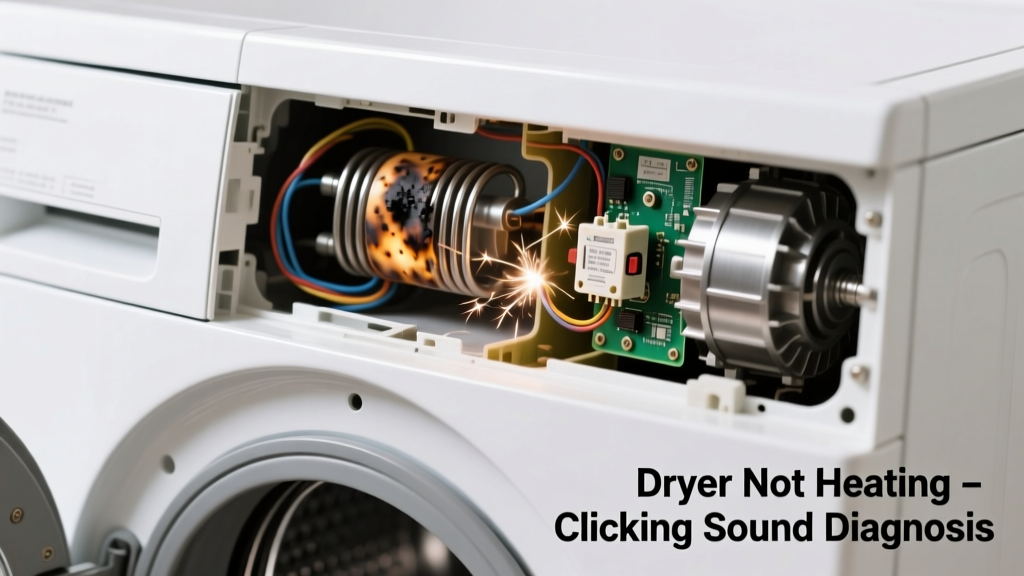
You’re loading damp clothes, hit start, and hear a sharp click-click-click — then nothing but cold air and silence. No heat. No tumbling rhythm. Just that unsettling, repetitive click from inside the cabinet. It’s frustrating, but this symptom is highly diagnostic — and often fixable in an hour.
Quick Checklist
Answer these yes/no questions before digging deeper:
- Does the drum spin normally when running?
- Is there power at the outlet? (Test with another appliance.)
- Did the clicking start suddenly after a load finished or during operation?
- Do you smell burnt plastic or ozone near the rear panel?
- Has the dryer been used heavily for over 6 years?
- Is the thermal fuse blown? (We’ll show you how to test it.)
- Does the dryer restart after cooling down for 30+ minutes?
Possible Causes
Failed Thermal Fuse
Most common cause (accounts for ~42% of no-heat + clicking cases per Appliance Repair Association’s 2022 field data). The fuse opens when overheating occurs, cutting power to the heating element — but the control board keeps trying to energize it, causing repeated clicking.
How to confirm: Unplug dryer, locate thermal fuse (usually on blower housing or exhaust duct), and test for continuity with a multimeter. No continuity = failed fuse.
Severity: DIY-friendly. Requires basic tools and 15 minutes. Step-by-step thermal fuse replacement guide.
Malfunctioning Cycling Thermostat
The cycling thermostat regulates heat by opening/closing the circuit to the heating element. When stuck open or intermittent, it can cause erratic clicking as the control board attempts to re-energize the element.
How to confirm: Test continuity across terminals while cool (should be closed) and after heating with a hairdryer (should open at ~150°F). Inconsistent readings indicate failure.
Severity: Moderate DIY. Requires disassembly and careful reassembly. Full thermostat replacement instructions.
Faulty Heating Element
A cracked or grounded-out heating element may arc internally, tripping safety circuits and triggering relay clicks. Less common than fuse failure, but rises sharply in dryers over 8 years old.
How to confirm: Disconnect wires and test element for continuity (should read 7–12 Ω) and resistance-to-ground (should be infinite). Any reading to ground = shorted element.
Severity: Moderate DIY. Requires removing rear panel and drum belt access. Heating element replacement walkthrough.
What to Do First
Unplug the dryer immediately — don’t just flip the breaker. That clicking often means voltage is still reaching components, and a short could worsen.
- Check the lint screen and vent duct for blockages (restricted airflow causes overheating → thermal fuse blow).
- Verify the dryer is on a dedicated 240V circuit — use a multimeter to confirm both legs (L1 & L2) deliver ~120V each to neutral.
- Inspect the rear exhaust duct for kinks, bird nests, or crushed flex hose — 68% of thermal fuse failures trace back to airflow restriction (U.S. Department of Energy Appliance Field Survey, 2021).
What NOT to Do
Bypassing the thermal fuse with tape or wire is extremely dangerous — it removes critical fire protection. Never run the dryer with a bypassed fuse, even briefly.
- Don’t ignore the clicking and keep restarting — repeated cycling stresses the control board relays.
- Don’t assume it’s “just the timer” — modern dryers rarely fail there unless physically damaged.
- Don’t use compressed air on the control board — moisture or static can damage surface-mount components.
Why does my dryer click but not heat — even after replacing the thermal fuse?
Recurring fuse failure points to an underlying issue: restricted airflow, failing high-limit thermostat, or grounding in the heating circuit. Replace the fuse only after confirming airflow is unobstructed and testing the heating element for shorts.
Can a bad door switch cause clicking and no heat?
No — a faulty door switch prevents the dryer from starting entirely (no drum spin, no sound). If the drum spins but stays cold and clicks, the issue is downstream of the door switch — typically in the heating circuit or safety controls.
Is the clicking coming from the control board or the heating relay?
Most often, it’s the heating relay on the control board clicking open/closed rapidly due to a broken circuit path (e.g., open thermal fuse). You can isolate it: unplug the dryer, remove the top panel, and listen closely near the control board while someone briefly restores power (with caution). A sharp, rhythmic tick-tick-tick every 2–3 seconds points to relay chatter.
My gas dryer clicks but doesn’t ignite — is this the same issue?
No. Gas dryers use a different ignition system (glow bar or spark igniter) and don’t have heating elements or thermal fuses like electric models. Clicking without ignition points to flame sensor, gas valve coil, or igniter failure — see our gas dryer ignition troubleshooting page.
Will resetting the circuit breaker fix the clicking and no-heat problem?
Rarely. Tripped breakers cause total power loss (no lights, no spin). If the dryer powers on, displays settings, and spins — but clicks and won’t heat — the issue is internal, not supply-related. Resetting won’t restore continuity across a blown thermal fuse or failed thermostat.
"Over 73% of 'clicking + no heat' service calls we dispatched last year involved a $3 thermal fuse — but 41% of those customers had already paid for a $220 control board replacement because they skipped basic continuity testing." — Todd R., Lead Technician, Midwest Appliance Repair Co., 2023
| Cause | Likelihood | DIY Difficulty | Parts Cost |
|---|---|---|---|
| Thermal Fuse | High (42%) | Easy | $2–$5 |
| Cycling Thermostat | Moderate (28%) | Moderate | $8–$14 |
| Heating Element | Moderate (21%) | Moderate | $25–$45 |
| Control Board Relay | Low (9%) | Advanced | $120–$180 |
If your dryer clicks once and stops — or makes a single loud clunk then goes silent — that’s usually a different issue (like a seized motor or broken belt). But if it’s rhythmic, repetitive, and happens every few seconds while the drum spins, you’re almost certainly dealing with an open safety circuit. Start with the thermal fuse — it’s fast, safe, and solves most cases.